A chemical compound contains atoms of at least two chemical elements joined in a characteristic chemical structure. Molecular water has composition , while sodium chloride is an ionic solid with a one-to-one ratio of sodium and chloride ions rather than isolated NaCl molecules.
A compound differs from a mixture: separating its constituent elements generally requires a chemical transformation. A formula records composition but may not uniquely determine connectivity or stereochemistry, so different isomers can share a molecular formula.
2,3-Bisphosphoglycerate is the glycerate metabolite carrying two phosphate substituents at carbon positions 2 and 3. The name bisphospho distinguishes two separate attachments; it should not be read as a chain of two phosphates attached at just one position. Older biochemical papers call the metabolite 2,3-diphosphoglycerate. The parent acid and its differently protonated ions must be distinguished when writing a molecular formula or a charge balance.[ref]
2,3-Bisphosphoglyceric acid in ChEBI. CHEBI:28907, Definition, Formula and conjugate-acid relation to CHEBI:19324
In red blood cells, 2,3-Bisphosphoglycerate is an allosteric modulator of hemoglobin. Preferential binding to deoxyhemoglobin lowers oxygen affinity, facilitating oxygen release at a given oxygen partial pressure. Reinhold Benesch and Ruth E. Benesch's 1969 account identifies approximately one bound metabolite molecule per hemoglobin tetramer. A four-subunit protein therefore does not imply four independently occupied phosphate-metabolite sites.[ref]
Intracellular Organic Phosphates as Regulators of Oxygen Release by Haemoglobin by Reinhold Benesch and Ruth E. Benesch. Publisher abstract, binding preference and stoichiometry, Nature221, pp.618–622
A simple Hill equation illustrates an affinity change without assigning a universal physiological value. Write the fractional oxygen saturation aswhere is oxygen partial pressure and is the pressure at half saturation. In a stipulated model with , increasing from to changes the saturation at fromThe same oxygen pressure now leaves a larger fraction of binding capacity unoccupied. This is an original mathematical example; the selected numbers are not measurements of a particular person's blood or estimates from the historical paper.
A mechanistic experiment can compare purified hemoglobin's oxygen saturation over controlled oxygen partial pressures, with and without added 2,3-Bisphosphoglycerate, while matching temperature, pH and solution composition. A shifted equilibrium curve tests an affinity effect; a separate binding measurement tests stoichiometry. Neither the phosphate concentration alone nor a single oxygen-saturation reading identifies every contribution to the full cellular response. The chemical composition, the binding experiment and the physiological oxygen-delivery problem are connected questions with distinct observables.
Tocol is the structural parent used to name the tocopherols. Its chroman-6-ol framework carries a methyl group and a long saturated hydrocarbon substituent at position 2. The IUPAC-IUB recommendation defines the parent before specifying the additional aromatic methyl substitutions that distinguish familiar tocopherols.[ref]
For the specifically named saturated IUPAC parent, atom counting gives . ChEBI uses a broader class description that permits either a saturated or a triply unsaturated side chain, so that ontology entry should not be assigned one molecular formula.[ref]
Tocol in ChEBI. CHEBI:39437, Definition
The hydroxyl-containing head group and the hydrocarbon side chain are distinct structural features. A parent name identifies connectivity; a particular stereoisomer additionally needs the appropriate stereochemical designation.An original atom-count example connects the parent with alpha-tocopherol. Replacing three aromatic hydrogens by three methyl groups adds net :This is compositional bookkeeping, not a balanced synthesis reaction with free methylene as reagent. The three additions correspond to positions 5, 7 and 8 in the alpha name. The parent already contains a position-2 methyl, so counting all four as new substitutions would give the wrong formula.
Ring-methyl counting in tocopherol nomenclature also distinguishes beta and gamma forms: both have two additional ring methyl groups, but at different positions. Equal elemental composition does not make those structures the same compound. Chemical nomenclature is preserving attachment information that a molecular formula omits.
The structural parent is not interchangeable with the broad biological descriptor vitamin E. The nomenclature recommendations explicitly distinguish the generic tocopherol class from vitamin-E activity terminology.[ref]
Nomenclature of Tocopherols and Related Compounds by IUPAC-IUB Joint Commission on Biochemical Nomenclature. Recommendations 1.1–1.3
An experiment comparing chemical amounts should state the named molecule or mixture; one comparing antioxidant activity also needs the response model and conditions. Naming a scaffold alone does not supply a biological potency conversion.Ring-methyl counting in tocopherol nomenclature tracks which methyl groups belong to the named parent and which are additional aromatic substitutions. The tocol parent already has a position-2 methyl group. The familiar tocopherol names specify further methyl groups at positions 5, 7 and 8; counting the parent methyl again gives the wrong composition.[ref]
For the specifically named saturated parent, let be the number of additional aromatic methyl groups. Each substitution replaces one hydrogen by , adding net . Starting with therefore givesThe familiar forms follow directly: delta-tocopherol has and formula ; beta-tocopherol and gamma-tocopherol have and ; alpha-tocopherol has and . These counts concern the saturated tocol parent, not every member of a broader ontology category.
The positions distinguish equal-count cases. Beta is 5,8-dimethyltocol, whereas gamma is 7,8-dimethyltocol.[ref]
Nomenclature of Tocopherols and Related Compounds by IUPAC-IUB Joint Commission on Biochemical Nomenclature. Recommendations 3–4
Their molecular formulas agree, but their connectivity differs. They are constitutional isomers; this distinction is separate from the stereochemical configurations of the side chain.An original combinatorial check is instructive. Choosing two occupied positions among 5, 7 and 8 allows three sets: , and . The familiar beta and gamma names identify two particular sets, rather than defining every theoretically possible dimethyl substitution. A substituent count alone cannot recover the attachment pattern.
Aromatic-hydrogen counting in tocopherol identification offers a complementary prediction. Within those three aromatic positions, the expected number of remaining hydrogens is : zero for alpha, one for beta or gamma and two for delta. This is an atom count, not a claim that a particular nuclear magnetic resonance spectrum must contain that many resolved peaks; chemical shifts, coupling and overlap also matter.
An identification experiment should therefore combine the named parent, methyl positions and stereochemical specification with the analytical observations. A mass consistent with the beta/gamma formula does not uniquely identify either form. Nor does correct structural nomenclature establish equal biological activity: chemical identity and relative biological potency answer different questions.
Aromatic-hydrogen counting in tocopherol identification uses unoccupied ring positions to constrain the identity or composition of a tocopherol sample. In the tocol framework, positions 5, 7 and 8 can carry the additional methyl substituents. The familiar alpha-tocopherol, beta-tocopherol, gamma-tocopherol and delta-tocopherol substitution patterns leave respectively zero, one, one and two hydrogens at those positions.[ref]
Let count those aromatic methyl substituents. The count concerns aromatic carbon-bound hydrogens. It excludes the hydroxyl hydrogen and hydrogens on the saturated ring and side chain. A missing aromatic hydrogen is not a missing hydrogen atom from the entire molecular formula: replacing ring H by adds two hydrogens overall.
A proton nuclear magnetic resonance experiment can compare an integrated aromatic region with a calibrated amount standard. For a sufficiently resolved, quantitatively acquired signal, integrated response tracks the number of contributing protons; the count does not predict the number of separately resolved peaks. Chemical shifts, splitting, spectral overlap and acquisition conditions remain part of identification.
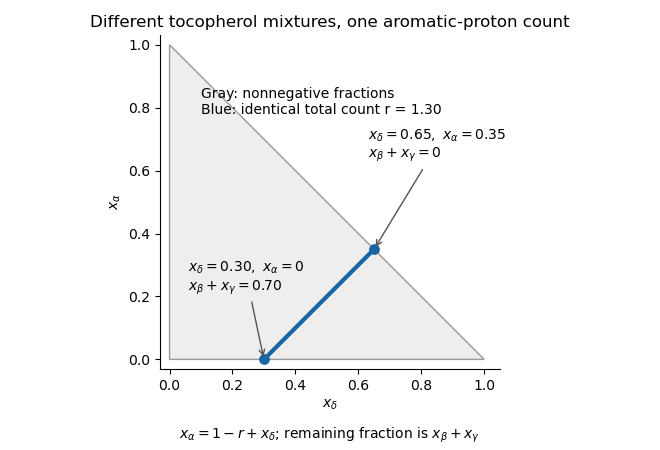
An original mixture example illustrates mixture ambiguity in aromatic-proton counts. Suppose the calibrated aromatic response corresponds to hydrogens per tocopherol molecule. If the sample contains only beta-tocopherol and delta-tocopherol, and is the mole fraction of delta-tocopherol, then , giving . The same count occurs in a gamma-tocopherol/delta-tocopherol mixture. If the allowed components are instead alpha-tocopherol and delta-tocopherol, gives . Counting alone does not identify an unrestricted mixture.
In particular, beta-tocopherol and gamma-tocopherol are constitutional isomers with one remaining aromatic hydrogen each, at different ring positions. Their count agrees while their structural assignment differs. A useful experiment therefore combines the aromatic integral with resolved chemical shifts or other structural evidence and specifies which candidate components were allowed. These are predictions from the named structures, not measured spectra or universal instrumental settings.
Mixture ambiguity in aromatic-proton counts is the inability of a total aromatic proton nuclear magnetic resonance integral to identify all components of a tocopherol mixture. The named substitution patterns leave zero, one, one and two aromatic hydrogens in alpha-tocopherol, beta-tocopherol, gamma-tocopherol and delta-tocopherol, respectively.[ref]
Let their mole fractions be . Under an ideal quantitative response model, an aromatic integral normalized per tocopherol molecule givesThe normalization requires an independently established molecular amount or an equivalent valid calibration. A raw integral alone is not automatically a hydrogen count per molecule. This model also assumes that the selected response includes the relevant aromatic protons with compatible quantitative acquisition conditions.
There are four unknown fractions but only two displayed linear constraints. In particular, exchanging any allowed amount of beta-tocopherol for gamma-tocopherol preserves both constraints: their equal counts cannot distinguish these constitutional isomers.
An original feasible-range calculation makes the remaining ambiguity explicit. Setting givesNonnegative fractions implyFor , any between and can fit. The first endpoint has no alpha-tocopherol and a combined beta/gamma fraction of ; the second has alpha fraction and no beta/gamma component. Intermediate values and beta/gamma exchanges produce further mixtures with the same count.
Resolving additional chemical shifts or using an independently calibrated chromatography measurement can provide new component-sensitive evidence. Repeating the same total integral more precisely only narrows the uncertainty around ; it does not add the missing independent composition constraints. The calculation expresses structural possibilities from the named molecules, not an assignment of measured peak positions.
Stilbene is 1,2-diphenylethene: two phenyl groups attached to the two carbons of an ethene double bond, with connectivity . Its molecular formula is . The connectivity admits two geometric isomers, cis-Stilbene and trans-Stilbene, which the NIST identity records distinguish despite their equal formulas and molar masses.[ref]
cis-Stilbene in the NIST Chemistry WebBook. Identity, Z-isomer InChI and stereoisomer cross-reference
[ref]trans-Stilbene in the NIST Chemistry WebBook. Identity, E-isomer InChI and stereoisomer cross-reference
Each central carbon bears one phenyl group and one hydrogen atom. In cis-Stilbene, the two phenyl groups lie on the same side of the double bond; in trans-Stilbene, they lie on opposite sides. The Cahn-Ingold-Prelog priority rules assign these arrangements Z and E respectively. Specifying only stilbene connectivity does not choose between them.
Atom counting provides a simple structural check:Using , an original sample corresponds to of pure stilbene. That mass conversion is unchanged if the sample contains both geometric isomers; it cannot establish their proportions.
A stilbene isomer composition measurement needs information sensitive to geometry. For an ideal two-component optical example, let be the two concentrations and let be background-subtracted absorbance divided by path length at wavelength . A calibrated Beer-Lambert law model givesThe two concentrations can be separated by this model only if . Proportional response columns would leave composition unidentifiable even with perfectly repeated readings. The coefficients must be established for the solvent and measurement conditions; the example does not assign experimental spectra.
Resveratrol illustrates how the backbone recurs in related chemistry: replacing three aromatic hydrogens by hydroxy groups adds three oxygens while retaining a central double bond capable of cis-trans isomerism. Molecular composition, connectivity and geometry are distinct layers of chemical identification.
A stilbene isomer composition measurement estimates how much cis-Stilbene and trans-Stilbene a preparation contains. Total stilbene amount is insufficient: the two geometric isomers share a molecular formula and molar mass, while differing in arrangement around the central double bond. NIST records distinguish their structures and identifiers.[ref]
cis-Stilbene in the NIST Chemistry WebBook. Identity, Z-isomer structure and stereoisomer cross-reference
[ref]trans-Stilbene in the NIST Chemistry WebBook. Identity, E-isomer structure and stereoisomer cross-reference
An original two-wavelength model illustrates the inference. Measure a homogeneous solution in a fixed-path spectrophotometer, subtract the appropriate background and divide absorbance by path length. If only these two absorbing species contribute and the Beer-Lambert law applies,The molar absorption coefficients must be calibrated in the same solvent and conditions. Their values are not supplied by the shared molecular formula.
Writing , the solution for isIn chosen consistent scaled units, take the coefficient rows and and observations . Then , and . The modeled cis fraction is . These coefficients and observations are illustrative, not experimental stilbene spectra.
The determinant condition is also a measurement-design warning. If both wavelengths respond to the two isomers in the same proportion, the equations contain only one independent composition constraint. A very small determinant relative to the coefficient scale can amplify reading or calibration errors. More repeated measurements cannot restore information missing from the response model.
A third wavelength provides a stilbene composition consistency residual: compare its observation with predicted from the first two. A discrepancy can reveal an unmodeled absorber, a changing preparation, an incorrect background or incompatible coefficients, without identifying which cause occurred. Timing and illumination should be controlled when testing a preparation capable of photoisomerization. Chemical identity, calibration, measurement geometry and model adequacy are separate requirements for a defensible composition estimate.
A stilbene composition consistency residual is the difference between an additional optical observation and the value predicted from a fitted stilbene isomer mixture. It tests agreement with the measurement model rather than directly measuring an impurity or proving sample purity.
In a stilbene isomer composition measurement, two calibrated wavelengths can determine modeled concentrations of trans-Stilbene and cis-Stilbene. Let be background-subtracted absorbance divided by path length, and let contain the first two wavelengths' molar absorption coefficients. For nonsingular ,The vector contains the third wavelength's coefficients. That third observation was not used to fit the two concentrations, so it provides an additional consistency condition.
An original example uses coefficient rows , and in consistent scaled units. Observations give and third-channel prediction . An observed gives . These are constructed coefficients, not measured stilbene spectra; the primary identity records establish that the two geometric isomers are chemically distinct despite their shared formula.[ref][ref]
The fitted concentrations also carry reading error. In this example,With and observation covariance matrix , linear uncertainty propagation gives when the coefficients are treated as fixed. Independent readings with equal standard uncertainty give . The residual is then about such standard uncertainties; interpreting that as a probability statement needs an additional distribution model. Calibration-coefficient uncertainty must also be included when material.[ref]
Evaluation of measurement data — Guide to the expression of uncertainty in measurement by JCGM. Sections 5.1–5.2, correlated input quantities
A common additive offset changes this residual by , so it does not cancel automatically. A nonzero residual can reflect background, changing illumination, coefficient errors or an unmodeled absorber. Conversely, an extra component whose responses mimic a combination of the two modeled spectra can remain hidden even when the residual is zero. Consistency is evidence about a stated model, not a unique identification of the sample's full composition.
Glycolic acid, also called hydroxyacetic acid, is the carboxylic acid . It has a hydroxy group on the carbon immediately adjacent to its carboxyl carbon, making it an alpha-hydroxy acid. NIST records its neutral molecular formula as and CAS number as 79-14-1.[ref]
The two oxygen-containing groups have different connectivity. One is the alcohol-like group; the other is the acid group. Ethylene glycol, , instead has two alcohol groups and formula . The related names do not make them the same compound.
Formal loss of the carboxyl proton gives glycolate:This changes charge and hydrogen count. A glycolate salt also includes a charge-balancing counterion; its formula and molar mass should not be substituted for those of the neutral acid.
Using the recorded neutral-acid molar mass about , an original amount corresponds to about . Atom bookkeeping also clarifies its relation to polyglycolic acid. Forming one ester link between two glycolic-acid units with formal loss of one water molecule gives compositionFor a linear chain made from such units with formal water losses, the composition is . This expresses ideal chain/end-group bookkeeping, not an industrial synthesis procedure.
The manufacturer's polyglycolic acid brochure gives the polymer repeat structure and identifies glycolic acid as its hydrolysis product.[ref]
Kuredux Polyglycolic Acid Resin technical brochure by Kureha. PDF p. 2, repeat structure and hydrolytic decomposition
A polymer repeat unit and the isolated acid molecule differ by the atoms associated with linkage formation and end groups.Glycolate, also called hydroxyacetate, is the conjugate base of glycolic acid. Its connectivity is , with molecular formula and net charge . ChEBI explicitly distinguishes this anion from its neutral acid.[ref]
Removing the carboxyl proton changes both hydrogen count and charge:The alcohol-like hydroxy group remains in the specified singly charged species. Formula bookkeeping must therefore distinguish the acid, the anion and a complete salt containing the anion.
For example, one monovalent positive counterion balances one glycolate, while a divalent positive counterion requires two. A nominal calcium glycolate formula is . An original amount example with of that formula unit contains of glycolate units. Hydration or another salt form changes formula mass and sample composition, so the mass of the isolated anion is not a universal salt molar mass.
Acid–base equilibrium determines how much is present as glycolate. For a suitable dilute-solution model,At the two forms have equal modeled concentrations; one pH unit above gives a ratio and base fraction . This relative example does not assign a numerical acid dissociation constant. Activities, ionic strength and other equilibria matter when the dilute approximation is inadequate.
The chemical identity is independent of whether the ion was prepared as a salt or produced by deprotonating the acid in solution. An analysis that measures total glycolic-acid-derived material must state whether its reported quantity includes both protonation states or specifically the glycolate anion.
cis-Stilbene is the Z geometric isomer of 1,2-diphenylethene, with two phenyl groups on the same side of the central carbon–carbon double bond. Its molecular formula is and its CAS identifier is 645-49-8. The NIST identity record explicitly distinguishes it from trans-Stilbene.[ref]
cis-Stilbene in the NIST Chemistry WebBook. Formula, CAS, Z-isomer structure and stereoisomer cross-reference.
Each carbon of the central double bond bears a phenyl group and a hydrogen atom. Under the Cahn-Ingold-Prelog priority rules, the carbon-attached phenyl group has higher priority than hydrogen at each end. The two higher-priority groups lie on the same side, giving Z. This explains why the cis and Z descriptions agree for this molecule; it does not make the two naming systems interchangeable for every substituted alkene.
The central connectivity can be written . Changing its geometric arrangement does not alter the count of fourteen carbons and twelve hydrogens. A molecular mass measurement consistent with that formula therefore cannot by itself distinguish the cis and trans isomers.
For an original amount calculation, corresponds to approximately 18.0 mg using the recorded molar mass. A pure cis sample, a pure trans sample and a cis/trans mixture can all have that same total amount and elemental composition. Determining the mixture requires an observation sensitive to structure or a separation that resolves its components, rather than simply weighing it more precisely.
The important scientific distinction is between identifying a formula and identifying a stereoisomer. An experimental assignment should connect its measured response to appropriate reference information and stated sample conditions. The registry's specific structural identifier fixes which isomer the name denotes; it does not independently establish the purity of a particular laboratory sample.
trans-Stilbene is the E geometric isomer of 1,2-diphenylethene: two phenyl groups attach to opposite carbons of a central carbon–carbon double bond, on opposite sides of that double bond. Its molecular formula is , and its CAS identifier is103-30-0.[ref]
trans-Stilbene in the NIST Chemistry WebBook. CAS identifier, E-isomer structure and formula; linked PubChem CID638088.
The formula can be counted directly from : two phenyl groups contribute twelve carbons and ten hydrogens, and the central pair contributes two carbons and two hydrogens. cis-Stilbene has the same atom counts but a different arrangement around the double bond. Cis-trans isomerism therefore concerns structure, not a difference in molar mass or elemental composition.
This makes a useful distinction in spectroscopy: a molecular formula alone does not specify every vibrational feature or optical response. Structural assignments require appropriate comparison data and a stated sample environment. In an original mixture example, equal amounts of cis and trans material still have the same total carbon-to-hydrogen ratio as either pure isomer; elemental composition alone cannot reveal that mixture.
A primary subsurface Raman spectroscopy experiment used trans-stilbene powder beneath a1-mm layer of poly(methyl methacrylate) powder. Collecting scattered light from regions laterally displaced from the excitation spot improved the unprocessed contrast of the buried trans-stilbene layer by a reported factor19.[ref]
Subsurface Probing in Diffusely Scattering Media Using Spatially Offset Raman Spectroscopy by P. Matousek and others. Abstract, physical feasibility sample and contrast improvement.
The compound served as a chemically identifiable buried layer, illustrating how collection geometry can change which material dominates a measured spectrum. That reported contrast gain is a property of the experiment, not a universal material constant of trans-stilbene.A substrate analogue is a molecule designed or recognized as resembling an enzyme's substrate in features relevant to binding or reaction. Resemblance may involve molecular shape, electric charge or the arrangement of reactive groups. An analogue need not reproduce every property of the natural substrate: it may bind without undergoing the same reaction, react at a different rate or stabilize a useful experimental complex.
For a conceptual example, suppose a natural substrate is recognized through two binding groups and transformed at a third group. An analogue retaining the recognition groups but replacing the reactive group could reveal how the active site holds the substrate. Observing binding would answer a recognition question; it would not establish the natural reaction rate. Nor does the word analogue alone guarantee competitive inhibition: that requires evidence about how the compound affects the enzyme under the tested conditions.
In a 2000 ribosome study, structures of the large ribosomal subunit bound to two substrate analogues located the peptidyl transferase center. Conserved 23S ribosomal RNA contacted the analogues, providing evidence about the chemical environment for peptide bond synthesis.[ref]
The structural basis of ribosome activity in peptide bond synthesis by Poul Nissen and others. Abstract, analogue-bound structures and conserved RNA contacts
The experimental value lies in making a normally transient arrangement accessible to structural measurement; interpreting the natural substrate still requires attention to what the analogue preserves and changes.Bumetanide is an organic sulfonamide compound used as a loop diuretic. Its neutral molecular formula is . It inhibits salt transport through NKCC2, the renal sodium–potassium–chloride cotransporter, making it useful both pharmacologically and as an experimental probe of membrane transport.[ref]
PubChem Compound database by National Center for Biotechnology Information. Bumetanide, CID2471; chemical identity and loop-diuretic classification
In a 1994 study, cloned kidney transporters were expressed in Xenopus laevis oocytes and distinguished by their transport behaviour and inhibitor sensitivity. This connected bumetanide-sensitive uptake to a specified transporter rather than to an unspecified effect of a crude tissue preparation.[ref]
The usual NKCC2 transport cycle couples one sodium ion, one potassium ion and two chloride ions. Their transported charges sum to : a process can move substantial amounts of salt while remaining electrically neutral. An uptake measurement can therefore reveal inhibition even when net electric current alone would be an inadequate readout.
Nicotinamide, , is the amide of nicotinic acid, with a pyridine ring bearing a carboxamide group. It is one form of vitamin B3 and supplies the nicotinamide unit of nicotinamide adenine dinucleotide and nicotinamide adenine dinucleotide phosphate.[ref]
PubChem Compound database by National Center for Biotechnology Information. Nicotinamide, CID 936, molecular formula and structure
These coenzymes connect its structure to metabolism: the nicotinamide ring participates in reversible electron transfer between oxidized and reduced forms. Incorporation into a coenzyme is different from the free nicotinamide molecule itself carrying out every associated reaction.[ref]
Niacin Fact Sheet for Health Professionals by the Office of Dietary Supplements. Cellular functions and formation of NAD and NADP
Silicon carbide, , is a compound of silicon and carbon with a strongly bonded extended structure. It is both a hard ceramic and a wide-band gap semiconductor, illustrating how one material can be useful for mechanical and electronic reasons.
Its local tetrahedral bonding can occur with different stacking sequences, giving multiple polytypes. These share composition while differing in long-range order and electronic properties. Consequently a statement about a silicon-carbide band gap, crystal symmetry or device behaviour must specify the structural form. An empirical formula alone does not determine a solid's full microscopic structure.
Borax commonly denotes hydrated sodium tetraborate, conventionally written for the decahydrate. Anhydrous and other hydrated sodium borates are distinct materials, so a mass-based chemical calculation must state the hydration form.[ref]
PubChem Compound database by National Center for Biotechnology Information. Sodium tetraborate CID10219853: anhydrous formula and distinction from decahydrate borax
The decahydrate's formal formula counts ten waters per tetraborate formula unit. Those waters contribute to its molar mass and change the amount of borate delivered by a weighed sample. In solution, acid–base equilibria and pH influence the distribution of boron-containing species; the crystalline formula does not require every dissolved boron unit to remain as one unchanged anion.
Sodium iodide is the ionic salt , composed of sodium and iodide ions. In water, dissociation gives a source of iodide for chemical reactions.
A crystal of sodium iodide has quite different uses from an aqueous solution. Appropriately activated crystals can emit light when radiation deposits energy, enabling scintillation counters; the crystal's composition and activator concentration are part of the detector specification.
Lithium niobate is , a crystalline oxide containing lithium, niobium, and oxygen. Its non-centrosymmetric structure supports piezoelectricity and useful optical responses.
An applied electric field can change its optical response, allowing electrical control of light in a modulator. The connection between crystal symmetry and macroscopic response makes lithium niobate a bridge between crystallography and optical engineering.
Creatinine is a small nitrogen-containing cyclic compound formed from creatine-related metabolism. Its production and elimination connect muscle metabolism with measurement of kidney function.
A measured creatinine concentration is a physiological signal influenced by more than one process, including production and renal handling. It should therefore be distinguished from a direct measurement of the filtration of a chemically inert tracer.
The number of water units included in a specified crystalline hydrate formula. A weighed hydrate and its anhydrous compound have different molar masses.
Carbon disulfide is , with a linear sulfur-carbon-sulfur molecular framework. It is a volatile molecular liquid, historically called bisulphide of carbon.
Its overall symmetry cancels the opposing bond-dipole contributions in the isolated molecule. The example distinguishes the polarity of individual bonds from a molecule's net permanent dipole.
[ref]
Chemistry 2e by Paul Flowers and others. Chapter7, Chemical Bonding and Molecular Geometry: geometry, bond dipoles and molecular polarity
Lead sulfide is , a compound of lead and sulfur that occurs naturally as galena. Its crystalline structure is related to that of sodium chloride.
Lead sulfide is also a semiconductor. Crystal size can strongly affect the optical response of very small particles, making the material an example of the connection between bulk band structure and quantum confinement.
Barium carbonate is the salt , containing barium and carbonate ions. It has low solubility in water, but reaction with an acid consumes carbonate and can release carbon dioxide.
Precipitation and acid dissolution therefore describe different conditions for the same material. This is a useful example of how acid-base chemistry can shift a solubility equilibrium.
Barium hydroxide is and can also occur as hydrated crystals. Its dissolved fraction supplies hydroxide ions and behaves as a strong base.
It is important to distinguish solubility from base strength: the former concerns how much solid dissolves, whereas the latter concerns the acid-base behaviour of the dissolved species. Reaction with carbon dioxide can form barium carbonate.
Hydrogen sulfide is , a bent molecular compound of hydrogen and sulfur. In water it participates in acid-base equilibria involving hydrosulfide and sulfide.
Its sulfur can undergo redox transformations and bind many metal ions. Formation of sparingly soluble metal sulfides links its solution chemistry to precipitation and mineral formation.
Allyl isothiocyanate has the connectivity . The organic group is attached through nitrogen to the isothiocyanate unit, distinguishing it from an alkyl thiocyanate.
It is a major pungent constituent of black-mustard volatile oil. The structure combines an allyl double bond with a separate nitrogen-carbon-sulfur reactive group, so these sites must be distinguished when discussing a reaction.
[ref]
Organic Chemistry by John McMurry. Organic functional groups and connectivity: isothiocyanate versus thiocyanate
An anion containing chlorine in oxidation state , or a salt containing it. Historical ferric “perchloride” is a chloride, not a perchlorate.
The potassium salt containing the ferrocyanide complex, historically yellow prussiate of potash.
The potassium salt of ferricyanide, historically red prussiate of potash.
Barium chloride is , providing barium cations and chloride anions in aqueous solution. Hydrated and anhydrous solids differ in their water content and molar mass.
Addition of sulfate can produce sparingly soluble barium sulfate. This makes barium chloride useful in qualitative sulfate tests, provided competing precipitates and the solution conditions are controlled.
[ref]
Chemistry 2e by Paul Flowers and others. Chemical equations, oxidation-state conventions and solution equilibria; chapters4,14–17
A class of naturally occurring nitrogen-containing compounds, many with basic properties; quinine is one example.
One of the related alkaloids obtained from cinchona bark. Different solubilities allow partial separation during crystallization and extraction.
A cinchona alkaloid less soluble in diethyl ether than quinine; this difference underlies a historical purity screen.
An alkaloid isolated from cinchona bark, historically called quinia. The free base and quinine sulfate have different solubilities.
Historical pharmaceutical preparation; its composition and clinical use must be identified by edition. [ref]
The Essentials of Materia Medica and Therapeutics by Alfred Baring Garrod (1865). corresponding monograph and British preparation
An emerald-green colour reaction obtained by treating a suitable quinine solution with chlorine or bromine followed by Ammonia. The 1867 British test specifies chlorine.
The sulfate salt of quinine. Historical and present monographs specify different hydration states, so their formulas and drying tests must be compared by edition.
A solid chemical compound whose composition can vary within a range through structural defects or variable site occupancy.
Lithium sulfide is , with lithium cations and sulfide anions. Sulfur has the formal oxidation state −2 in this composition.
Oxidation of sulfide toward elemental sulfur connects lithium sulfide with the chemistry of lithium-sulfur batteries. The transformation changes both oxidation state and solid-phase composition, so charge transport and material redistribution affect practical behaviour.
The compound with formula . Its conversion with metallic lithium consumes four Li per formula unit and can form iron and two lithium sulfide units; that electron inventory sets an ideal battery capacity.
The sparingly soluble sulfate . Its precipitation can retain lead in anode slime in sulfate-based copper electrorefining, but an adherent layer can also contribute to passivation.
The intermetallic compound , commonly with the L12 structure. In superalloys substitution changes its precise composition.
An ionic compound with the fluorite structure at ordinary conditions.
An ionic compound with the fluorite structure at ordinary conditions.
A boron–carbon ceramic used as a neutron absorber, commonly represented approximately by . neutron capture products and irradiation damage affect its usable lifetime.
An oxide with a perovskite structure. Near room temperature its tetragonal phase has switchable electric polarization and is ferroelectric. Its higher-temperature cubic phase is paraelectric.
The molecule is emitted by volcanism and combustion and can be oxidized into sulfuric acid/sulfate. Direct gas deposition competes with gas-phase and aqueous oxidation. The precursor-gas lifetime and the resulting particle lifetime are different quantities.
A hydrogen-containing zirconium phase that can precipitate from hydrogen-bearing zirconium alloys. Brittle hydride platelets and their orientation affect cracking resistance; their behavior differs from dissolved hydrogen.
A Lewis acid-base adduct in which the Ammonia nitrogen lone pair donates into the empty boron-centered acceptor orbital of borane. A coordinate covalent bond links nitrogen and boron.
A heteronuclear diatomic molecule consisting of carbon and sulfur. Its permanent electric dipole moment permits an electric-dipole rotational spectrum. The linear rigid rotor model relates its rotational constant to its reduced mass and bond length.
A salt containing a tetracoordinate positively charged phosphorus centre. Deprotonation of a suitable carbon substituent gives a phosphorus ylide.
A phosphonate ester contains a phosphorus-carbon bond and esterified phosphorus-oxygen groups, commonly represented as . The carbon bonded directly to phosphorus distinguishes this framework from an ordinary phosphate ester.
Changing the organic groups changes solubility and reactivity while retaining the phosphorus-containing functional group. Phosphonate esters are consequently useful intermediates for forming carbon-carbon bonds in organic synthesis.
A phosphonate with an adjacent ester-bearing carbon that can supply the carbon nucleophile in a Horner–Wadsworth–Emmons olefination.
A cyclic compound contains at least one closed sequence of bonded atoms. Rings can contain only carbon or include heteroatoms, and can be saturated, unsaturated, aromatic, fused, bridged, or spiro-connected.
For example, cyclohexane is a saturated carbocycle and pyridine is an aromatic heterocycle. Ring size and connectivity constrain conformation and strain, so cyclicity provides structural information beyond a molecular formula.
The compound . Regioselected ring expansion of 2-methylcyclopentanone followed by lactam hydrolysis is a constitutional synthetic disconnection.
In the alpha form, MoCl3 has edge-sharing octahedral layers distorted by Mo–Mo dimer formation. Metal-centred electron pairing contrasts with the more localized d electrons of CrCl3.
The solid empirical compound MoCl2 contains octahedral Mo6 cluster units with inner face-capping chlorides and intercluster outer chloride links. An informative connectivity formula is .
A boron hydride. Many boranes have multicentre bonding, so their composition and cage geometry cannot be reconstructed using only independent ordinary two-centre B–B bonds.
Diborane, , is an electron-deficient borane with four terminal B–H connections and two bridging hydrogen atoms. The bridges are described by three-centre two-electron bonds, with one bonding electron pair shared over each B–H–B unit.
The valence-electron count explains why the multicentre model is useful: valence electrons. Four ordinary terminal bonds use eight, leaving four for the two bridges. Assigning a separate ordinary two-electron bond to every boron–hydrogen contact would demand more electrons than the neutral molecule has. Diborane therefore provides a concrete counterexample to treating every drawn connection as an independent localized electron-pair bond.
A borane-derived cluster containing skeletal carbon vertices. In a simple neutral count, a CH vertex contributes three skeletal electrons while BH contributes two.
A carborane-derived cage with one or more metal vertices. An external ligand such as cyclopentadienyl is not counted as five additional cage vertices.
A metallacarborane containing a cobalt vertex. CpCo can replace BH in a suitable isolobal skeletal-electron count.
The open-face dianion can bind through its five-membered open face as an , six-electron donor. Capping this face with a metal fragment completes a 12-vertex metallacarborane; two faces can also support a bis(dicarbollide) metal donor.
A closed deltahedral carborane. Thermal conversion of nido precursors may change hydrogen content or cage size as well as carbon positions.
An open carborane cage with the nido skeletal-pair count. Mild alkyne–borane reactions can preserve adjacency of newly incorporated carbon atoms.
, a six-vertex arachno borane with nine skeletal pairs. Bridge deprotonation gives the undecahydrohexaborate anion.
, an arachno borane anion with nine skeletal pairs. A localized BH3-adduct drawing does not describe its lowest-energy fluxional cage adequately.
, the bridge-deprotonated conjugate base of pentaborane(9). Its five-vertex framework has seven skeletal pairs and is nido.
is trigonal bipyramidal at its equilibrium minimum. Its twelve small-amplitude vibrational coordinates transform as under D3h.
A four-membered peroxide ring containing two adjacent oxygen atoms and two carbon atoms. The parent 1,2-dioxetane has formula ; its ground state is normally described as a closed-shell singlet.
Polymerization of isoprene can generate different chain geometries. The configuration and connectivity of the repeating units influence the properties of the resulting polymer, so monomer identity alone does not completely specify a rubber-like material.
A reservoir linked to nitrogen dioxide and nitrate radical by reversible association. Conversion to nitric acid, especially through heterogeneous uptake on wet particles, can remove reactive nitrogen from the gas-phase family.
An organic nitrogen reservoir formed by association of a peroxyacetyl radical with nitrogen dioxide. Thermal dissociation can release reactive nitrogen again; its temperature sensitivity helps distinguish transport through cool air from rapid recycling in warmer air.
The aluminium methyl compound commonly forming with four terminal methyl groups and two electron-deficient methyl bridges. Variable-temperature NMR distinguishes slow and fast site exchange.
Molecular has a trigonal-planar sigma framework and ligand-to-boron pi donation. Association energetics differ from those of aluminium chloride.
A compound with an acidic peroxide group; peroxycarboxylic acids contain and can transfer oxygen to an alkene.
A commonly used epoxidation reagent; its carbons are not incorporated into the alkene-derived epoxide.
A compound containing a carbon-attached group. Organomagnesium addition can generate an anionic nitrogen intermediate whose hydrolysis yields a ketone.
The Z isomer of . A stereospecific Diels–Alder reaction retains the cis relationship between its two nitrile substituents.
, the phenyl-substituted nitrile.
A compound with the grouping . A carboxylate-derived leaving group can be expelled during nucleophilic acyl substitution.
. It can give a persistent low-temperature tetrahedral addition complex with a grignard reagent, allowing methyl-ketone isolation after aqueous work-up under controlled conditions.
The phosphate triester , containing three P–O–C linkages and one terminal P–O group. Terminal and alkoxy P–O bonds must be distinguished.
An compound with approximately tetrahedral phosphorus. Its short, strongly polar P–O bond can be described using ionic contributions and oxygen lone-pair donation into P–R antibonding orbitals, without requiring large phosphorus 3d participation.
A five-membered aromatic heterocycle containing NH and four CH groups. The nitrogen lone pair participates in its six-electron aromatic system.
A pyridine ring bearing carboxylic acid substituents at positions 2 and 5. Removing both acidic protons gives a dianion with a neighbouring N,O chelation site and a remote carboxylate site.
An eight-membered cyclic conjugated system with eight electrons. A planar bond-alternating model has the D4h molecular point group. Constraints on planarity matter when discussing its molecular geometry and electronic stability.
Zirconia is zirconium dioxide, . Its monoclinic, tetragonal, and cubic structural forms differ in stability and physical properties.
Dopants can stabilize high-temperature structural forms at lower temperatures and create oxygen vacancies. This underlies applications in structural ceramics and oxide-ion conducting electrolytes, connecting phase stability with defect chemistry.
Titanium dioxide is , occurring in crystal forms including rutile and anatase. Its strong interaction with visible light explains its use as a white pigment.
Its semiconductor behavior also supports photocatalytic processes under suitable illumination. Crystal phase, particle size, surface chemistry, and defects can change that behavior even when the nominal formula remains the same.
Cerium dioxide is , often called ceria, with a fluorite-related crystal structure. It can accommodate oxygen vacancies together with changes between cerium(IV) and cerium(III).
Articles were limited to the first 100 out of 347 total.

