Let be a square-free integer, and let be the associated quadratic field. ThenThe pair is an integral basis. The field discriminant is in the first case and in the second. This statement requires to be a square-free integer: for example, but omits .[ref]
https://kconrad.math.uconn.edu/blurbs/gradnumthy/quadraticgrad.pdf. Conrad, Factoring in Quadratic Fields, Theorem 3.4
For , the integral basis is , and the field discriminant is . For , it is with , and the field discriminant is . The identity makes closed under multiplication. Since , the smaller order in a number field consists precisely of with even . This computes its index two and shows concretely why adjoining a square root does not always supply every algebraic integer.
In this second integral basis, the field norm isIn particular, and : the extra algebraic integer is also a unit. The units of the quadratic field Q square root of five describe all its powers.
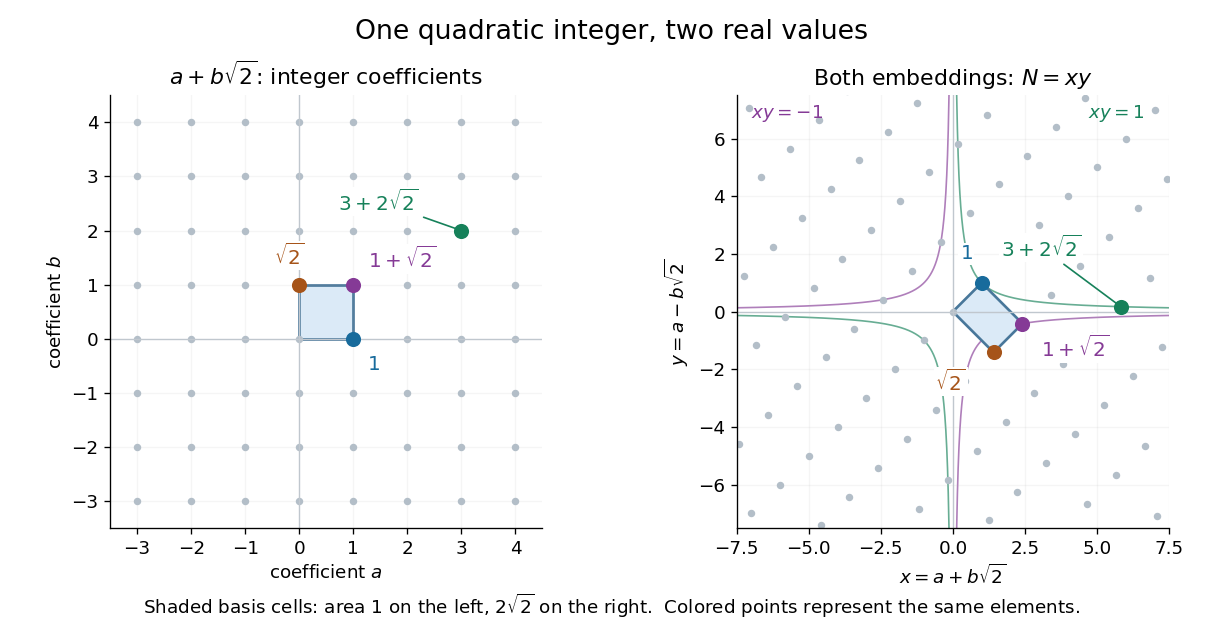
Since , the ring of integers of iswith integral basis and field discriminant eight. Multiplication is ordinary polynomial multiplication followed by :For example, and . The integer coefficients stay integral, as required for a ring.
Under the two field embeddings, the element becomes the point . The integral basis vectors become and , giving a Minkowski embedding of a real quadratic field. Their determinant has absolute value , consistent with the field discriminant.

The ring is a Euclidean domain for the absolute field norm. Approximate both rational coefficients of a quotient by nearest integers. If the errors are , then , giving a remainder of strictly smaller absolute norm. In particular this ring is a principal ideal domain and has trivial ideal class group.
Articles by others on the same topic
There are currently no matching articles.