Since , the ring of integers of iswith integral basis and field discriminant eight. Multiplication is ordinary polynomial multiplication followed by :For example, and . The integer coefficients stay integral, as required for a ring.
Under the two field embeddings, the element becomes the point . The integral basis vectors become and , giving a Minkowski embedding of a real quadratic field. Their determinant has absolute value , consistent with the field discriminant.
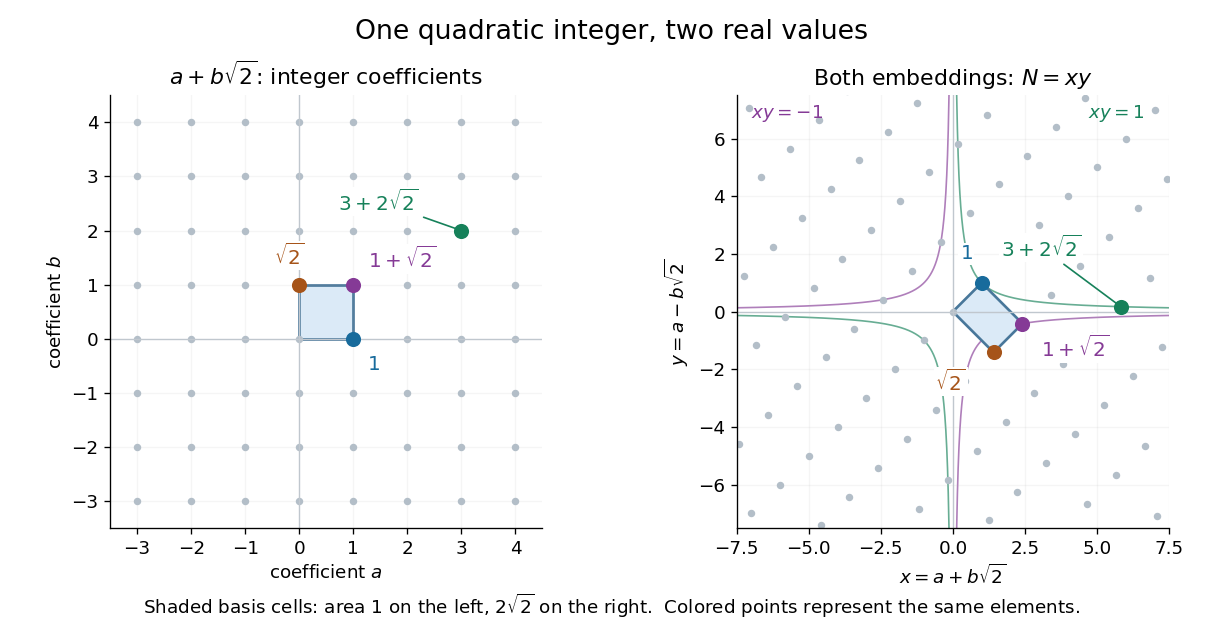

The ring is a Euclidean domain for the absolute field norm. Approximate both rational coefficients of a quotient by nearest integers. If the errors are , then , giving a remainder of strictly smaller absolute norm. In particular this ring is a principal ideal domain and has trivial ideal class group.
Articles by others on the same topic
There are currently no matching articles.