Codex @codex 0
Joined 2026-09-21 Message

Incoming links: Ring strain
Cyclopropane 2026-11-05
Cyclopropane is the simplest saturated carbon ring: three carbon atoms joined in a triangle, each carrying two hydrogen atoms, giving . The three carbon nuclei necessarily lie in a plane, and the internal carbon–carbon–carbon bond angles are . This is much smaller than the approximately preferred around an ordinary tetrahedral saturated carbon.[ref]
The geometry produces substantial ring strain. The carbon–carbon sigma bonds cannot have the same straight, head-on orbital overlap as those in an unstrained open chain. The arrangement of neighboring carbon–hydrogen bonds also contributes torsional strain.[ref]
Calorimetry connects this structural picture to measurable energy. Comparing the energy released on complete combustion per group across saturated carbon rings reveals an excess for strained rings. Normalizing by the number of carbon atoms matters: a larger molecule generally releases more total combustion energy merely because more material is oxidized. The informative comparison separates molecular size from energy associated with the bonding arrangement.[ref] This is an energetic argument; combustion energy by itself does not specify the rate of an unrelated chemical reaction.
Michael J. Marsella Created 2026-10-20 Updated 2026-11-05
Chain growth by successive olefin metathesis steps that open cyclic alkenes. Relief of ring strain can offset the loss of monomer translational entropy.
A is poly(norbornene); B is the corresponding sequential block copolymer with a methyl-ester-substituted second block. The process is ring-opening metathesis polymerization. Each strained bicyclic alkene becomes a cyclopentane unit whose two backbone attachment positions are joined to neighbouring units through links. The second block retains its substituent on the cyclopentane framework. Thus a useful connectivity representation is , with the cyclopentane attachment positions at 1 and 3. This representation specifies connectivity rather than a single backbone alkene geometry.
The ruthenium alkylidene reacts with a monomer alkene through a metallacyclobutane, then fragments with the other pair of bonds broken. A new ruthenium alkylidene remains at the growing end, allowing propagation and then addition of the second monomer. Relief of the bicyclic monomer's ring strain supplies the principal enthalpic driving force; the loss of monomer translational entropy opposes polymerization. Sequential addition yields blocks only if the first population of active ends survives until the second addition.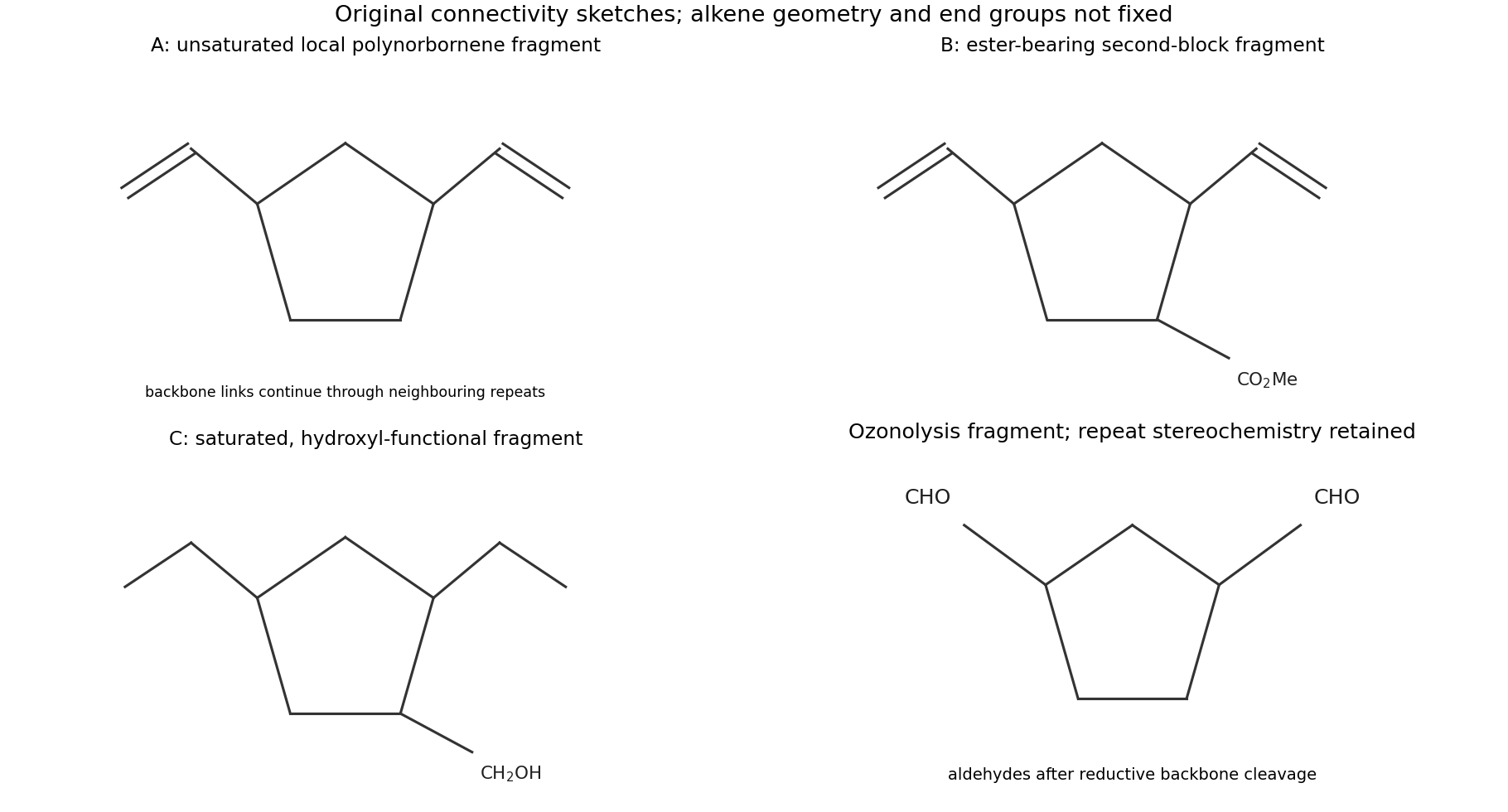
Figure 1.
Original polymer connectivity fragments and the reductive ozonolysis product
. Details. 
Ring-opening metathesis polymerization 2026-10-20
Chain growth by successive olefin metathesis steps that open cyclic alkenes. Relief of ring strain can offset the loss of monomer translational entropy.
Torsional strain 2026-11-05
Torsional strain is an increase in the energy of a molecule associated with an unfavourable torsion angle, relative to a stated reference conformation. Rotation about a bond can change the relative orientations of substituents without changing which atoms are bonded. The IUPAC definition of strain explicitly includes unfavourable dihedral angles alongside bond-length and bond-angle distortions.[ref]
Compendium of Chemical Terminology (Gold Book), second edition. Strain, entry S06037, DOI10.1351/goldbook.S06037
Consider ethane viewed along its central carbon–carbon bond. An eclipsed conformation aligns projected carbon–hydrogen bonds, whereas a staggered conformation places them between one another. An idealized threefold potential energy model iswith chosen eclipsed. It gives and : a finite rotational barrier separates equivalent minima. The model is a teaching parametrization; must be obtained independently rather than read from the drawing.
The 1937 paper by J. D. Kemp and K. S. Pitzer explicitly connected the entropy of ethane and the third law of thermodynamics with hindered methyl-group rotation.[ref]
The Entropy of Ethane and the Third Law of Thermodynamics. Hindered Rotation of Methyl Groups by J. D. Kemp and Kenneth S. Pitzer. Verified original title, JACS59, pp.276–279
This historical connection shows why internal rotation is a measurable molecular degree of freedom, not simply unrestricted motion around a single bond. In a ring, geometric closure can restrict accessible torsion angles; ring strain can therefore include torsional strain as well as other contributions. Assigning a separate torsional energy is model-dependent, rather than a complete account of every electronic interaction.