Scott Kirkpatrick is a computer scientist whose work connects statistical physics with computational complexity theory and optimization. With Charles Daniel Gelatt Jr. and Mario P. Vecchi, he developed simulated annealing as a method for combinatorial optimization.[ref]
Optimization by Simulated Annealing by Scott Kirkpatrick and others. 1983, introduction and pages 672–673
The method borrows a rule from the Metropolis algorithm: a proposed increase in cost can be accepted with probability , where is an adjustable control parameter in the same units as the cost. Allowing occasional uphill changes can escape a local minimum; reducing progressively makes them less likely. The original work applied this physical analogy to electronic component placement and wiring.[ref]
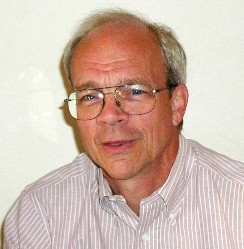
Portrait of Scott Kirkpatrick
. Photograph from Hebrew University of Jerusalem's official researcher profile. Source. Articles by others on the same topic

Scott Kirkpatrick is known for his work in the field of computer science, particularly in optimization and artificial intelligence. He is credited with the development of simulated annealing, a probabilistic technique that is used for approximating the global optimum of a given function. Simulated annealing mimics the process of annealing in metallurgy, where controlled cooling helps to minimize defects. Kirkpatrick introduced this algorithm in a landmark paper co-authored with Chilean physicist Jorge A.