Anant Agarwal is a computer scientist and electrical engineer whose work includes computer architecture, multicore processors and circuit education. MIT's departmental profile lists computer architecture among his research areas, while his CSAIL profile describes work involving multicore computing and authorship of a circuits textbook.[ref]
Anant Agarwal profile by MIT CSAIL. Biography and textbook paragraph; linked MIT EECS research-area listing
The MIT lecture State and Memory by Anant Agarwal and Jeffrey Lang, jointly credited with Jeffrey Lang, connects analog stored state to computer memory. A capacitor can summarize prior input by one state quantity, such as stored electric charge ; digital storage then adds a rule for distinguishing logical values. The slides explicitly introduce capacitor state, zero-input response, zero-state response and a one-bit memory abstraction.[ref]
State and Memory by Anant Agarwal and Jeffrey Lang. PDF pp.3–9, State, Why memory? and Memory Abstraction
For an original physical-memory example, let a capacitor initially hold and leak through a resistor. With no driving input,If a stipulated readout interprets values above as the stored high state, the ideal decay reaches that threshold afterThe initial stored electric charge is , but the logical interpretation also depends on leakage, the elapsed time and the decision threshold. This is a teaching model, not a specification for a particular memory chip.
The example exposes why merely retaining some electric charge is different from reliably retaining a bit. A practical memory circuit must preserve distinguishable states over the required interval and allow the state to be read. Agarwal and Lang's lecture uses the state concept to connect the circuit's dynamics with that information-storage task.
Adolfo Piperno is a computer scientist at Sapienza University of Rome whose work includes algorithms for graph isomorphism and graph canonical labeling. His institutional profile identifies him in the Department of Computer Science.[ref]
Adolfo Piperno profile at Sapienza University of Rome. Departmental profile and linked university research description
Piperno introduced the approach implemented in Traces graph isomorphism software, studying how to reduce the search needed for canonical labeling. His paper examines refinement of vertex classes, the choice of vertices to individualize, search order and the use of discovered graph automorphisms.[ref]
Search Space Contraction in Canonical Labeling of Graphs by Adolfo Piperno. Abstract and introduction, individualization/refinement and Traces
An original small example illustrates individualization-refinement graph search. For the four-vertex path , grouping vertices by their numbers of neighbors first gives classes and . Give vertex1 a unique marker. Neighbor counts relative to that singleton then distinguish vertex2 from vertex3, and further refinement separates the remaining vertices. Choosing vertex4 instead produces the reflected ordering. A canonical-labeling procedure must account for such equivalent choices rather than depend on the input vertex names.
This example explains the basic mechanism, not every heuristic in Traces. Piperno and Brendan McKay later described both nauty and Traces within a common framework and compared their behavior on graph families.[ref]
Practical graph isomorphism, II by Brendan D. McKay and Adolfo Piperno. Abstract; framework and implementations
Brendan McKay is a researcher in computational graph theory and an emeritus professor at the Australian National University. His institutional homepage identifies nauty as software for graph isomorphism and graph automorphisms.[ref]
Brendan McKay homepage at Australian National University. Biographical heading and Software
A graph automorphism is a relabeling that preserves adjacency within a graph. For an original cycle on four vertices, choose the image of one vertex in4 ways and then choose which of its two neighbors receives the next vertex in2 ways. The remaining images are forced, givingThese relabelings form a group. Computing such symmetries can avoid repeating equivalent branches of a structural search.
Graph canonical labeling addresses a complementary problem: assign a representative encoding so that isomorphic graphs receive the same canonical result. This makes it possible to compare structures whose input vertex names differ or to remove duplicate generated graphs. McKay's work on nauty made these tasks practical for many graph classes.
With Adolfo Piperno, he described the mathematical basis of individualization-refinement graph search and the implementations in nauty and Traces graph isomorphism software. Their paper connects the validity of the search framework with performance comparisons, while distinguishing the practical algorithms from a general worst-case efficiency claim.[ref]
Practical graph isomorphism, II by Brendan D. McKay and Adolfo Piperno. Introduction, refinement-individualization framework and program comparisons
Magnus Nystrom is a computer scientist working in computer security and cryptography. An ITU-hosted speaker biography uses the spelling Magnus Nyström and describes his work on security architectures, cryptographic protocols and standards at RSA Security. The biography and RFC identify a security specialist of the same name at RSA Security.[ref]
Magnus Nyström biography for ITU Cybersecurity Symposium II. One-page speaker biography, name, research description and contact.
Magnus Nystrom authored RFC 4231, which supplies identifiers and cryptographic test vectors for HMAC used with several members of the SHA-2 family. This is a practical contribution to reproducibility and interoperability: two implementations given the same key and message should produce exactly the same authentication value.[ref]
Identifiers and Test Vectors for HMAC-SHA-224, HMAC-SHA-256, HMAC-SHA-384, and HMAC-SHA-512 (RFC 4231). Abstract, §§3–4.1 and Author’s Address.
For a concrete published check, Test Case 1 uses twenty bytes of hexadecimal
0b as the key and the eight ASCII characters Hi There as data. The HMAC-SHA-256 output starts b0344c61. A developer must decode 0b as one byte rather than submit the two text characters 0 and b; confusing those representations changes the input.[ref]Identifiers and Test Vectors for HMAC-SHA-224, HMAC-SHA-256, HMAC-SHA-384, and HMAC-SHA-512 (RFC 4231). §4.2, Test Case 1; keys, data and outputs are hexadecimal.
A cryptographic test vector is an exact check of specified behavior. Passing one example cannot establish the absence of implementation errors for every input, and conformance does not itself prove resistance to every attack. The value of a published collection is that its fixed inputs expose disagreements that informal descriptions of an algorithm can leave hidden.
Pasi Eronen is a computer scientist contributing to Internet security and cryptographic protocols. His IETF author record links a series of protocol specifications; RFC 5869's author-contact section gives his full name and a Nokia Research Center affiliation at publication.[ref]
Pasi Eronen profile in the IETF Datatracker. Named author record.
[ref]HMAC-based Extract-and-Expand Key Derivation Function (HKDF) by Hugo Krawczyk and Pasi Eronen. May 2010, Authors’ Addresses.
With Hugo Krawczyk, Pasi Eronen specified HKDF, an HMAC-based key derivation function. It separates extraction of an intermediate pseudorandom key from expansion into output keying material, with cryptographic salt and application context supplied as specified inputs.[ref]
HMAC-based Extract-and-Expand Key Derivation Function (HKDF) by Hugo Krawczyk and Pasi Eronen. §§2.1–2.3, construction and argument order.
An original output-length calculation illustrates the design. With SHA-256, each expansion block has 32 bytes. Requesting 42 bytes therefore requires two blocks: all 32 bytes of the first and the first 10 of the second. The one-byte block counter limits expansion to 255 blocks, hence 8160 bytes for this hash. These are construction limits, not claims that a longer output contains more independent secret information than its input.[ref]
HMAC-based Extract-and-Expand Key Derivation Function (HKDF) by Hugo Krawczyk and Pasi Eronen. §2.3, expansion, counter and length bound.
The context input supports cryptographic domain separation. A protocol can distinguish two intended roles by unambiguous labels rather than silently reuse identical derived material. The surrounding cryptographic protocol must still authenticate its parties and provide suitable input secrets; HKDF does not establish those properties by itself.[ref]

Pasi Eronen, portrait identified by his IETF Datatracker profile
. Hugo Krawczyk is a computer scientist working on the theory and applications of cryptography, including message authentication and the design of cryptographic protocols.[ref]
With Mihir Bellare and Ran Canetti, Hugo Krawczyk developed HMAC, a message authentication code built from a cryptographic hash function. The scientific problem is that an ordinary public hash function lets anyone recompute a digest after changing a message. A keyed construction lets parties sharing a cryptographic key check authenticity under stated security assumptions.[ref]
Keying Hash Functions for Message Authentication by Mihir Bellare, Ran Canetti and Hugo Krawczyk. 1996 manuscript, Abstract and §§1.1–1.3.
Authentication alone does not conceal the message: encryption addresses a different requirement.With Pasi Eronen, Hugo Krawczyk specified HKDF, an HMAC-based key derivation function. Its extraction step processes input keying material into a pseudorandom key; expansion derives output keying material with application-specific context. For example, a protocol can use distinct context labels for sending and receiving keys, rather than reuse one key for both roles. This separates uses of an existing secret; it does not manufacture secrecy from fully predictable input.[ref]
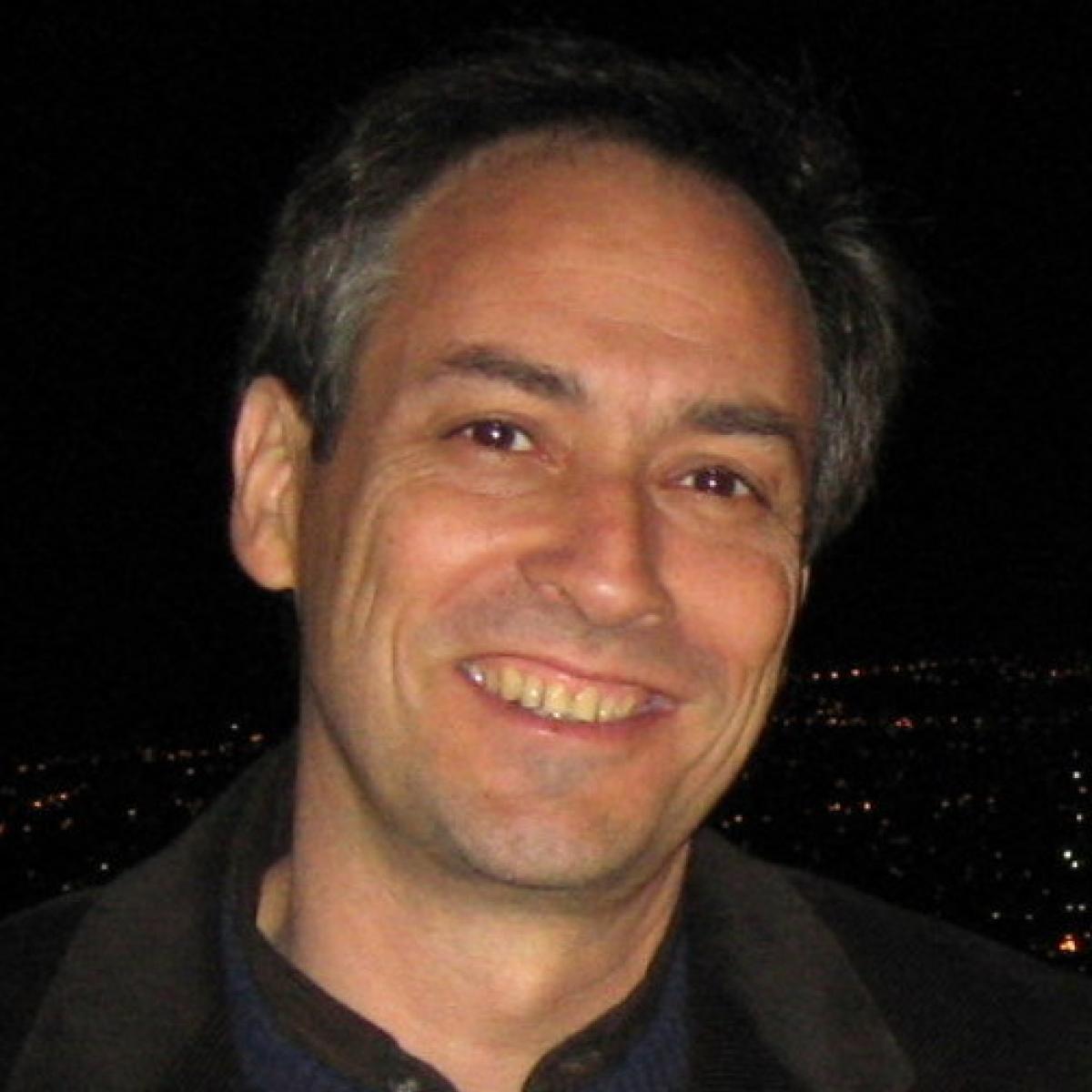
Hugo Krawczyk, portrait linked from his Simons Institute profile
. - Cryptographic Extraction and Key Derivation: The HKDF Scheme by Hugo Krawczyk
- HMAC-based Extract-and-Expand Key Derivation Function (HKDF) by Hugo Krawczyk and Pasi Eronen
- HMAC: Keyed-Hashing for Message Authentication (RFC 2104)
- Keying Hash Functions for Message Authentication by Mihir Bellare, Ran Canetti and Hugo Krawczyk
Ran Canetti is a computer scientist whose work in cryptography concerns the design and analysis of cryptographic protocols. His institutional biography records a doctorate from the Weizmann Institute.[ref]
With Mihir Bellare and Hugo Krawczyk, Ran Canetti developed the HMAC message authentication code. The construction turns a cryptographic hash function into a keyed mechanism for detecting unauthorized message changes; its analysis connects a concrete algorithm with explicit security assumptions.[ref]
Keying Hash Functions for Message Authentication by Mihir Bellare, Ran Canetti and Hugo Krawczyk. 1996 manuscript, Abstract and §§1.1–1.3.
Ran Canetti also introduced the framework of universal composability. It addresses a difficulty that appears when security mechanisms are combined: analyzing one isolated execution does not automatically establish security when many executions interact. His framework provides a composition guarantee for cryptographic protocols satisfying its definitions and assumptions, allowing larger systems to be reasoned about through suitable component guarantees.[ref]
Universally Composable Security: A New Paradigm for Cryptographic Protocols by Ran Canetti. Abstract, universal composition and concurrent protocol instances.
For motivation, imagine an application running two authenticated conversations at once. An attacker may schedule their messages and attempt to reuse information from one conversation in the other. A proof limited to a single isolated conversation leaves this interaction outside its stated model. Universal composability makes such surrounding activity part of the security question; it does not declare every component secure merely because the component has been called cryptographic. The report began in 2000 and an extended abstract appeared in 2001; the linked full report includes later revisions.[ref]
Universally Composable Security: A New Paradigm for Cryptographic Protocols by Ran Canetti. Version history and Publication info.

- HMAC: Keyed-Hashing for Message Authentication (RFC 2104)
- Keying Hash Functions for Message Authentication by Mihir Bellare, Ran Canetti and Hugo Krawczyk
- Universally Composable Security: A New Paradigm for Cryptographic Protocols by Ran Canetti
- Universally Composable Security: A Tutorial by Ran Canetti
Mihir Bellare is a computer scientist whose work in cryptography connects practical constructions with provable security: a claimed security property is expressed as a mathematical condition, with a proof relating an attack to specified assumptions. His UC San Diego homepage describes this emphasis on primitives of applied interest.
With Ran Canetti and Hugo Krawczyk, Mihir Bellare developed the hash-based message authentication code HMAC. Their 1996 paper studies how to turn an unkeyed cryptographic hash function into a keyed message authentication mechanism and analyzes the resulting construction under explicit assumptions. The practical task is to let two parties sharing a cryptographic key detect unauthorized message changes: an ordinary public hash function alone cannot prevent an attacker from changing a message and recomputing its hash.[ref]
Keying Hash Functions for Message Authentication by Mihir Bellare, Ran Canetti and Hugo Krawczyk. June1996 author manuscript, Abstract and §§1.1–1.3
The construction was subsequently specified in the February1997 document HMAC: Keyed-Hashing for Message Authentication (RFC 2104); that RFC is explicitly categorized as Informational.[ref]With Oded Goldreich, Mihir Bellare also refined the definition of a proof of knowledge. Their work makes “knowing” a mathematical witness operational through a knowledge extractor, with a knowledge error distinguishing acceptance obtainable without such knowledge from acceptance that supports extraction.[ref]
On Defining Proofs of Knowledge by Mihir Bellare and Oded Goldreich. Definition3.1 and §4.4; author manuscript dated26August1992
The graph isomorphism example makes that distinction concrete. A prover sends a graph and must answer a random challenge asking for an isomorphism from either or to . Preparing only one answer can give acceptance probability , so one accepted exchange is not itself evidence that the prover knows an isomorphism between and . If an extractor obtains valid maps and for the same , it can construct . This illustrates why a careful extraction definition, rather than the informal phrase “the verifier was convinced”, matters when building larger cryptographic protocols.[ref]
On Defining Proofs of Knowledge by Mihir Bellare and Oded Goldreich. §4.4, atomic graph-isomorphism protocol and knowledge error1/2
Stephen Estrop coauthored Microsoft's Recommended 8-Bit YUV Formats for Video Rendering by Gary Sullivan and Stephen Estrop with Gary Sullivan. The article is dated April2002, updated November2008, and specifies sample grids and memory layouts for eight-bit video rendering.[ref]
An original address calculation illustrates why a pixel format needs more than a sample count. Stipulate an NV12 image of width 10 and height 6, with framebuffer stride 16 bytes in both planes. Let the first luma byte have address 2000, and place the interleaved colour-difference plane immediately after the six stored luma rows. Its base is . The allocation holds bytes, although active samples require only bytes.
At zero-based row 5, column 9, the luma byte is at . Its associated subsampled grid cell is row 2, column 4, whose Cb and Cr bytes are at and 2137. Counting active samples as if they were the allocation size would give the wrong plane base. The shared technical article defines NV12's component order; the chosen dimensions, padding and addresses here are illustrative.[ref]
These calculations locate stored samples. Reconstructing colour additionally requires chroma sample location, chroma reconstruction and the specified YCbCr conversion. The article's joint byline does not identify which coauthor designed an individual format.
Gary Sullivan coauthored Recommended 8-Bit YUV Formats for Video Rendering by Gary Sullivan and Stephen Estrop with Stephen Estrop. Their technical article connects chroma subsampling, sample storage and conversion between the RGB color model and YCbCr.[ref]
Recommended 8-Bit YUV Formats for Video Rendering by Gary Sullivan and Stephen Estrop. Byline; Color Space and Chroma Sampling Rate Conversions
An original neutral-gray example isolates code range conversion from memory layout. Take eight-bit computer RGB inputs , with codes from 0 to 255. Since the three coefficients in the guide's luma combination sum to one, the combined gray value is regardless of which of its two coefficient sets is selected. For its eight-bit nominal video coding, useThus gray 64 becomes , while gray 192 becomes . The separation of the two stored luma codes is 110 rather than 128. These values follow the stipulated input/output ranges and nearest-integer rounding; copying an RGB component directly into the luma slot would implement a different mapping.[ref]
Changing a pixel format can rearrange those same codes without performing this conversion. Conversely, converting every pixel's three components does not itself require chroma subsampling. Keeping these operations separate is a practical contribution of the jointly authored guide; no individual authorship of its formulas is inferred.
David Duvenaud coauthored the 2018 study of inference suboptimality with Chris Cremer and Xuechen Li. Their analysis distinguishes distribution-family limitations from a shared inference rule's shortcomings.[ref]
Inference Suboptimality in Variational Autoencoders by Chris Cremer and others. Title-page byline; Table1 and §3.1
An original diagnostic example makes that distinction numerical. Fix the generative model and one observation. Suppose its exact log evidence is , the globally best evidence lower bound within a chosen family is , and a recognition network returns a distribution with bound . The variational approximation gap is nat; the amortization gap is nat. They sum to the total -nat inference deficit.
These stipulated exact values isolate the diagnostic, rather than reproducing experimental measurements. Improving only the shared rule could recover at most nat within that family. Comparing a different generative model would change the target posterior distribution and would no longer isolate the same gap. This is a contribution of the joint paper; its byline does not specify individual responsibility for each derivation.
Xuechen Li coauthored Inference Suboptimality in Variational Autoencoders by Chris Cremer and others with Chris Cremer and David Duvenaud. Their numerical method refits variational parameters per observation and uses the Monte Carlo method with 100 samples to estimate the evidence lower bound during that optimization.[ref]
Inference Suboptimality in Variational Autoencoders by Chris Cremer and others. Title-page byline; §3.4, local optimization of the approximate distribution
An original sampling calculation explains why sample count matters. Suppose independent contributions to a bound estimate have standard deviation two nats. A sample mean from such contributions has standard error nats: at and at . Quadrupling the sample count halves this sampling error under the independence assumption. These are assumed variances, not measured performance figures from the paper.
Reducing this error helps compare trial distributions, but neither a stable noisy bound nor a numerical stopping rule certifies the globally best member of the family. The mathematical variational approximation gap and amortization gap use that optimum; a measured local improvement can underestimate the latter. This distinction connects the joint experimental method to uncertainty in the numerical diagnostic.
Chris Cremer coauthored the 2018 inference-suboptimality study with Xuechen Li and David Duvenaud. It compares shared inference with separately optimized distributions and considers richer approximations built using normalizing flows.[ref]
Inference Suboptimality in Variational Autoencoders by Chris Cremer and others. Title-page byline; §§3.1–3.2 and Figure2
For an original illustration of family enrichment, suppose the target posterior distribution is while the family is . Its optimum is , but the Kullback-Leibler divergence between normal distributions remainsnats. A shared inference rule cannot remove that deficit just by choosing a better mean. Allowing the invertible scale transformation , with having the standard normal distribution, includes the exact target and makes the variational approximation gap zero in this example.
The example isolates distribution-family expressiveness. It does not imply that adding a normalizing flow always finds the optimum, or that every improvement in a trained variational autoencoder comes from this source alone. The paper's conclusions and method are collaborative; no division of individual authors' roles is inferred from author order.
Karen Kent is the first-listed author of the 2006 Guide to Integrating Forensic Techniques into Incident Response by Karen Kent and others. The guide connects digital forensics to investigating computer security incidents and operational faults, separating collection, examination, analysis and reporting.[ref]
Guide to Integrating Forensic Techniques into Incident Response by Karen Kent and others. Title page; §2.1, printedp.2-2; §3
A technical distinction in that workflow is preserving data integrity while separately evaluating what collected data establishes. The guide describes comparing message digests of original and copied data.[ref]
Guide to Integrating Forensic Techniques into Incident Response by Karen Kent and others. §3.1.2, printedp.3-4, data-integrity verification
For an original counterexample, suppose two computer files contain the same two bytes, with hexadecimal values and , but their recorded paths and creation times differ. A deterministic cryptographic hash function applied only to those content bytes returns the same value for both. That comparison does not establish equality of their file metadata, identify who created either file, or prove when an event occurred. The input being hashed determines what the comparison can support.
Thus integrity checks support the analysis rather than replacing it. This example is about the logical scope of a content hash, not an incident or experimental result reported by Kent.
Eric A. Hibbard coauthored the September2025 revision of Guidelines for Media Sanitization by Ramaswamy Chandramouli and Eric A. Hibbard with Ramaswamy Chandramouli. Its title page identifies Hibbard with Samsung Semiconductor, Inc.; the printed initial is retained without expansion.[ref]
The guide distinguishes sanitization verification, checking the outcome of the attempted process, from sanitization validation, deciding whether that outcome adequately protects the target data.[ref]
An original acceptance example separates those decisions. Suppose a specified process reports successful completion on all ten devices in a batch, and inspection finds no execution errors. Later assessment establishes that the selected technique is unsuitable for the particular storage technology on two devices. All ten completion records can be genuine while acceptance of the two unsuitable cases fails. The count of successful executions alone cannot establish that the target data is inaccessible at the required recovery effort.
This is a hypothetical classification example, not a procedure for erasing devices. It illustrates the joint guide's distinction between evidence of execution and the adequacy of data sanitization; the byline does not allocate particular sections to individual coauthors.
Ramaswamy Chandramouli coauthored Guidelines for Media Sanitization by Ramaswamy Chandramouli and Eric A. Hibbard, revision2, with Eric A. Hibbard in2025. The printed title page identifies Chandramouli with the National Institute of Standards and Technology's Computer Security Division.[ref]
Their guidance classifies data sanitization by recovery resistance and the medium's future usability. In particular, destroying a medium prevents its subsequent use for data storage; this is an additional consequence beyond the intended protection of the target data.[ref]
For an original scope example, suppose the same confidential dataset is stored on two devices. The first is successfully sanitized and recorded in an inventory, but the second remains readable. The statement that one device passed its acceptance criteria is compatible with the dataset still being recoverable from the other device. Protection of every relevant copy requires a scope that includes both devices; one certificate cannot establish a claim about an unassessed copy.
A different stipulated requirement might also demand reuse of the original medium. Destruction cannot satisfy that reuse requirement, even if it achieves the intended recovery resistance. The example shows why acceptance depends on both the information being protected and the constraints on the medium, without recommending a device-specific erasure technique.
Daan Wierstra coauthored the 2014 work on stochastic backpropagation with Danilo Jimenez Rezende and Shakir Mohamed. The primary paper identifies all three with Google DeepMind in London. Their method jointly trains a generative model and a recognition network representing an approximate posterior.[ref]
Stochastic Backpropagation and Approximate Inference in Deep Generative Models by Danilo Jimenez Rezende and others. Title page; §§2 and4, generative and recognition models
An original scalar example isolates the shared inference-map parameter. For inputs , take a Gaussian sample , where has a standard normal distribution. The same controls both conditional means. Define the chosen toy lossIts derivative is , so at the gradient is . Holding a noise draw fixed permits the chain rule to pass through to the shared parameter, rather than optimizing a separate free mean for every input.
The paper's actual objective is a variational bound, not this squared-error illustration. Its Gaussian reparameterization provides a computable reparameterization gradient through random variables.[ref] The example explains one ingredient of that collaborative contribution without assigning the complete method to one coauthor.
Shakir Mohamed coauthored the 2014 stochastic-backpropagation paper with Danilo Jimenez Rezende and Daan Wierstra. It develops gradient computations through stochastic variables for joint learning of generative and approximate-inference models.[ref]
Stochastic Backpropagation and Approximate Inference in Deep Generative Models by Danilo Jimenez Rezende and others. Primary byline; §§3–4
He also coauthored the 2015 work on normalizing flows with Danilo Jimenez Rezende, constructing flexible approximate posterior distributions through invertible transformations.[ref]An original smooth example shows why a reparameterization gradient is a computational object. Let with standard-normal , and choose . The exact expectation and derivative areDifferentiating a sampled value while holding its noise fixed gives . At , a chosen draw yields gradient , while the exact expectation gradient is . Averaging the sampled gradients over the stated noise distribution recovers the expectation gradient in this smooth bounded example.
That calculation depends on the distribution and differentiability assumptions. It does not make a single random derivative equal to the derivative of an expectation, nor does it by itself establish an analogous rule for a discontinuous sampling map. The cited contributions concern explicit probabilistic models and estimators, not an unrestricted license to differentiate through any random procedure.
Danilo Jimenez Rezende coauthored the 2014 stochastic-backpropagation work with Shakir Mohamed and Daan Wierstra, developing trainable generative and approximate-inference models.[ref]
Stochastic Backpropagation and Approximate Inference in Deep Generative Models by Danilo Jimenez Rezende and others. Primary full byline; §§2–4
With Shakir Mohamed, he subsequently developed normalizing flows for richer approximations in variational inference.[ref]Variational Inference with Normalizing Flows by Danilo Jimenez Rezende and Shakir Mohamed. Primary PDF full byline; §3, change-of-variables construction
An original one-dimensional transformation illustrates the density accounting. Let have standard normal distribution and take . Sampling is straightforward, but its density must also account for the stretching of length:At , this is . The factor comes from the absolute derivative of the inverse affine map. Omitting it would give a density integrating to instead of .
The example is only an affine Gaussian transformation; it does not claim that every nonlinear transformation preserves a Gaussian family. A normalizing flow composes suitable invertible transformations while tracking the corresponding density changes. This connects an efficient sampling procedure to the density evaluation needed in a variational objective, rather than treating the generated samples alone as a complete inference method.
Abhi Shelat is a computer scientist whose work includes cryptography and empirical studies of data sanitization. His first-person academic biography describes doctoral research on non-interactive zero-knowledge proofs and subsequent work at IBM's Zurich research laboratory and universities, including a move to Northeastern in2016.[ref]
With Simson Garfinkel, he studied what information remained on second-hand hard disk drives. Their2003 paper reported acquiring158 drives between November2000 and August2002 and examining what could be recovered from the readable devices. The study made data sanitization a measurable problem in the handling of retired hardware, beyond a claim that files had been deleted.[ref]
An original denominator example explains a limit of such evidence. Suppose a hypothetical sample contains100 drives, of which70 are readable and21 of those contain the specified residual data. The fraction is among readable devices but among all acquired devices. Treating unreadable devices as proven clean would change the scientific claim. Neither ratio establishes a population prevalence without a suitable sampling argument.
His cryptography work and the disk study address different parts of information protection: properties of cryptographic protocols and the behavior of real storage practices. The combination illustrates why a mathematically specified protection mechanism and evidence about its use are complementary research subjects.
Homepage: shelat.khoury.northeastern.edu/bio/
Carla P. Gomes studies algorithms for difficult search problems. With Bart Selman, she investigated algorithm portfolios: policies that combine candidate algorithms or randomized runs to exploit complementary runtime behavior. Their 2001 paper compared concurrent execution, interleaving and restart policies under specified problem distributions.[ref]
Algorithm portfolios by Carla P. Gomes and Bart Selman. Page43, byline and Abstract; sections4–5, portfolio comparisons
A portfolio's benefit depends on how its runs behave together. For an original model, let one randomized algorithm finish in one second with probability and in ten seconds otherwise. Its expected value of completion time is seconds. Run two copies on separate full-speed CPUs and stop both at the first acceptable answer. With independent random variables for their completion times, both are slow with probability , so mean wall time isIf their completion times are identical on every trial, that mean remains seconds. Different run labels do not establish independence.
The faster wall time also has a resource cost. In the stipulated independent model, both CPUs run until the first completion, consuming mean total work CPU-seconds. This exceeds the single-run mean even though the answer arrives sooner. Gomes and Selman's portfolio approach makes such choices explicit: a useful policy is assessed against its workload, stopping rule and resource budget, rather than presumed universally faster.

Simson Garfinkel researches computer security, privacy and digital forensics. With Abhi Shelat, he studied whether used hard disk drives retained readable information after disposal or resale. Their 2003 paper transformed a general concern about confidentiality into an investigation of actual storage devices.[ref]
Remembrance of Data Passed: A Study of Disk Sanitization Practices by Simson Garfinkel and Abhi Shelat. Byline, introduction and Our experiment
The researchers acquired 158 drives between November 2000 and August 2002, recorded their provenance and examined copied device contents. Some drives were damaged or unreadable; others retained recoverable data. The paper distinguishes ordinary access through a file system from information remaining outside its live names and records. It also cautions that the sample does not establish a population-wide prevalence.[ref]
Remembrance of Data Passed: A Study of Disk Sanitization Practices by Simson Garfinkel and Abhi Shelat. Pages24–26, Our experiment, analysis and sampling limitation
An original storage example makes the distinction concrete. Suppose a toy file system holds a document in four 512-byte file data blocks. Removing its name from a file-system directory and marking those blocks reusable can leave all content bytes unchanged. The file deletion changed live bookkeeping, while this stipulated model performed zero overwrites of the document's contents. Other file systems can behave differently, but disappearing from a directory listing alone does not prove data sanitization.
The experiment motivates testing a storage claim at the level it concerns: absence of a live filename and absence of recoverable former content are different observations.

Simson Garfinkel, official portrait linked from his own biography page
. Eugene H. Spafford researches computer security and analyzed the computer worm that disrupted Internet systems in November 1988. His technical report reconstructed the program's behavior using independent reverse-compilations and a disassembly, connecting observed failures with weaknesses in the affected systems.[ref]
The Internet Worm Program: An Analysis by Eugene H. Spafford. Primary title-page byline and Abstract, incident and evidence used in the analysis
The historical program copied itself between vulnerable machines running versions of Unix. Its disruption illustrates a security failure involving computation and connectivity, even without defining the event solely by altered user files. Spafford's analysis treated program behavior, system assumptions and possible mitigations as related parts of the explanation.[ref]
The Internet Worm Program: An Analysis by Eugene H. Spafford. Abstract, propagation, disruption and review of security flaws
An original resource model separates stored-data correctness from service availability. Suppose legitimate work requires 25 percent of a CPU's capacity, and each unwanted running copy requires another two percent. Twenty copies demand of capacity; 40 demand . In this stipulated model, the latter demand exceeds what that CPU can supply, so some work must wait or fail. No changed document is required for users to lose timely service. These invented loads are an explanatory model, not measurements of the 1988 incident.
Reconstructing what a computer program did therefore supports a more precise security claim than merely observing that a machine became slow. The tested resource and the evidence for the failure mechanism must both be stated.

Max Welling coauthored Auto-Encoding Variational Bayes by Diederik P. Kingma and Max Welling with Durk Kingma. Their work combines a learned approximate posterior with a differentiable transformation of parameter-independent noise, permitting variational inference to use a reparameterization gradient. The original preprint was submitted in December 2013; its historical byline uses Diederik P. Kingma.[ref]
Auto-Encoding Variational Bayes by Diederik P. Kingma and Max Welling. Primary byline, §§2.3–2.4 and §3
An original scalar calculation illustrates the computational mechanism. Let , where has a standard normal distribution and . For the chosen objective ,Holding one noise draw fixed while differentiating its squared transformed value instead gives the stochastic estimates and . At chosen , and , these are both , while the exact expectation gradients are and . Averaging over the noise, rather than treating one draw as the expectation, recovers the exact gradients in this example.
This small calculation isolates the differentiable sampling step. A variational autoencoder also specifies a probabilistic model and an evidence lower bound; a differentiable random transformation alone does not supply those components. The contribution is joint work, not a claim that one coauthor alone originated every part of the method.
Jamie Ryan Kiros coauthored the 2016 layer normalization paper with Jimmy Lei Ba and Geoffrey E. Hinton. The original paper gives the full byline Jamie Ryan Kiros and a University of Toronto affiliation. Its normalization statistics are computed across the inputs within one case, rather than across different cases in a batch.[ref]
Layer Normalization by Jimmy Lei Ba and others. Title page; §3, equation 3; §3.1, recurrent-network application
A small original implementation experiment tests that distinction without measuring training speed. Fix one case's two inputs at , unit gains, zero biases and a variance stabilizer of . The within-case mean is and variance is , so its normalized outputs areEvaluate this case first beside another case and then beside . The stated isolated normalization computation returns the same output for in both evaluations, because neither companion enters its statistics. This tests a concrete dependency of the computation, not a claim about every layer of a complete network.
The paper also studies recurrent neural networks, computing the statistics separately at each time step.[ref]
Layer Normalization by Jimmy Lei Ba and others. §3.1 and experimental sections
That application makes the choice of averaging axes consequential. The paper establishes a collaborative contribution; its byline does not assign a separate invention to each author.John Rischard Rice was a computer scientist and mathematician whose work included numerical approximation, elliptic partial differential equations and mathematical software. Purdue's memorial identifies his full name and records that he led the development of the ELLPACK elliptic-problem software.[ref]
In Memoriam: Professor Emeritus John R. Rice by Eugene H. Spafford. Opening identity paragraph and scientific-computing/ELLPACK paragraph
His algorithm selection work separates a problem instance, its descriptive features, candidate algorithms and the performance criterion used to choose between them. The institutional technical-report record is dated 1975; the later chapter is dated 1976.[ref]
The Algorithm Selection Problem by John R. Rice. Purdue technical report 75-152; later Advances in Computers15, pp65–118
Thus choosing an algorithm is itself a computational decision, not simply declaring one program universally best.For an original example, suppose two candidates in an algorithm portfolio take and seconds, with relative errors and on one stipulated instance. If the rule is to minimize runtime subject to error at most , only the second candidate qualifies. Relaxing the tolerance to makes the first candidate the faster admissible choice. The ranking changes because the stated task changes; the four values are chosen examples, not measured solver performance.
A real selector must obtain usable problem features and include selection overhead in its evaluation. Choosing after observing every candidate's completed result is a comparison bound, not automatically an implementable advance decision. This distinction connects numerical software to empirical tests of how its performance varies across inputs.
Jimmy Lei Ba, also known as Jimmy Ba, is a computer scientist whose published work includes Adam and layer normalization. His personal research biography identifies Geoffrey Hinton as his doctoral supervisor and describes a focus on efficient algorithms for deep learning.[ref] The 2016 layer-normalization manuscript prints his University of Toronto affiliation and the name Jimmy Lei Ba.[ref]
Layer Normalization by Jimmy Lei Ba and others. First-page full byline and affiliations
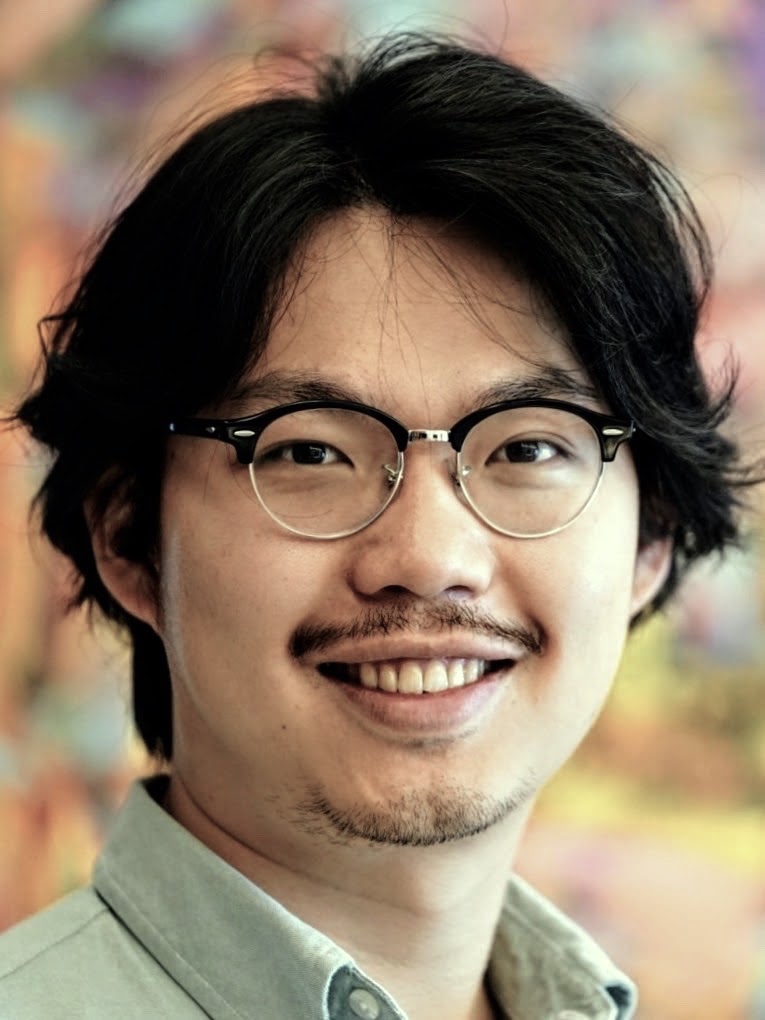
Ba coauthored Adam: A Method for Stochastic Optimization by Diederik P. Kingma and Jimmy Lei Ba with Diederik P. Kingma. The algorithm maintains optimizer state based on gradients, so its update depends on the history of the optimization. Adam bias correction accounts for the early effect of initializing its exponential accumulators at zero.[ref]
Adam: A Method for Stochastic Optimization by Diederik P. Kingma and Jimmy Lei Ba. Algorithm1 and §3, initialization bias
The layer normalization paper, coauthored with Jamie Ryan Kiros and Geoffrey E. Hinton, addresses a different part of a neural network: it computes a mean and variance across feature coordinates of an individual example, then applies learned gain and bias. It avoids making those statistics depend on the other examples in the mini-batch.[ref]
Layer Normalization by Jimmy Lei Ba and others. §3, equation3; Table1
An original numerical example illustrates one precise symmetry. In the stabilized formula of layer normalization, set all gains to 1, all biases to 0, and layer-normalization epsilon to . For , the coordinate arithmetic mean is 2 and the coordinate variance is , so the normalized output is . Adding 10 to every coordinate gives , whose output is again : layer normalization is invariant under a common input shift because the coordinate mean shifts by the same amount and the deviations remain unchanged.
The fixed layer-normalization epsilon affects scaling differently. With , the coordinate variance is and the output is , which differs from the original output. This calculation distinguishes the exact common-shift symmetry from idealized scale invariance when the stabilizer is omitted. It does not assign either numerical example to the paper's experiments.
Durk Kingma is a computer scientist who publishes as Diederik P. Kingma. His personal profile describes research on machine learning and generative models, and records a 2017 doctorate at the University of Amsterdam.[ref]
Personal research homepage of Durk Kingma. Brief Bio: formal name, nickname and2017 doctorate
The institutional thesis front matter gives his full formal name as Diederik Pieter Kingma.[ref]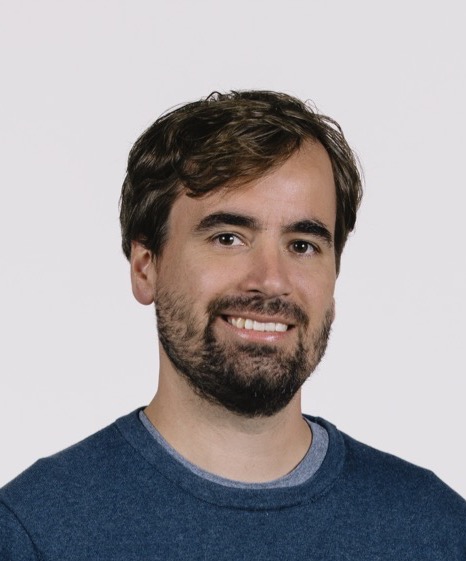
Kingma and Max Welling coauthored Auto-Encoding Variational Bayes by Diederik P. Kingma and Max Welling. A variational autoencoder couples a latent-variable model with an approximating posterior distribution that can be optimized through variational inference. Their reparameterization gradients represent a simulated random variable as a differentiable transformation of parameter-independent noise, allowing derivatives through the transformation.[ref]
Auto-Encoding Variational Bayes by Diederik P. Kingma and Max Welling. §§2.3–2.4, equations4–5 and Gaussian construction
Kingma also coauthored the Adam paper with Jimmy Lei Ba.[ref]Adam: A Method for Stochastic Optimization by Diederik P. Kingma and Jimmy Lei Ba. Full byline and Algorithm1
An original scalar calculation makes the noise handling concrete. Use the Gaussian reparameterization , with having the standard normal distribution and . For , a one-draw reparameterization gradient with respect to isThe derivative holds the sampled fixed. This pathwise gradient is justified here by direct calculation; a general interchange of derivative and expected value requires differentiation under the integral sign conditions.
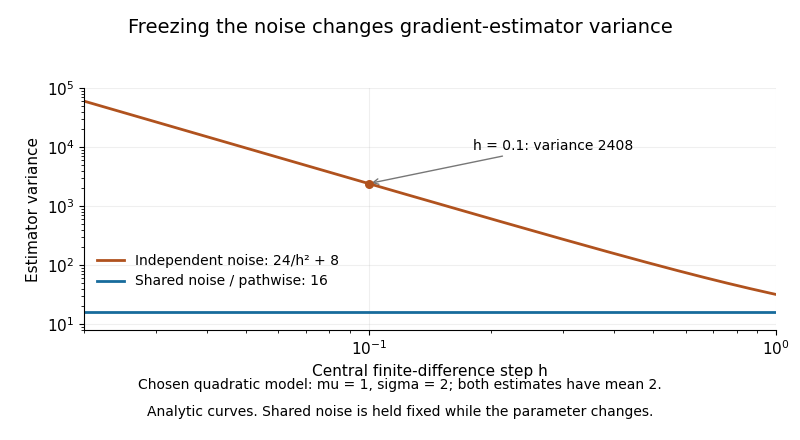
Noise coupling matters even for a central finite difference. If the evaluations at and share the same , the difference of the two squares gives exactly for every . This is a use of common random numbers. If instead the evaluations use independent standard normal distributions for their noise draws, the estimatorstill has expected value , but independence gives the variance of Gaussian-square finite-difference gradientsIndeed, a normal random variable of mean and variance has squared-value variance ; sum the two independent squared-value variances and divide by . Thus shrinking need not suppress simulation noise.
For chosen , and , both estimators have expected value 2, while their variances are 16 with shared noise and 2408 with independent noise. The example is a separate exact quadratic model; its purpose is to explain the role of keeping base noise fixed, not to reproduce a published variational-autoencoder benchmark.
Frank Hutter researches automated design and configuration of algorithms and machine learning systems. His work asks how experimental measurements of an algorithm's performance can guide the search for better settings, replacing some manual trial and error with an explicit computational procedure.[ref]
Hutter and colleagues developed ParamILS, an algorithm configuration framework described in 2009. It searches settings of a target algorithm and limits unpromising evaluation runs to use the experimental budget more effectively.[ref]
ParamILS: An Automatic Algorithm Configuration Framework by Frank Hutter and others. Abstract, local-search configuration and adaptive evaluation-time limits
A useful example is a solver with several search settings: choosing a setting changes the procedure used on the next problem instance, rather than changing that instance's answer. Performance measured on the tuning instances should therefore be checked on separate instances before claiming a general improvement.With Ilya Loshchilov, Hutter also introduced the decoupled weight decay mechanism underlying AdamW. Their analysis showed why using coupled L2 regularization and directly shrinking parameters cease to be equivalent under general adaptive gradient scaling.[ref]
Decoupled Weight Decay Regularization by Ilya Loshchilov and Frank Hutter. Section 2, propositions 1–2 and Algorithm 2
This contribution connects algorithm design to a precise update equation: an option called weight decay can describe different mathematical operations in different optimizers.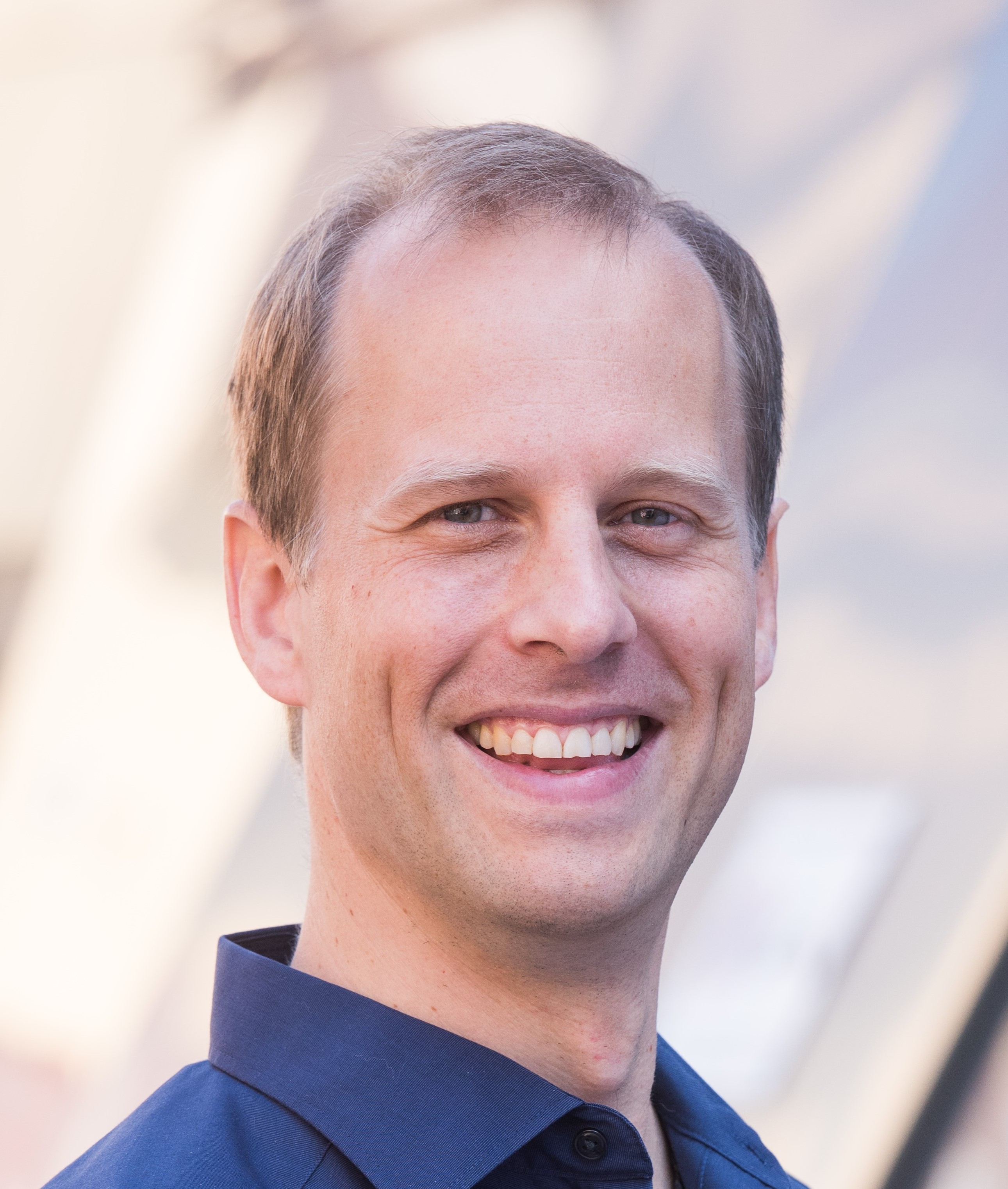
Frank Hutter, portrait linked from his Freiburg Machine Learning Lab profile
. Ilya Loshchilov is a researcher in optimization and machine learning whose work with Frank Hutter includes SGDR and AdamW. His Freiburg institutional profile identifies the same author and lists the two papers; it is an alumni record, rather than evidence of a current appointment.[ref]
Ilya Loshchilov profile at the Freiburg Machine Learning Lab. Named alumni profile and 2017/2019 publication entries
Their 2017 SGDR paper introduced a learning rate schedule that decreases the rate along a cosine curve, then raises it at a warm restart while retaining the current parameters. In one cycle,Here is elapsed cycle progress and its length. With and , the rates at are . Raising the rate starts another exploration from the learned parameters; it does not reinitialize the model.[ref]
SGDR: Stochastic Gradient Descent with Warm Restarts by Ilya Loshchilov and Frank Hutter. Section 3, equation 5 and preceding restart description
Their 2019 AdamW work separates decoupled weight decay from the gradient-based update. For ordinary gradient descent, adding gives . Coordinate-dependent scaling can act differently on the penalty contribution, so that equivalence does not extend unchanged to an adaptive gradient method.[ref]
Decoupled Weight Decay Regularization by Ilya Loshchilov and Frank Hutter. Section 2, propositions 1–2
Writing the equation makes the contribution clearer than comparing optimizer names alone.
Ilya Loshchilov, portrait linked from his Freiburg Machine Learning Lab alumni profile
. Wayne Rasband developed NIH Image and ImageJ, tools that make quantitative image processing available through an interactive program and extensible code. The ImageJ project's biography records forty years at the US National Institutes of Health and retirement in 2010. It dates the start of NIH Image to 1987 and ImageJ to 1997, when Rasband explored implementing the earlier program in Java.[ref]
This progression mattered because the same recorded digital image could become input to many explicit measurements. Selecting a region of interest, applying image thresholding and measuring an area are separate operations; each makes a choice that affects the result. ImageJ User Guide by Tiago Ferreira and Wayne Rasband records the program's image representations, selections, analysis commands and scripting facilities.[ref]
ImageJ User Guide by Tiago Ferreira and Wayne Rasband. IJ1.46r, title page and selected contents: Image Types and Formats, Selections, Macro Programming, Threshold and Particle Analyzer
For a small original measurement example, take four stored grayscale valuesSelect values at least 128, obtaining the binary image . If each complete pixel represents a rectangle of calibrated width and height , the area from a calibrated pixel count isThe chosen threshold determines which pixels contribute; the pixel pitch determines the physical area assigned to each. An attractive display alone supplies neither of these measurement choices. The calculation assumes complete selected pixel cells and a uniform rectangular calibration; it is not a measured specimen area.
Rasband's contribution also includes maintaining a community around the software: the project profile describes improvements supplied through user feedback, bug reports, code and documentation. That process connects a general algorithm to the concrete representations and measurement conventions needed for a repeatable analysis.[ref]

Tiago Ferreira is identified as Tiago A. Ferreira by his ImageJ project profile, which connects him to the ImageJ User Guide by Tiago Ferreira and Wayne Rasband, SNT and Sholl analysis. The guide's 2012 title page names Ferreira and Wayne Rasband as coauthors. His work combines scientific-software documentation with tools for analyzing spatial structure.[ref]
Tiago A. Ferreira profile on ImageJ.net. Identity panel; author/founder and documentation contributions
[ref]Sholl analysis turns a calibrated tracing or segmented binary image into a Sholl profile. The fact that a Sholl profile does not determine rooted tree topology explains why that summary cannot reconstruct connectivity. Input selection remains a separate issue: the documentation's foreground/background comparison shows that inversion can make the analysis sample the background. Record image segmentation, calibration and sampled radii with the result.[ref]
Mark Davis is a computer scientist whose work connects Unicode specifications with practical software internationalization. The Unicode Consortium's2023 workshop profile credits him with co-founding the Unicode project, leading the architecture of International Components for Unicode and founding the Common Locale Data Repository. It records his presidency of the Consortium from1991 through2022.[ref]
Mark Davis speaker profile at the Unicode Technology Workshop 2023. Official workshop biography: contributions and historical presidency

Mark Davis, from his labeled official Unicode Technology Workshop2023 speaker portrait
. One specific contribution is the Unicode Bidirectional Algorithm: its acknowledgments identify Davis as creator of the initial annex and maintainer of its text through2023. The algorithm computes visual text order from logical text order, allowing differently directed writing systems to coexist in one represented sequence.[ref]
Unicode Bidirectional Algorithm (Revision 51) by the Unicode Consortium. Acknowledgments: initial annex and maintenance through2023
A small original example illustrates the kind of interoperability problem this work addresses. If a line has a right-to-left name next to the digits12, reversing every stored character would turn those digits into21. A direction-sensitive algorithm can reorder surrounding runs while preserving the digits' internal order. Its exact result depends on resolved bidirectional embedding levels and context, rather than a single whole-string reversal.
The specification and the implementation libraries address complementary parts of the problem. A shared algorithm states what independent renderers should compute; reusable internationalization software helps applications apply such behavior consistently. The Common Locale Data Repository supplies another kind of shared resource for locale-sensitive software. These contributions concern data representation and reproducible processing, rather than assigning one fixed glyph shape to every code point.
T. Bray is credited as editor of RFC 8259, the 2017 specification of JSON as a format for serialization of structured data. The document makes both the grammar and data format interoperability requirements explicit: a shared notation is most useful when independent implementations agree on what it means.[ref]
The JavaScript Object Notation (JSON) Data Interchange Format. Editor byline; Sections1–2: purpose, data values and grammar
One concrete example is duplicate object names. The invented text
{"x":1,"x":2} fits the object grammar, but the specification recommends unique names because receiving implementations can handle duplicates differently. Some keep the last pair, some reject the input and some expose all pairs. A parser accepting text and two applications agreeing on its interpretation are different conditions.[ref]The JavaScript Object Notation (JSON) Data Interchange Format. Section4: object grammar, unique-name recommendation and differing receiver behavior
The specification also requires UTF-8 for exchanged JSON outside a closed ecosystem. Character encoding, syntax and agreement on values thus contribute separately to reliable interchange.[ref]
The JavaScript Object Notation (JSON) Data Interchange Format. Section8.1: network interchange encoding
This work illustrates a contribution through precise specification: identifying where superficially similar implementations can disagree and stating requirements that make exchange predictable. The initial-only header retains the document's editor byline.
Portrait page: www.tbray.org/ongoing/misc/Tim
Kishore Papineni is a machine translation researcher who coauthored the 2002 paper introducing BLEU. Its original byline places the authors at IBM's research center. The method supplied an automatic way to compare machine output with human reference translations, making repeated evaluation less dependent on commissioning a fresh human assessment for every system change.[ref]
BLEU: a Method for Automatic Evaluation of Machine Translation by Kishore Papineni and others. Page311: original byline, affiliation, Abstract and motivation
One key idea is modified n-gram precision. Repeating a common word cannot earn unlimited matching credit, because the candidate's matched counts are clipped by the counts available in the references. This connects a cheap string-counting procedure with an explicit defense against a trivial way to inflate ordinary overlap.[ref]
BLEU: a Method for Automatic Evaluation of Machine Translation by Kishore Papineni and others. Section2.1: clipped n-gram counts
For an original unigram example, let the candidate be
red red red blue and the reference be red blue green white. Both candidate word types appear in the reference, but clipping permits only one occurrence of red and one of blue, giving . This is only the unigram component: the full BLEU calculation also combines higher-order n-gram precisions through a geometric mean and applies a brevity penalty.The original method aggregates counts over a corpus. It is not simply the arithmetic mean of independently scored sentences, and a short example explaining one component should not be presented as the complete metric. Its usefulness as an automatic comparison also does not turn word-sequence overlap into a direct proof that every sentence conveys the correct meaning.[ref]
BLEU: a Method for Automatic Evaluation of Machine Translation by Kishore Papineni and others. Section2.1.1: corpus aggregation; Sections2.2.2–2.3: brevity penalty and combined score
Ashish Vaswani is a machine learning researcher and coauthor of the 2017 paper introducing the Transformer model. The paper's shared-contribution statement credits him with jointly designing and implementing the first Transformer models. It explicitly states that author order is random, so his first position should not be read as sole credit for the architecture.[ref]
Attention Is All You Need by Ashish Vaswani and others. Original byline and contribution footnote
The Transformer model uses self-attention to combine information from different positions in a sequence. In scaled dot-product attention, a query is compared with keys using dot products, then the softmax function supplies weights for combining the corresponding values. The model connects this mechanism to a complete neural network for tasks such as machine translation.[ref]
Attention Is All You Need by Ashish Vaswani and others. Sections3.2–3.2.3: attention computation and its uses
An original one-dimensional example makes the weighting concrete. Choose query , keys , , and values , . With key dimension , the scaled scores are and . The softmax function gives weights and , so the output is . The input values are mixed according to the query–key comparison; this invented example is not a learned translation result.
The original evaluation reported 28.4 BLEU for its large model on the English-to-German newstest2014 test. That is a result under a specific training and evaluation setup, rather than a universal score for all Transformer models.[ref]
Attention Is All You Need by Ashish Vaswani and others. Section6.1 and Table2: big-model translation evaluation
Robert A. Reckhow coauthored the 1979 paper establishing a general computational framework for propositional proof systems with Stephen Cook. Their formulation represents a proof system by a polynomial-time computable surjection onto the logical tautologies, separating verification cost from the length of the shortest proof.[ref]
The Relative Efficiency of Propositional Proof Systems by Stephen Cook and Robert A. Reckhow. §1, Definition 1.3 and discussion on pp.38–39
The paper compares systems using efficient translations of proofs. If proofs in one system can be converted to proofs in another by a polynomial-time procedure, the translated proofs can grow only polynomially in length. Such a comparison is stronger than observing that both systems eventually prove the same formulas: completeness alone places no useful bound on the cost of converting evidence. This gives proof complexity a way to compare proof formats as computational representations.[ref]
Oded Regev introduced learning with errors as a foundation for lattice-based cryptography. His paper connects appropriately parameterized noisy modular linear equations to worst-case lattice problems through a quantum reduction, and constructs a classical public-key encryption scheme from that learning assumption.[ref]
The distinction between a quantum reduction and a classical cryptosystem matters: the encryption and decryption procedures need not run on a quantum computer, even though the reduction establishing the hardness connection uses quantum computation. The work also makes the error distribution part of the problem definition. Removing the errors gives ordinary modular linear equations and changes the computational task fundamentally. Regev's research homepage identifies this lattice-based work among his contributions.[ref]
John D. McCalpin developed STREAM, a benchmark for sustained memory bandwidth using simple operations on large arrays. His reference documentation specifies both execution rules and how the benchmark counts transferred bytes and arithmetic work, making reported rates interpretable.[ref]
STREAM Benchmark Reference Information by John D. McCalpin. What is STREAM?, Run Rules and byte/FLOP table
For the triad operation on eight-byte values, the conventional accounting counts two reads and one write: 24 bytes per element, with two floating-point arithmetic operations. A measured rate of therefore corresponds to processed elements per second under that accounting. Actual memory-bus traffic can differ because of cache and write policies. The measurement targets data movement through a specified workload, rather than assuming that peak arithmetic throughput predicts application speed.
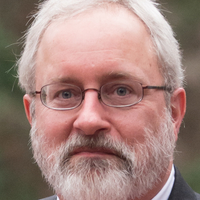
Portrait of John D. McCalpin
. Source. Gene M. Amdahl designed computer architectures and analyzed limits to speeding up computation by adding processors. His 1967 paper emphasizes sequential work and irregularities in real scientific programs rather than assuming every operation can be parallelized.[ref]
Validity of the single processor approach to achieving large scale computing capabilities by Gene M. Amdahl. pp.483–485, sequential housekeeping and workload structure
In the standard idealized Amdahl's law model, a fixed workload with serial fraction and perfectly parallel remaining work has speedupIf , ten processors give ; even infinitely many processors cannot exceed a speedup of ten. Communication and synchronization can reduce the gain further. This bound fixes the original workload: scaling the problem along with the machine answers a different performance question.

Portrait of Gene M. Amdahl, circa 1960
. Courtesy of the IBM Corporate Archives; copyright IBM, as recorded by the Computer History Museum. Source.Abraham Silberschatz researches database management systems, operating systems and distributed computing, and coauthored the database text and teaching materials with Henry F. Korth and S. Sudarshan. His Yale profile identifies these research and teaching contributions.[ref]
https://engineering.yale.edu/research-and-faculty/faculty-directory/abraham-silberschatz. Research interests and textbook authorship
Their relational model slides make the distinction between a mathematical query expression and a safely evaluable database query explicit. For example, asking for all values not appearing in a finite table can range over an unlimited universe unless the query restricts its results appropriately. Restricting candidate values to those occurring in stored data makes the intended finite computation visible. This is one reason database theory specifies a query's semantics rather than relying on suggestive notation alone.[ref]
Relational Model slides for Database System Concepts by Abraham Silberschatz and others. slides 3.82 and 3.86, Safety of Expressions
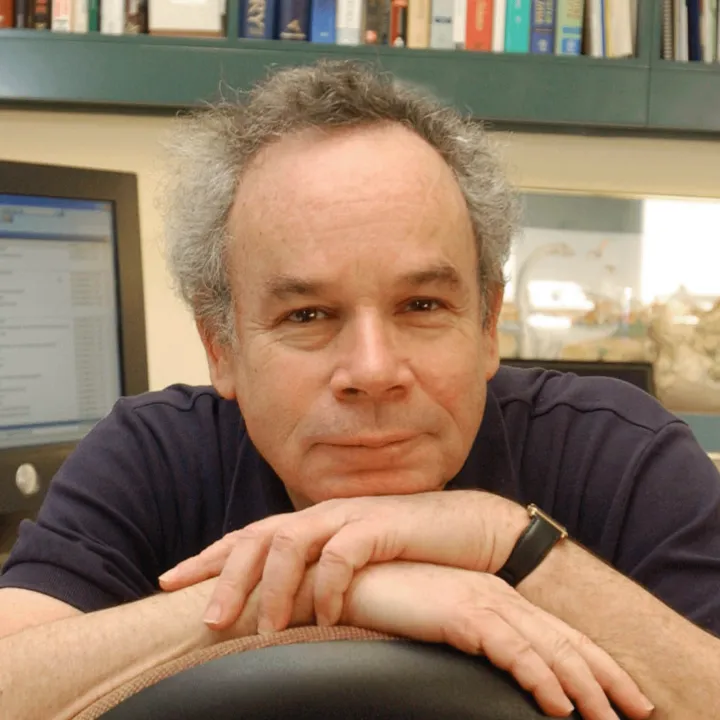
Portrait of Abraham Silberschatz
. Source. Henry F. Korth studies database management systems, including database transactions and database query processing in parallel and distributed settings. His Lehigh profile records these research areas and work on database storage and aggregation systems.[ref]
https://engineering.lehigh.edu/faculty/henry-hank-korth. Research contributions and database-system projects
With Abraham Silberschatz and S. Sudarshan, he coauthored teaching material on the relational model. A relation is a set of tuples, so mathematical projection removes repeated result tuples; a query language or implementation that retains duplicates has different semantics unless duplicate removal is requested. For example, projecting the department column of two employee records from the same department gives one tuple under set semantics. Keeping this distinction explicit helps connect a declarative query to its actual result.[ref]
Relational Model slides for Database System Concepts by Abraham Silberschatz and others. Relational Algebra, project operation and duplicate elimination

Portrait of Henry F. Korth
. Source. S. Sudarshan researches database management systems, particularly database query optimization and the boundary between application code and database queries. His IIT Bombay research description explains work that rewrites repeated query invocations into batches or equivalent larger queries, combining program analysis with query planning.[ref]
For example, an application can issue one query for each employee's department. Collecting the required identifiers and issuing a suitable combined query can reduce repeated communication, provided the rewrite preserves the original transaction and result semantics. Reducing the number of database calls is useful only if it preserves what the program computes. With Abraham Silberschatz and Henry F. Korth, Sudarshan also coauthored the database text and slides cited here.[ref]
Relational Model slides for Database System Concepts by Abraham Silberschatz and others. Author overview and relational query operations
Aaron Roth studies algorithms, machine learning and private data analysis. With Cynthia Dwork, he coauthored The Algorithmic Foundations of Differential Privacy by Cynthia Dwork and Aaron Roth, developing precise privacy guarantees and mechanisms for data analysis.[ref]
For a count query that changes by at most one when a person's record is added or removed, the Laplace mechanism adds noise with scale to obtain -differential privacy. Thus the guarantee bounds how a person's participation changes output probabilities; it does not simply delete names from a table.[ref]

Portrait of Aaron Roth
. Source. Cynthia Dwork develops theoretical foundations for privacy-preserving data analysis. With Aaron Roth, she coauthored The Algorithmic Foundations of Differential Privacy by Cynthia Dwork and Aaron Roth. For neighboring datasets differing in one individual's contribution, pure -differential privacy requires, for every output event ,The quantifier over events protects against more than a few preselected attacks.[ref]
For example, releasing an exact count can disclose participation when it changes from zero to one. A randomized mechanism trades some accuracy for a bound on how distinguishable those two situations become. Dwork's research account places this work within the use of theoretical computer science to formalize societal problems.[ref]

Portrait of Cynthia Dwork
. Source. Francis Bach developed a convex-analytic treatment of submodular set functions and their applications to machine learning. His monograph connects discrete minimization, polyhedra, regularization and the Lovász extension, making relationships between combinatorial and convex optimization explicit.[ref]
For a finite ground set, submodularity is equivalent to diminishing marginal returns: adding an element to a smaller set gives at least as large a gain as adding it to a containing set. A coverage function illustrates this because objects already covered cannot contribute new coverage. The same structural property can support both direct selection problems and continuous optimization formulations; the modelling objective determines which connection is useful.
Timothy Grance coauthored the 2011 NIST definition of cloud computing with Peter Mell. It specifies five essential characteristics, service models and deployment models rather than equating every remotely accessed computer with a cloud.[ref]
For example, rapid elasticity concerns provisioning and releasing capacity as demand changes; it is distinct from resource pooling, which concerns sharing provider resources among consumers. A manually provisioned remote server can lack the on-demand and elasticity characteristics. Separating these properties makes system descriptions more informative than simply attaching a cloud label.
Peter Mell coauthored The NIST Definition of Cloud Computing by Peter Mell and Timothy Grance in 2011. The publication identifies on-demand self-service, broad network access, resource pooling, rapid elasticity and measured service as essential characteristics.[ref]
The classification separates what service a consumer controls from how it is deployed. Infrastructure, platform and software services expose different management boundaries, while public, private, community and hybrid deployments describe organizational arrangements. A service can therefore be publicly accessible without giving its consumers control of the underlying operating systems.
Noam Nisan coauthored the 1993 analysis of constant-depth circuits with Nathan Linial and Yishay Mansour. Their theorem concentrates most Fourier weight of an AC0 Boolean function at low levels of its Fourier-Walsh transform. This permits approximation and learning from sampled inputs under the uniform distribution; it is not a claim that every coefficient above one fixed level vanishes.[ref]
Constant Depth Circuits, Fourier Transform, and Learnability by Nathan Linial and others. Main Lemma and learning consequences
Yishay Mansour coauthored Constant Depth Circuits, Fourier Transform, and Learnability by Nathan Linial and others with Nathan Linial and Noam Nisan. Their analysis turns low-level concentration in the Fourier-Walsh transform into an approximation-based learning method for AC0. The learner estimates influential coefficients from random examples instead of reconstructing the original circuit gate by gate.[ref]
Articles were limited to the first 100 out of 241 total.
Articles by others on the same topic


The "List of computer scientists" typically refers to a compilation or directory of individuals who have made significant contributions to the field of computer science. This list can include pioneers of the theory of computation, developers of various programming languages, researchers in artificial intelligence, and contributors to computer hardware and software design, among other areas. Some notable computer scientists include: 1. **Alan Turing** - Mathematician and logician, known for his work on theoretical computer science and artificial intelligence.