A Sagnac interferometer uses a beam splitter to send light with optical coherence around a common closed optical path in opposite directions, then recombines the beams to read their phase difference. Mirrors or a guiding path define the loop; the source, beam splitter, loop and readout rotate together in the basic experiment. A small relative beam tilt makes spatial interference fringes whose displacement reveals a change of phase difference. At one fixed output, a photodetector can instead record the corresponding change in light intensity.
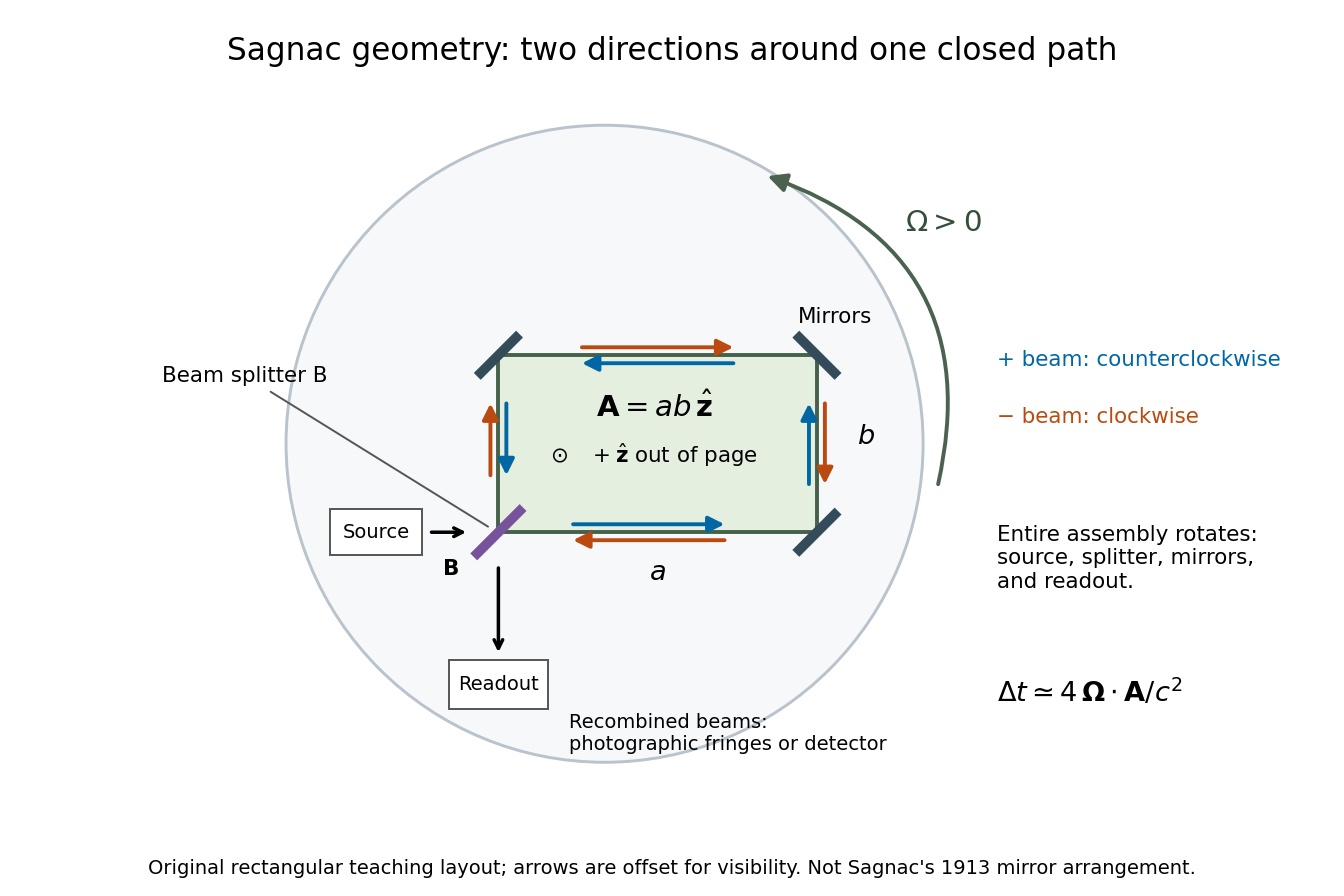

In 1913 Georges Sagnac mounted a lamp, collimator, beam splitter, four mirrors and photographic plate on a horizontal rotating platform. The mirrors defined a closed polygon; the two beams traversed it in opposite senses. A slight beam splitter adjustment produced visible interference fringes. A motor brought the platform to steady rotation, and switching the lamp exposed the plate. Comparing opposite senses of rotation revealed a reversing displacement. Changing the beam splitter adjustment supplied a further check against optical deformation. The report compared measured and calculated displacements. Georges Sagnac interpreted this as evidence for a luminiferous aether; the relativistic derivation below reproduces the delay without that hypothesis.[ref]
Regarding the Proof for the Existence of a Luminiferous Ether Using a Rotating Inteferometer Experiment by Georges Sagnac. Georges Sagnac, 1913 second report, inspected in William Lonc's 2008 English translation, pp. 77–80, §§1–3: rotating apparatus, photographic procedure, reversal and deformation controls, comparison table, historical interpretation
The readout measures a relative wave phase, not two stopwatch readings separated by an optical transit time. Reversal isolates a contribution odd in angular velocity: if a signed interference fringe position is to leading order, then cancels the fixed offset . Changes of alignment or temperature correlated with reversal can survive this subtraction. Thus the experimental inference concerns a reproducible rotating-loop phase difference, with controls for disturbances; it is not by itself a unique test of an underlying propagation hypothesis.
Articles by others on the same topic
There are currently no matching articles.