A simple cell is a visual cortical neuron whose receptive field has spatially separable ON and OFF receptive-field subregions. Elongated neighboring subregions give a preferred orientation and a sensitivity to the location and polarity of visual contrast. “Simple” describes the response organization; it does not describe a simpler cell body or a particular shape of neuron.
Hubel and Wiesel's 1962 classification emphasized four observations: distinguishable ON and OFF receptive-field subregions, summation within each region, antagonism between regions, and qualitative prediction of responses to differently shaped stimuli from those regions' arrangement. A slit fitting an elongated center was more effective than a smaller spot; a larger patch could invade opposing flanks and lose effectiveness. An edge separating bright and dark regions could be effective when its boundary matched the boundary between subregions. These were observations about spike trains, rather than an assertion of exact linearity. [ref]
https://www.gatsby.ucl.ac.uk/teaching/courses/tn1-2020/additional/systems/JPhysiol-1962-Hubel-106-54.pdf. Hubel and Wiesel (1962), pp. 109–112: simple-field criteria and slit/edge experiments
The following deliberately coarse signed spatial filter model of a simple cell makes the geometry easy to count. A centered bright bar contributes positively at five sites. Rotating it preserves its area but mixes positive and negative weights; shifting it preserves its orientation but changes which weights it samples. The model is useful because it predicts distinct effects of these three manipulations instead of treating any bright stimulus as equivalent.
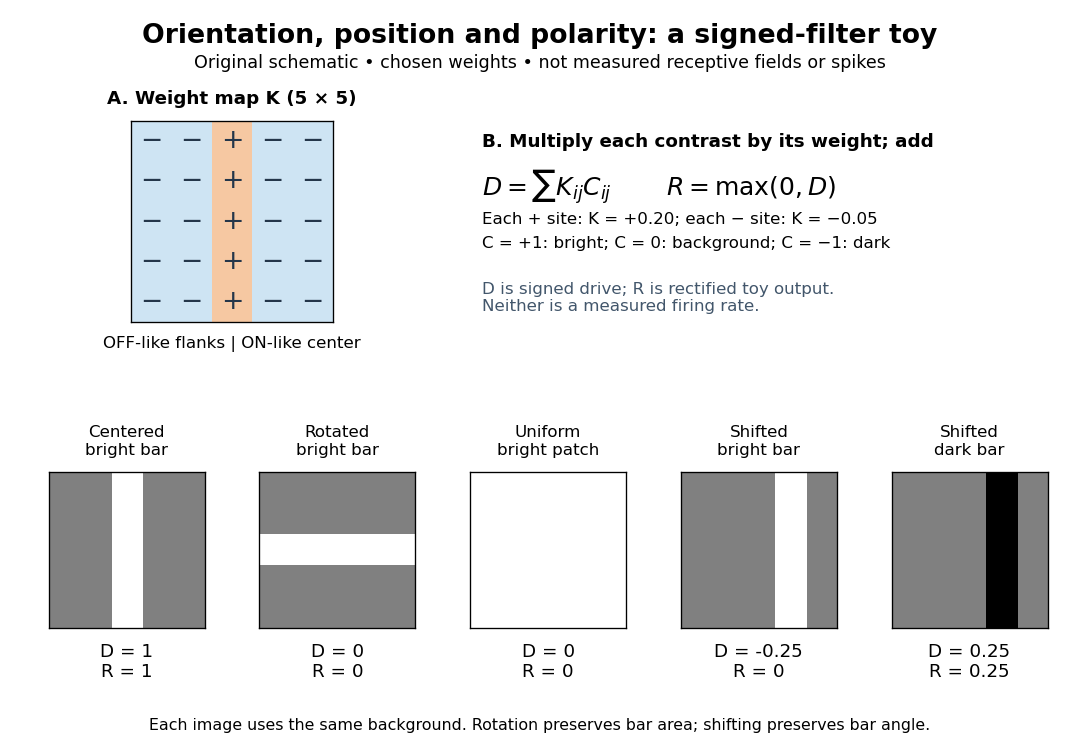

A simple cell is not an ideal linear sensor. Its spike train is nonnegative in event count, and neural adaptation can change responsiveness. The signed spatial filter model of a simple cell supplies a useful approximation to spatial drive and an explicit output rule. Comparing predictions with unseen stimuli is more informative than assuming the rule from the name “simple”. In contrast, the existing complex cell models explore tolerance to phase and local displacement.
Articles by others on the same topic
There are currently no matching articles.