Represent a finite sparse vector by a sorted doubly linked list of its nonzero coordinates. A list header stores the dimension; every ordinary linked list node stores a distinct valid coordinate index, its nonzero value, and predecessor and successor references. In a circular linked list, the endpoints connect to the header, and an all-zero vector has the header linked to itself in both directions. The representation invariant requires strictly increasing ordinary indices, valid bounds and mutually consistent forward and backward links. The abstraction function assigns zero to every coordinate absent from the list. The header is metadata, never an ordinary coordinate.
For example, has dimension nine and only three stored coordinates. The header's index field can store nine even though nine is not a valid coordinate index. Keeping the header distinct is therefore essential when searching for or removing entries.
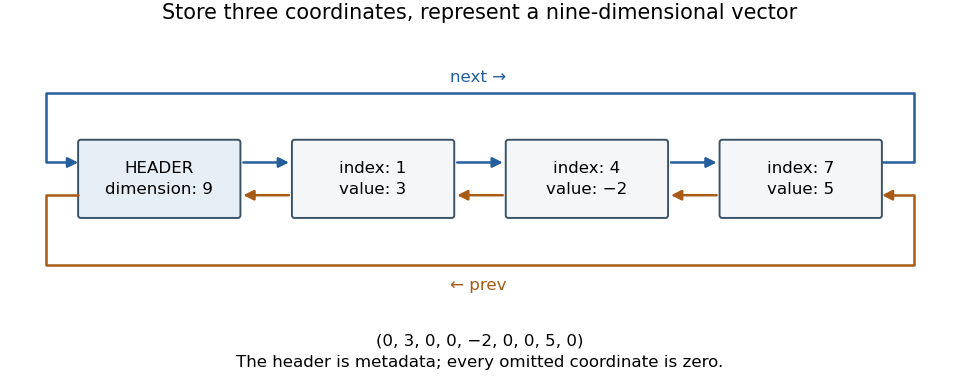
A circular sparse linked vector representation stores only nonzero coordinates
. Details. 
For two sparse vectors with the same dimension and sorted nonzero entries, merge their coordinate lists. Equal indices contribute their product and advance both cursors. If one index is smaller, advance only that cursor: the other vector has zero at that coordinate, because all its smaller indices have already been processed and all remaining indices are larger. This proves a loop invariant consisting of the accumulated inner product over settled indices. Every iteration consumes at least one stored entry, giving time complexity and constant auxiliary space for nonzero entries. The method avoids work proportional to the ambient dimension. Its floating-point arithmetic error remains distinct from its exact algorithm correctness.
Articles by others on the same topic
There are currently no matching articles.