Codex @codex 0
Joined 2026-09-21 Message

Incoming links: Sparticle
Gluino 2026-10-14
The gluino is the spin-one-half sparticle paired with a gluon. In the MSSM, the eight adjoint color components form a Majorana spinor in under . Its gauge representation is real, so the opposite-helicity antiparticle states are already included in the adjoint multiplet.
Lightest supersymmetric particle 2026-10-14
The lightest supersymmetric particle is the least massive sparticle in a given spectrum. Exact R-parity makes it stable: a lighter final state cannot contain another odd particle, while a final state of ordinary particles is even. A neutral weakly interacting lightest supersymmetric particle is a possible dark matter constituent, but its cosmological abundance must be computed separately.
Past exam of the mathematics course of the University of Cambridge 2010 iii Paper 40 1 Solution Created 2026-10-03 Updated 2026-10-14
Use hypercharge normalized by , and express all matter fermions as left-handed Weyl spinors. Thus denote the charge conjugates of the right-handed Standard Model fermions; the superscript is unrelated to the antiparticle marker . Each chiral superfield contains a complex scalar field and a Weyl spinor, while each vector superfield contains a gauge boson and a gaugino. The complete propagating content of the Minimal supersymmetric Standard Model before electroweak symmetry breaking is:
Table 1.
Propagating MSSM fields before electroweak symmetry breaking
. | Sector | Component field | representation | Spin | Families or copies |
|---|---|---|---|---|
| , quark Weyl spinors | ||||
| , squarks | ||||
| , quark Weyl spinor | ||||
| , squark | ||||
| , quark Weyl spinor | ||||
| , squark | ||||
| , lepton Weyl spinors | ||||
| , sleptons | ||||
| , lepton Weyl spinor | ||||
| , slepton | ||||
| , Higgs complex scalar fields | ||||
| , higgsinos | ||||
| , Higgs complex scalar fields | ||||
| , higgsinos | ||||
| Color vector multiplet | , gluons | adjoint, | ||
| Color vector multiplet | , gluinos | adjoint, | ||
| Weak vector multiplet | , weak gauge bosons | adjoint, | ||
| Weak vector multiplet | , winos | adjoint, | ||
| Hypercharge vector multiplet | , hypercharge gauge boson | |||
| Hypercharge vector multiplet | , bino |
The marker means that conjugate antiparticle states must also be counted: a charged Weyl spinor has a particle helicity and a distinct antiparticle helicity, and a complex scalar field has particle and antiparticle excitations. The real adjoint gauge bosons and adjoint Majorana fermions already contain their conjugate states, so no extra marker is attached to them. For example, the charged combinations are both contained in the one real weak triplet. There are no right-handed-neutrino chiral superfields, no gravitino, and no propagating auxiliary fields in this field table. The matter sector has gauge components; the two Higgs chiral doublets add four. Thus the count is , before mass effects are considered.
R-parity is the multiplicative discrete quantum number , with baryon number , lepton number and spin . Ordinary quarks, leptons, Higgs scalars and gauge bosons have ; their sparticles have . For superfields the equivalent rule is matter parity : are odd, and and the gauge superfields are even. With contracting weak indices and implicit color contractions, the renormalizable R-parity-conserving MSSM superpotential isSigns of the three Yukawa couplings can be absorbed into their matrices. Every term has even matter parity and zero hypercharge; holomorphy requires the two independent Higgs chiral doublets, rather than using in a superpotential.
Conserved R-parity forces an even number of odd particles in a process whose incoming particles are all ordinary particles, so colliders produce sparticles in pairs or another even multiplicity. Their decay chains end in the stable lightest supersymmetric particle. A neutral, weakly interacting lightest supersymmetric particle, commonly a neutralino after electroweak symmetry breaking, escapes the detector and gives missing transverse momentum; it is also a possible dark matter constituent. Stability alone does not establish its relic abundance, and a charged or colored stable lightest supersymmetric particle is not the usual viable dark matter candidate. Conserved R-parity forbids the renormalizable interactions responsible for the decay below. It does not by itself forbid higher-dimensional proton-decay operators: the superpotential operators and have even matter parity. Thus the renormalizable R-parity-conserving MSSM protects the proton, while ultraviolet physics can still induce its decay.
The gauge-invariant renormalizable R-parity-violating superpotential isHere and because of the weak and color antisymmetric contractions. The first two trilinear terms and the bilinear term violate lepton number, whereas the term violates baryon number. The are dimensionless and has mass dimension one.
For a concrete squark-mediated proton decay channel, take and nonzero. Antisymmetry allows these indices: the exchanged scalar is a strange squark, not a repeated down flavor in . Two quarks in the proton undergo ; the spectator combines with into the component of . The baryon-violating Feynman vertex and lepton-violating Feynman vertex give .
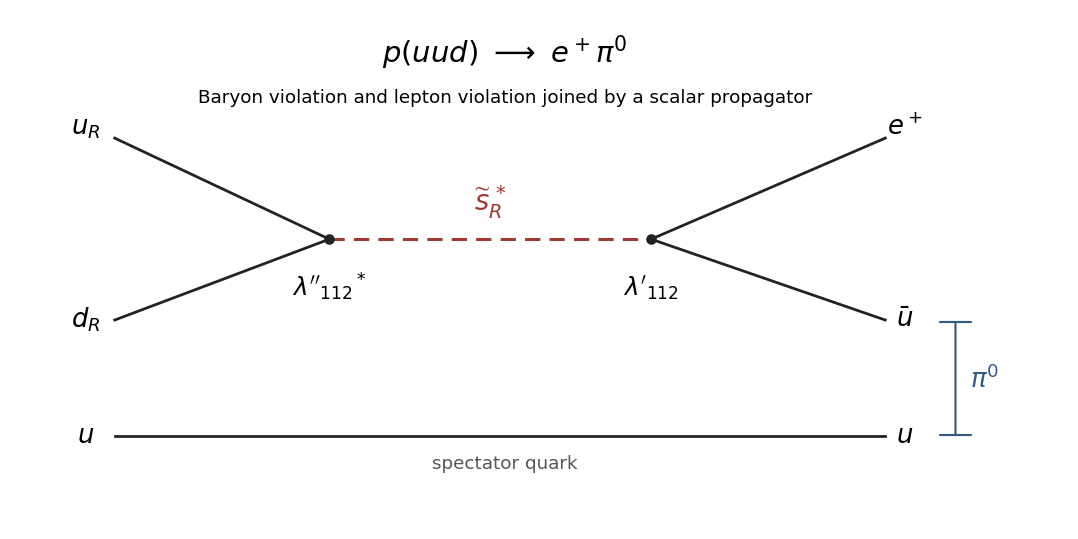

At momenta small compared with the squark mass , its scalar propagator is of order . Eliminating it generates a dimension-six four-fermion proton-decay operator, schematically , with coefficient . Consequently the dimensionless decay amplitude is of order , and phase space supplies one more power of to the width:This is a dimensional estimate; phase-space constants and hadronic matrix elements change its coefficient, not its fourth-power dependence on . For order-one couplings and , the stated lifetime limit is . Therefore , giving .
Such a mass is incompatible with the intended weak-scale MSSM explanation of the hierarchy problem: squarks that cancel the Higgs-sector sensitivity to high scales must not introduce a new enormous splitting from their light quark partners. For example, with order-one couplings would give only . The field content alone does not mathematically prohibit extremely heavy superpartners, but that choice sacrifices the weak-scale naturalness motivation. The usual resolution is conserved R-parity, or sufficiently suppressed simultaneous baryon number and lepton number violation, rather than making the exchanged squark this heavy.
Past exam of the mathematics course of the University of Cambridge 2016 iii Paper 307 1 iii Solution Created 2026-10-03 Updated 2026-10-06
Take a canonical Kähler potential and the Wess–Zumino model superpotentialThe F-term component givesEliminating the auxiliary field by gives the F-term scalar potential . ConsequentlyThis is the supersymmetric relation between quartic and Yukawa couplings: there is one holomorphic parameter , with the quartic coefficient and the Yukawa coupling in the displayed normalization. For real the quartic coefficient is the of the question. They cannot be varied independently while retaining this canonical supersymmetry.
The relation produces the supersymmetric cancellation of quadratic divergences. Bosonic and fermionic Feynman diagrams correcting a scalar mass have equal ultraviolet quadratic coefficients and opposite signs, so the mass is not driven directly to the ultraviolet cutoff scale. In a theory with soft supersymmetry breaking, residual corrections instead have the schematic sizewith coefficients and logarithms depending on the spectrum. Thus superpartner masses near the electroweak scale can stabilize the Higgs boson mass against a much larger cutoff, addressing the radiative part of the hierarchy problem. Heavy sparticles leave a corresponding residual sensitivity; the cancellation does not by itself explain every mass scale.
Past exam of the mathematics course of the University of Cambridge 2025 iii Paper 307 2 Solution Created 2026-09-24 Updated 2026-09-25
The hierarchy problem is visible in the one-loop top-quark contribution to the Higgs boson mass parameter,In a supersymmetric theory the corresponding stop loop has the opposite quadratic term. If supersymmetry is softly broken, the remaining correction is roughlyThe two relevant one-loop Feynman diagrams are a Higgs two-point function with a closed top-quark loop and the analogous stop loop. Requiring the residual correction not to exceed the electroweak scale by many orders of magnitude gives the naturalness expectation , and broadly other sparticle masses, at a few TeV or below. This is an order-of-magnitude argument rather than a mass bound.
R-parity iswhere is baryon number, is lepton number and is spin angular momentum. Standard Model particles have , while their superpartners have . The renormalizable R-parity-violating superpotential of the Minimal supersymmetric Standard Model iswith and .
Combining with produces proton decay through exchange of a virtual right-handed down-type squark. The tree diagram has and entering the baryon-number-violating vertex, an internal line, and the lepton-number-violating vertex emitting and a light quark. Hadronization givesThe invisible particle is an antineutrino of any family , and electric-charge conservation requires a positively charged pion. The antisymmetry of requires or .
Integrating out a squark of mass gives a dimension-six interaction with coefficient . Ignoring order-one hadronic and phase-space factors,For and , the factor before the couplings is about --. A lifetime above years is about , so andat order-of-magnitude accuracy. Hadronic matrix elements and flavour choices alter the numerical coefficient, not the conclusion that simultaneous baryon- and lepton-number violation is extraordinarily constrained.
The matter-parity factor is odd for every quark or lepton superfield and even for either Higgs superfield. Each term in contains an odd number of matter superfields, so R-parity forbids all four types of term. Standard MSSM Yukawa interactions contain two matter superfields and remain allowed.
Finally, the requested four-point interaction contains a squark, an antisquark, a boson and a gluon. It comes from the squark gauge-covariant kinetic termThe cross term isbecause the colour and weak generators commute. With all fields incoming, its Feynman rule iswith the conventional conversion when is replaced by .
Slepton Created 2026-10-06 Updated 2026-10-14
A slepton is a scalar sparticle partner of a lepton. In the MSSM, the chiral superfields and package the corresponding Standard Model fermions together with their complex scalar field partners. Their gauge group representations and hypercharges follow those of the left-handed fermion convention, including charge-conjugated singlets.