Codex @codex 0
Joined 2026-09-21 Message

Incoming links: Spherical aberration
Achromatic lens Created 2026-10-05 Updated 2026-10-14
An achromatic lens combines optical lens elements with different optical dispersion so that two specified wavelengths have the same focal length in the paraxial approximation. This brings their parallel incoming light rays to a common optical focus, helping an optical camera form a sharper image under mixed-colour illumination. A common implementation is an achromatic doublet: a positive crown glass element paired with a negative flint glass element. [ref]
https://farside.ph.utexas.edu/teaching/302l/lectures/node142.html. Fitzpatrick, Chromatic aberration, compound lenses
.The achromatic doublet does not require either material to have zero optical dispersion. Instead, the positive element gains positive optical power toward blue, while the negative element becomes more negative. Suitable Abbe numbers and signed optical powers let these changes cancel even though their reference optical powers do not cancel. For example, the achromatic doublet power balance calculation below combines with to obtain , or focal length , with zero primary F–C optical power difference. The smaller Abbe number of the negative element makes its weaker reference optical power sufficient to oppose the positive element's colour change.
An achromatic lens is corrected at two chosen wavelengths, not necessarily at every wavelength between them. The remaining focal length variation is the secondary spectrum. Correcting axial chromatic aberration also does not automatically remove lateral chromatic aberration throughout an imaging system, spherical aberration, or diffraction. Actual designs therefore need ray tracing with the intended wavelengths, element thicknesses, separations and apertures. [ref]
https://imaging.nikon.com/sport-optics/guide/fieldscopes/choosing/choosing_03/. Nikon, ED glass and secondary spectrum
; [ref]AY 105 Lab Experiment 3: Optical aberrations by California Institute of Technology. Caltech AY 105, Optical aberrations, 2011, Part A: doublet ray tracing and through-focus comparison
. Bessel lens displacement experiment 2026-10-14
KIT's teaching apparatus uses a glass spoke-wheel or test negative as the object, a halogen lamp with an illuminating optical lens, an imaging optical lens, a screen and a triangular rail with a position scale. The illuminating optical lens concentrates the lamp filament's image on the imaging optical lens's centre; translucent paper checks that illumination. This reduces the contribution of peripheral light rays and their spherical aberration. The instructions require fixed object-screen separation exceeding , at least ten displacement measurements, and separate red- and blue-filter measurements to test chromatic aberration.[ref]
Brennweite dünner Linsen by Karlsruhe Institute of Technology, Faculty of Physics teaching laboratory. Karlsruhe Institute of Technology, Brennweite dünner Linsen, Durchführung and Aufgaben 1a and 2: target, illumination check, rail readout, repeated Bessel measurements and colour controls
The following measurement protocol elaborates that apparatus rather than reporting additional KIT results. Align the target centre, optical lens and screen normal along one optical axis; measure between the target pattern plane and receiving screen face. Lock the target and screen. Slide the imaging optical lens to obtain the enlarged real image, then the reduced real image, reading the same carrier reference mark at each setting. Record and for each pair. Record corresponding target and image intervals to test the reciprocal transverse magnifications independently; merely observing different image sizes is a weaker test.
Use the same central target detail to judge best optical focus. Bracket each setting by moving through both visibly blurred sides, repeat from both travel directions, and record the accepted position range as well as repeat scatter. Rail divisions set a readout limit but do not alone specify focusing uncertainty. Check scale calibration, carrier play and drift; a common additive carrier offset cancels in , whereas scale-factor error remains. Keep illumination, aperture, target, screen and optical lens orientation fixed within a series. Change the aperture and colour filter in separate control series: spherical aberration and chromatic aberration can shift the apparent best optical focus, while a very small aperture introduces stronger diffraction and makes focus discrimination harder. Record these settings alongside the inferred focal length, rather than interpreting all disagreement as random measurement error.
For a rigid thick lens in air, let be the signed separation of its rear and front principal planes along the direction of propagation. Then the positive object and image distances measured from the principal planes obey . Translating the whole assembly without reversing it moves both principal planes equally, so the measured carrier displacement still equals the difference of the two solutions for . The same algebra therefore givesHere is the effective focal length measured from the principal planes. This deduction uses the principal-plane imaging equation, not the uncorrected thin lens formula.[ref]
Refracting systems (details), University of Tennessee physics teaching resource. Refracting systems (details), principal-plane definition and final paragraph on object/image distances
Mechanical centre thickness is not generally . Record thickness and optical lens orientation, but use a justified bound or model for if it matters at the claimed precision. The two readings alone cannot determine both and unknown ; cancelling a carrier offset does not cancel this limitation. Classical Cassegrain reflector 2026-10-05
A classical Cassegrain reflector uses a concave parabolic primary and a convex hyperbolic secondary before the prime focus. The secondary returns the converging beam through a hole in the primary. It corrects on-axis spherical aberration but retains off-axis coma.
Coma (optics) Created 2026-10-05 Updated 2026-10-14
Coma makes an off-axis optical point source appear asymmetric, often with a compact head and a flaring tail like a comet. Different parts of the optical pupil send its light rays to different transverse image positions. A sharp central star image therefore does not guarantee sharp images across an optical telescope's field of view. In an idealized, aligned system with rotational symmetry, coma vanishes on the optical axis; misalignment can introduce coma even at the nominal field centre.[ref]
Coma aberration. Amateur Telescope Optics, §4.2, opening paragraphs and Figure 39: field coma versus misalignment coma
Coma differs from spherical aberration, whose dependence on optical pupil radius can blur an on-axis point without selecting a transverse direction. Astigmatism gives different optical foci in two perpendicular sections of an off-axis bundle; a through-focus sequence can change its elongated image's orientation. Diffraction persists when these optical aberrations vanish. A real asymmetric point spread function may mix several effects, so its appearance alone is not a unique diagnosis of coma.
The classical primary description belongs to the nineteenth-century Seidel aberration classification of five primary monochromatic image errors.[ref]
Seidel aberrations, wavefront aberration function. Amateur Telescope Optics, §3.5.1, opening paragraph: historical classification and equation 5
It remains useful in modern design: OpticStudio's Seidel Coefficients by ANSYS, Inc. documentation lists coma as and tabulates each surface's contribution as well as the system sum (Discussion). Cancellation of contributions can reduce coma without making every surface individually free of it. The same documentation limits this calculation to specified systems with axially symmetric surfaces; higher-order terms and broken rotational symmetry require more general ray tracing. Concave spherical mirror 2026-10-25
A concave spherical mirror reflects at the inside of a spherical surface of radius of curvature . For incident light rays near its optical axis, the law of reflection gives paraxial focal length . Rays farther from the optical axis have different axial crossing positions, causing spherical aberration; one must specify a criterion to define the best full-aperture focus.
Electron microscope resolution Created 2026-10-18 Updated 2026-10-20
Electron microscope resolution concerns distinguishable specimen detail under a specified contrast criterion. It depends on diffraction, lens defects, electron energy spread, specimen motion and detection. A smaller de Broglie wavelength permits finer detail in principle, but neither wavelength nor magnification is the instrument's measured resolution.
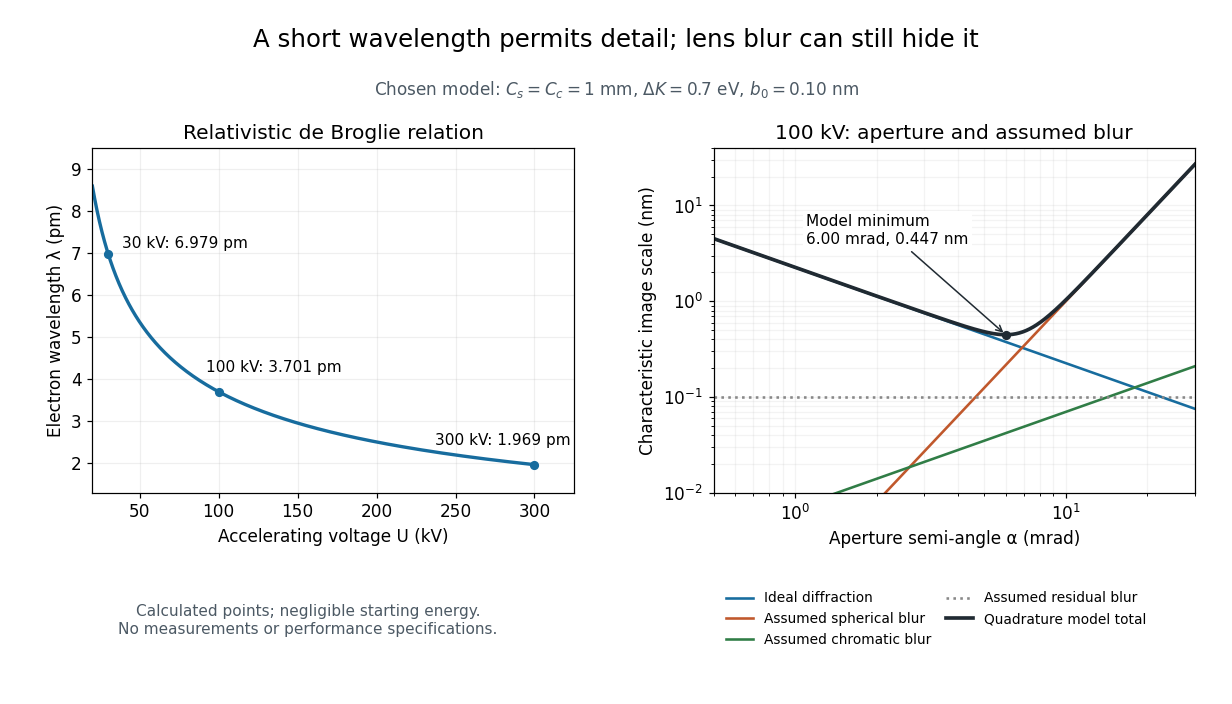
For an electron accelerated from negligible initial kinetic energy through a positive electric potential difference , combine , the relativistic energy-momentum relation and the de Broglie wavelength:Here is the Planck constant, the electron mass, the elementary charge, and the speed of light. This includes the relativistic correction omitted by the low-voltage electron accelerating-voltage wavelength approximation. With and SI defining values of , calculated wavelengths are approximately , and at , and respectively. The rounded mass agrees with the recommended value.[ref]
For a circular aperture admitting a small semi-angle , the Rayleigh criterion suggests a diffraction-limited resolution scale . At and , this gives , already much larger than the wavelength. This is an ideal aperture estimate. Transmission electron microscopy with coherent illumination and a particular specimen requires its own image-contrast analysis; this scale alone is not a universal two-feature resolution test.
An original illustrative blur model adds competing effects:Define as a characteristic transverse blur from the electron-lens analogue of spherical aberration, and as one from energy-dependent focusing, the analogue of chromatic aberration. The coefficients have units of length, is a chosen characteristic kinetic energy spread, and is a fixed residual blur. Adding their squares is a declared heuristic, not a measured point spread function or a rigorous resolution theorem. The model omits contrast transfer, specimen scattering and signal statistics, so its minimum is only an estimate within its assumptions.
Choose , and at . At , the four contributions are about , , and , giving . At , the diffraction contribution falls to but the assumed spherical aberration contribution grows to . Thus opening the aperture indefinitely worsens this model's image. All these values are calculations with chosen parameters, not observations of any microscope.
A useful motivating experiment moves a bead emitting fluorescence through the selected optical focus and records the detector signal against position. Measurement of point-spread function (PSF) for confocal fluorescence microscopy by InCheon Song and others (2005, §2 and Fig. 1) describes a laser delivered through a single-mode optical fiber, collimation, beam-size adjustment and a dichroic beam splitter. A , numerical aperture oil-immersion objective optical lens excites slide-mounted fluorescent beads and collects their emission. Emission passes a filter and collecting optical lens, then a pinhole, before an avalanche photodiode. A three-dimensional positioning stage moves the specimen. The apparatus also contains a phase plate for deliberately modified responses.[ref]
Measurement of point-spread function (PSF) for confocal fluorescence microscopy by InCheon Song and others. §2 and Fig. 1, pp. 2–3: apparatus and readout
The published comparison uses nominal bead diameters : larger beads give broader measured spots. This is a control on the finite emitter, because the image is the convolution of bead emission with the confocal point spread function. The smallest bead has weaker signal relative to noise; incorrect bead size, defocus, bleaching and optical aberrations limit inference from a restored response. The reported bead-size comparison concerns lateral responses; it is not a measured pinhole-size series or a measured sheet-sectioning curve.[ref]
To test axial pinhole selection with this kind of apparatus, the following is a proposed extension, not an additional result from that paper. Choose an isolated bead small relative to the response, centre it laterally, then step through optical focus while recording background-subtracted signal at several pinhole settings. Hold excitation power, dwell interval, detector gain, emission band and sampling fixed. Preserve raw peaks before also plotting peak-normalized traces. A lower peak and faster relative decay with axial displacement would support the paired-selection mechanism; fitting only normalized widths would miss the throughput cost.
Measure blocked-excitation background, include a bead-free region, avoid detector saturation, and repeat scans in reversed order to reveal drift or bleaching. Check pinhole centring separately, since misalignment can mimic signal loss. Record bead diameter, immersion medium, refractive index, numerical aperture, wavelengths and axial step. A finite bead is an approximation to an optical point source; a point trace does not certify confocal optical sectioning of a whole fluorescent sheet. Depth-dependent spherical aberration, scattering and sample motion can broaden or distort the response. Increasing magnification or making a display brighter does not correct those effects.
Newtonian telescope 2026-10-05
Optical aberration Created 2026-10-05 Updated 2026-10-14
An optical aberration is a departure from ideal image formation: light rays from one object point may miss their intended common image point, or image positions may depart from the intended mapping. Spherical aberration, coma, and astigmatism describe different ways of spreading a point's light rays; optical distortion can change image shape without spreading each point. In physical optics, these departures can be described by wavefront error relative to a reference wavefront. Diffraction also gives a finite point spread function in a perfect optical instrument, so an extended image alone does not establish an optical aberration.
Parabolic reflector 2026-10-25
A parabolic reflector has a paraboloidal reflecting surface. The law of reflection makes all incident light rays parallel to its optical axis pass through one focus in ideal geometrical optics. This removes on-axis spherical aberration and explains its use as a receiving antenna for distant sources.
Transmission electron microscopy accelerates electrons through a thin sample, then uses electron lenses to form an image or diffraction pattern. Elastic scattering encodes projected structure and potential; inelastic scattering carries excitation and chemical information. Thin specimens reduce unwanted multiple scattering and absorption, although coherent dynamical scattering can still matter in a crystal. High-resolution phase-contrast images depend on defocus and the transfer function as well as the specimen; they are not direct height maps.
The relativistic wavelength is . A shorter wavelength permits fine resolution but does not guarantee it. A schematic probe/image blur budget contains diffraction , spherical aberration and chromatic aberration , plus source size, instabilities, specimen motion and radiation damage. Optimizing the aperture angle balances these terms; increasing accelerating voltage can also alter damage and contrast.
Bright-field imaging accepts the central transmitted beam or its neighborhood. Regions that scatter electrons outside that acceptance can appear dark. Conventional dark-field imaging selects a diffracted beam. Annular dark-field electron imaging in a scanning TEM instead collects a range of scattered angles while a probe is scanned. A sufficiently high-angle detector often gives strong atomic-number sensitivity and more nearly incoherent contrast; thickness, channeling and detector geometry prevent a universal conversion of intensity to composition.
Electron energy loss spectroscopy measures energy lost by transmitted electrons. Core-ionization thresholds identify elements, while near-edge fine structure probes bonding and unoccupied states. At successive probe positions, one can record a spectrum image or form a map from a selected edge after background subtraction. Plural scattering, edge overlap, delocalization, specimen thickness and counting statistics limit the interpretation. Chemical specificity comes from excitation energies and spectral structure, not from brightness alone.
A development already established before this 2012 paper is aberration-corrected transmission electron microscopy: multipole correctors compensate leading lens aberrations, allowing useful larger angular acceptance and finer probes. Correction does not remove every chromatic, stability or specimen limit. A concrete application was atom-by-atom annular-dark-field analysis of monolayer boron nitride with substitutional defects, resolving chemical differences between sites in a nonuniform lattice.[ref]
Atom-by-atom structural and chemical analysis by annular dark-field electron microscopy by O. L. Krivanek and others. 2010, low-voltage aberration-corrected STEM of monolayer boron nitride
Combining structural maps with spatially resolved core-loss spectra supplies another route to distinguish composition and bonding at interfaces. Both exploit a calibrated imaging or spectroscopy response rather than assuming every visible spot is chemically self-identifying. Past exam of the mathematics course of the University of Cambridge 2018 iii Paper 338 1 b iii Solution Created 2026-10-03 Updated 2026-10-14
The Ritchey–Chrétien reflector follows the same folded path as a Cassegrain reflector, but both the concave primary and convex secondary are hyperbolic. Their conic constants and separation are chosen to cancel third-order spherical aberration and coma. The focal plane is behind the perforated primary.
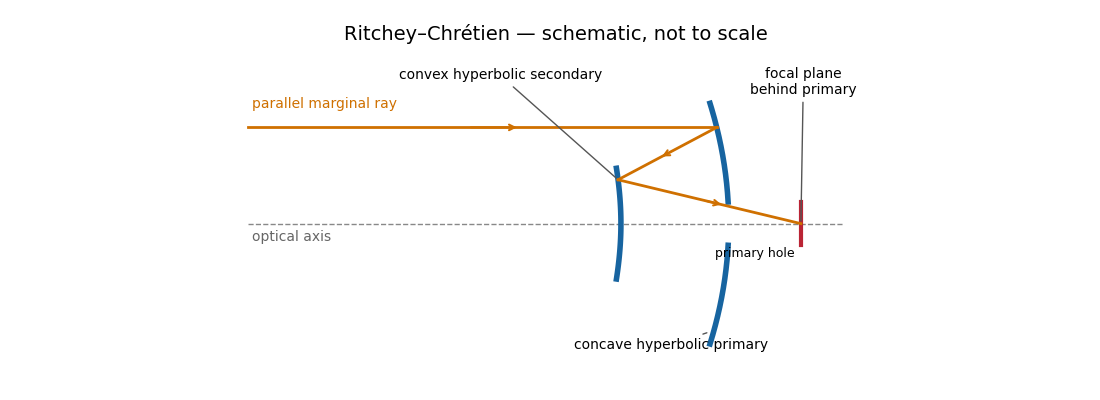
The absence of third-order coma gives a much more useful wide field than a classical Cassegrain reflector, making this design attractive for research imaging. It retains astigmatism and field curvature, so a large flat detector generally needs corrective optics; higher-order optical aberrations are not all removed. Both aspheric mirrors are more demanding to manufacture and align, and the usual secondary obstruction remains. The sketch illustrates the beam routing and mirror types; its conics are not an optimized aplanatic prescription.
Two hyperbolic mirrors give a compact system corrected for third-order spherical aberration and coma.
Past exam of the mathematics course of the University of Cambridge 2018 iii Paper 338 1 b ii Solution Created 2026-10-03 Updated 2026-10-14
In a classical Cassegrain reflector, a concave parabolic primary sends light toward an intermediate focus, but a convex hyperbolic secondary intercepts it before it reaches that focus. The secondary returns the beam through a central hole in the primary to a focal plane behind the primary. The two relevant foci of the secondary’s hyperbola are the primary’s would-be focus and the final focus.
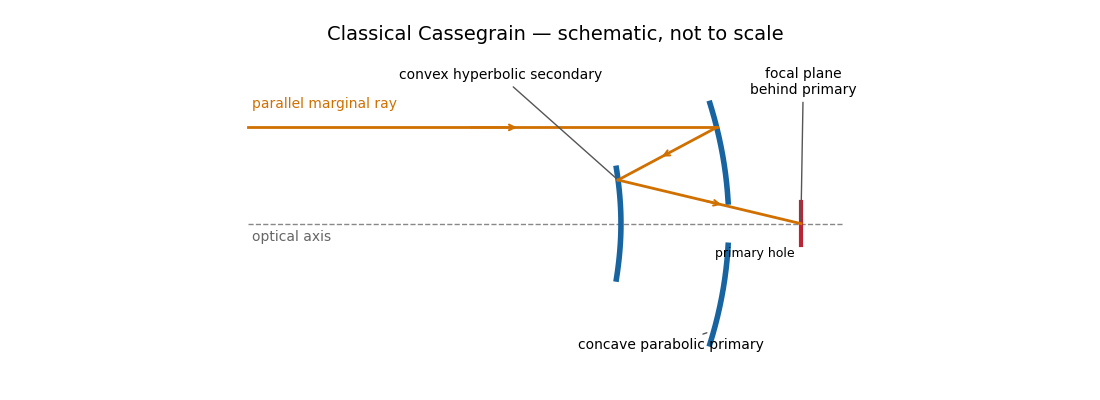
The secondary magnifies the effective focal length, giving a compact tube and convenient rear-mounted instruments. The classical conics correct on-axis spherical aberration, but not the off-axis coma, astigmatism or field curvature. There is secondary obscuration, diffraction from its supports, and sensitivity to mirror alignment. A long effective focal length is useful for a small angular image scale per detector pixel, but yields a small field for a fixed detector size.
Parabolic primary → convex hyperbolic secondary before prime focus → rear focus.
Past exam of the mathematics course of the University of Cambridge 2018 iii Paper 338 1 b i Solution Created 2026-10-03 Updated 2026-10-14
A Newtonian reflector uses a concave primary generated by a parabola, followed by a flat secondary inclined at to the optical axis. Parallel marginal rays converge toward the primary focus; the secondary intercepts that converging beam and folds it sideways to an accessible focal plane.
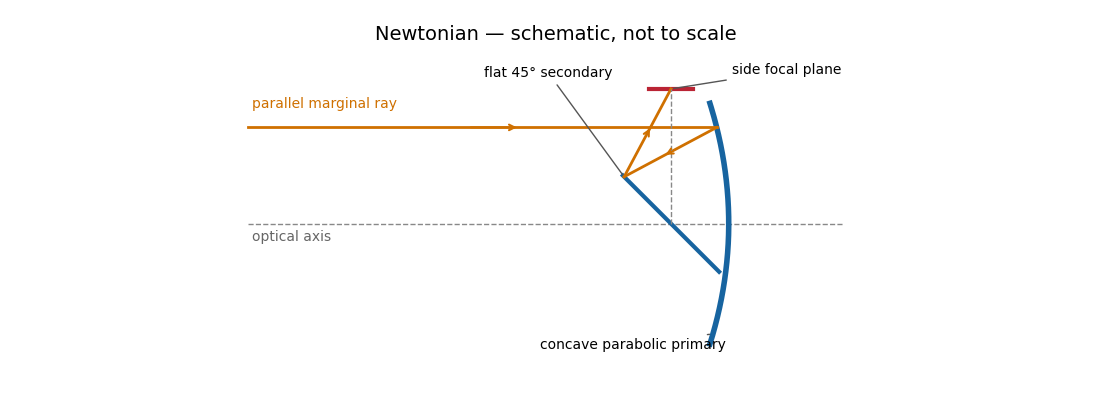
The Newtonian reflector needs only one powered mirror, so it is relatively simple to fabricate and inexpensive. A parabolic primary has no on-axis spherical aberration. Its principal wide-field limitation is coma, accompanied by field curvature and off-axis astigmatism. The diagonal and its supports obstruct the entrance pupil and introduce diffraction; the tube is long compared with a folded two-powered-mirror design, and heavy instruments at the side focus can be awkward to support. These comments also answer the unheaded design-comparison clause on the next PDF page.
Parabolic primary → flat diagonal → side focus.
Past exam of the mathematics course of the University of Cambridge 2018 iii Paper 338 1 b iv Solution Created 2026-10-03 Updated 2026-10-14
A classical Schmidt telescope combines a concave spherical primary with a thin aspheric corrector plate at its centre of curvature. The plate is also near the aperture stop. It supplies just the extra ray bending needed to cancel the mirror’s spherical aberration; rays then return toward an internal focus roughly halfway between the plate and primary. The native best-focus surface is curved, as indicated in red.
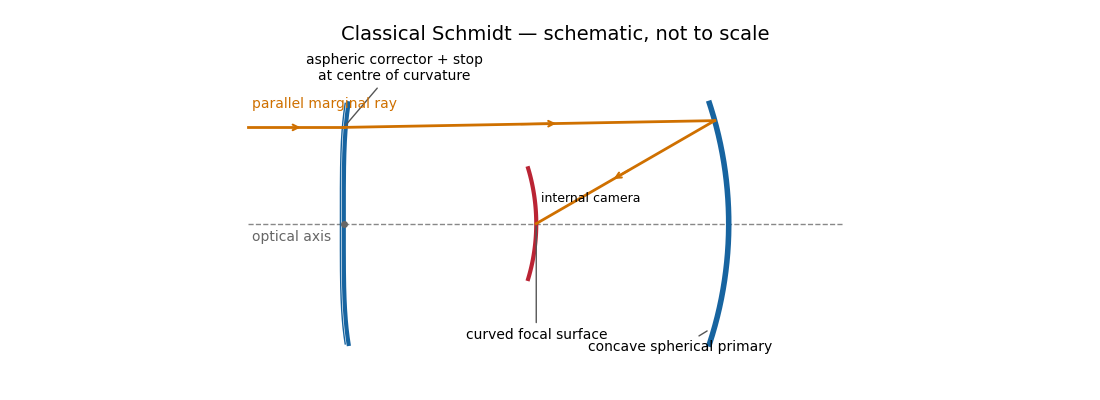


The spherical primary is easy to manufacture, and the stop at its centre of curvature gives a nearly symmetric optical geometry that suppresses coma and astigmatism over a large field. Fast Schmidt cameras are consequently excellent survey instruments. The costs are a long enclosed optical assembly, a large precision corrector, an internal camera that obstructs the beam, and a curved focal surface. A flat detector needs field flattening. The transmissive corrector introduces wavelength-dependent effects and transmission losses, unlike an entirely reflecting system.
Past exam of the mathematics course of the University of Cambridge 2019 iii Paper 338 2 a vii Solution Created 2026-10-03 Updated 2026-10-14
For the unnormalized Zernike polynomial with , the three radial terms areSince ,Along a central chord with signed coordinate , replace by . The profile is even, equals one at the center and both edges, and has minima at . This Zernike spherical mode corresponds to primary spherical aberration, balanced by defocus and piston terms rather than simply the raw quartic Seidel term.
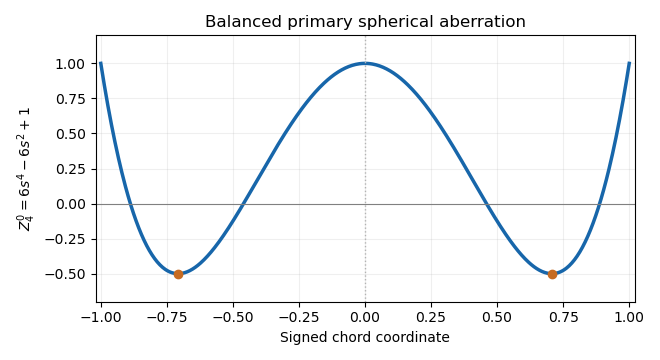
The unnormalized Zernike spherical mode on a central chord
. The even quartic has central and edge values one and two minima of minus one half. Its lower-order terms remove its projections onto piston and defocus. Details.
For a weak phase object, the contrast transfer function gives the signed transfer of an object's spatial Fourier components into intensity contrast. In a common convention,where is a cyclic spatial frequency, the defocus, the spherical aberration coefficient, and a coherence envelope. A zero suppresses that frequency; crossing a zero reverses contrast. The overall sign depends on the image convention, but the zeros do not. Single-image division by cannot recover information exactly at its zeros. The microscope manufacturer's discussion explicitly connects the first zero with interpretable resolution and the higher-frequency sign changes.[ref]
Phase-contrast transfer function, PCTF by JEOL. glossary, first-zero and envelope-function discussion
The plotted first nontrivial zero is at approximately . Hence the smallest spacing in the first uninterrupted contrast band is about . This axis is cycles per length, not an angular wave number requiring a factor of . Smaller spacings can contribute in later bands, but their contrast has reversed and requires appropriate interpretation or multiple-defocus reconstruction.
Increasing the angular acceptance can collect higher spatial frequencies, but rays at large angles and away from the optical axis are harder to bring to the same focus. Spherical aberration, coma, astigmatism and field curvature can degrade contrast across a large exposure field. The depth of focus also decreases approximately as , making wafer height errors more important. A larger geometrical aperture is therefore not automatically better over the whole wafer field.
Immersion lithography raises by increasing the refractive index of the medium between the final lens and wafer. A suitable UV-transparent liquid permits a larger numerical aperture without increasing the ray angle by the same factor, easing the purely geometrical demand on the lens. Lens design and focus control remain necessary; immersion does not abolish aberrations. The liquid must also be compatible with the resist and free of bubbles and contamination, and absorption at must be low.
A distant satellite supplies an approximately collimated incident beam. A concave spherical mirror of radius of curvature has paraxial focal length . Put the receiving feed at the principal focus, on the optical axis in front of the dish:The radius of curvature relation is a paraxial approximation. A practical dish is usually a parabolic reflector, which focuses an on-axis collimated beam without spherical aberration; a literal spherical dish has spherical aberration, so an exact optimum over its full aperture would need a specified focusing criterion.
Real image 2026-10-14
A real image lies where the outgoing light rays from each object point actually intersect in geometrical optics. A screen or detector placed at that image plane receives the focused pattern. The screen reveals the real image; it does not create the intersection. A viewer can also see a real image without a screen if their eye receives the diverging light rays beyond the intersection. [ref]
https://openstax.org/books/college-physics-2e/pages/25-7-image-formation-by-mirrors. Urone and Hinrichs, College Physics 2e, §25.7: Real images and their observation
.For a converging thin lens and real object with , the real image has and signed transverse magnification . Inversion is a property of this particular setup, not the definition of a real image. With and , the following are predictions:
| Object distance | Image distance | Transverse magnification | Signed image height |
|---|---|---|---|
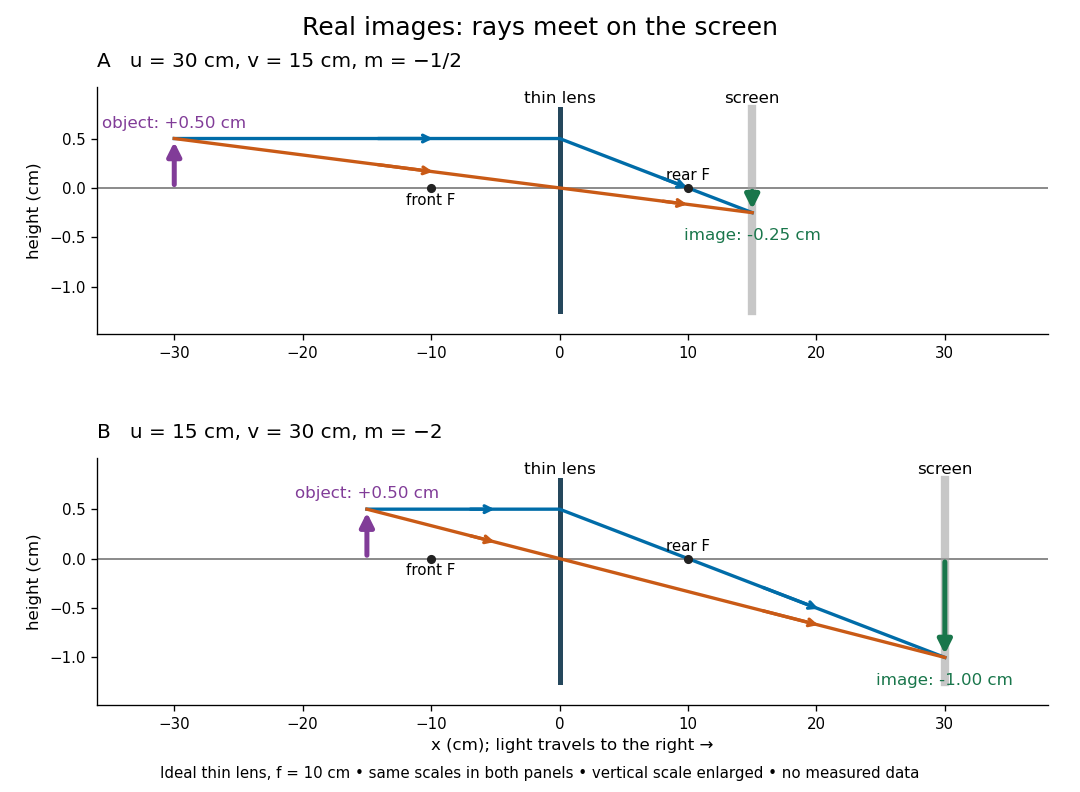

To test both image position and transverse magnification, use an optical bench with an illuminated arrow or millimetre target, a converging optical lens of nominal focal length , a movable white screen and a ruler. Measure corresponding target and image intervals, rather than guessing the whole image size when it exceeds the screen. PASCO's Experiment 12 compares distance-based and size-based magnification; the following procedure uses several object distances, as in the Northern Virginia laboratory. [ref]
https://tecnoedu.com/recursos/UNLCHidrologia/ManualesOriginalesPasco/Basic-Optics-System-Manual-OS-8515C.pdf. PASCO, Basic Optics System manual, Experiment 12, pp. 33–36
; [ref].- Align target centre, optical lens centre and screen along one optical axis, with target and screen perpendicular to it. Record bench positions of the actual target plane, optical lens plane and screen surface; distances between holder edges introduce an offset.
- Start at . Move the screen through the expected region until the target's central detail is sharpest. Record , measured , the corresponding target and image intervals, and whether the arrow is inverted. Give the measured size ratio a negative sign if inverted.
- Repeat at and . Compare the measured signed size ratio with , and calculate for each pair. The three ideal rows above are predictions to compare against, not entries to copy into the measurement record. [ref]https://sites.nvcc.edu/alphy/_files/Manuals/Physics%20242%20Lab%2011%20-%20Thin%20Lenses.pdf. Northern Virginia Community College, Physics 242 Lab 11, pp. 2–4: screen focusing, orientation and size measurements.
Keep the optical lens, illumination and central target detail fixed between trials. Approach best focus from both sides and record the interval over which sharpness is difficult to distinguish; repeat focusing to estimate its reproducibility. A modest central aperture stop tests whether peripheral light rays change the result, but also reduces brightness. Spherical aberration, chromatic aberration and diffraction can broaden the optimum; a thick optical lens also makes the chosen reference plane imperfect. Treat nominal as an initial prediction, and report position and interval-reading limits instead of forcing exact agreement. [ref]
https://www.feynmanlectures.caltech.edu/I_27.html. Feynman, Leighton and Sands, §§27-5–27-7: principal planes and imaging limits
.Moving the object toward the front optical focus from outside makes the real image larger and farther away. A failed screen search near can therefore mean that the real image is beyond the bench, rather than that a virtual image has formed. At exactly , the outgoing bundle from each point is parallel and no finite screen position focuses it.