An original reduced model makes the cancellation explicit. Assume LS coupling, neglect nuclear spin, and write the electronic magnetic dipole moment as . For , , the projection used to derive the Landé g-factor givesThese coefficients follow by substituting or into the angular-momentum projection formula; neither level measures pure spin alone. In a weak uniform magnetic field, adjacent electronic projections have spacing when . ThereforeThe common magnetic field and Bohr magneton cancel. The ratio determines , not without further knowledge of . For , it gives . Small departures from are magnified differently from small departures of from ; the two fractional changes should not be identified.
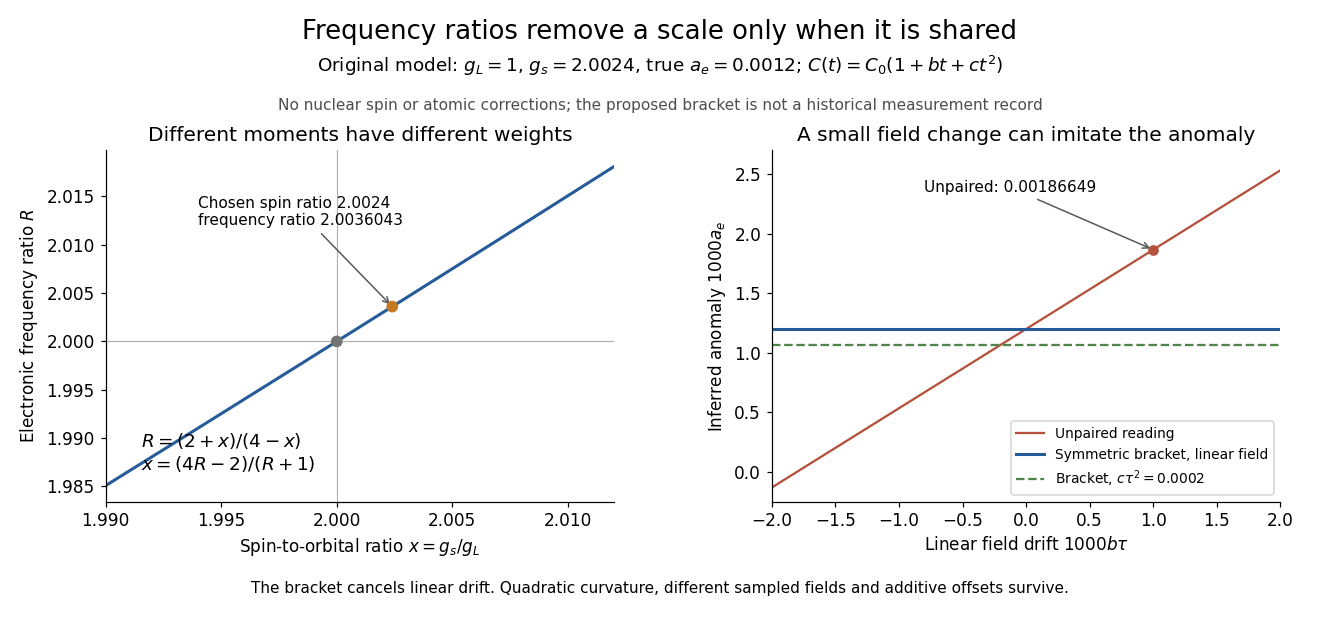
With the stipulated inputs , and , the two electronic frequencies are and . Their ratio is approximately , and inversion recovers . These are ideal electronic lines, not historical gallium data. Nuclear spin, mixing between levels and other deviations from LS coupling require a more complete model in an actual atom.
Even a shared field does not cancel if it is sampled at different times. Write and , where . As an original proposed diagnostic, bracket the -state reading at with -state readings at :If , the denominator is exactly , so . A single earlier reading instead gives . For the preceding numerical model and , this unpaired comparison falsely gives approximately ; interpolation recovers . The sequence illustrates cancellation and is not asserted to be Kusch and Foley's exact historical timing protocol.
Cancel a shared calibration scale without hiding its limitations
. Original calculations for spin-orbit g-factor ratio from two P states and drift cancellation in a g-factor comparison. All inputs are stipulated. The left plot shows the nonlinear inversion from a frequency ratio to a spin-to-orbital g-factor ratio. The right plot contrasts an unpaired reading with a symmetric bracket under linear field drift; the dashed curve adds chosen quadratic curvature . No curve is a measured resonance or a historical fit. Details.
For a curved field , the same calculation givesThe linear drift cancels but the curvature remains. Different fields sampled by the two beams, additive frequency offsets and incorrect atomic corrections also survive. For a small ratio error , direct differentiation of the inverse relation givesRepeated readings can reduce random measurement uncertainty; agreement among genuinely different state comparisons is what tests shared systematic errors in their interpretation.
Articles by others on the same topic
There are currently no matching articles.