The electron magnetic moment couples an Electron's angular momentum to a magnetic field. Its intrinsic spin contribution isHere is the Bohr magneton, and is the positive electron spin g-factor under this sign convention. The minus sign makes magnetic dipole moment antiparallel to spin angular momentum. An Electron in a chemical atom can also contribute an orbital magnetic dipole moment; the measured response of a whole atomic level combines these contributions.
Measuring a tiny departure of from tests how well a theory predicts an Electron's interaction with its surroundings. The Dirac equation gives before radiative corrections; the anomalous magnetic moment makes a small correction experimentally accessible.[ref]
The magnetic moment of the electron by Polykarp Kusch. pp. 299–300: spin moment and Dirac prediction
A useful strategy is to compare two atomic energy levels whose orbital and spin contributions have different weights, rather than trying to calibrate an absolute magnetic field more accurately.The dimensionless coefficient in the spin part of the electron magnetic moment. It is distinct from a gyromagnetic ratio, which has units: in the angular convention, . It is also distinct from the Landé g-factor of a combined atomic angular momentum and from a nuclear or hyperfine g-factor.
For spin one-half, the largest magnitude of a spin-component magnetic dipole moment is , not . Thus the ideal value gives one Bohr magneton. This follows directly from the spin angular momentum projections .
Polykarp Kusch and Henry Michael Foley compared hyperfine structure resonance frequencies for different electronic states of gallium, indium and sodium. Their 1948 paper reports mutually consistent departures from the ratios expected with orbital factor and spin factor . Comparing several states constrained the alternative explanation of perturbed atomic levels.[ref]
The Magnetic Moment of the Electron by Polykarp Kusch and Henry Michael Foley (1948). Abstract: atomic states, frequency comparisons and interpretation
The Rabi molecular beam magnetic resonance experiment explains the readout principle: a resonant transition changes an atom's magnetic response, and hence its transmitted beam signal. Kusch describes rapidly interchangeable ovens, several radio frequency oscillators and careful field homogenization. Measurements taken during monotonic field drift were reduced to a common field.[ref]
The magnetic moment of the electron by Polykarp Kusch. pp. 303–304: resonance analysis, ovens, oscillators and field drift
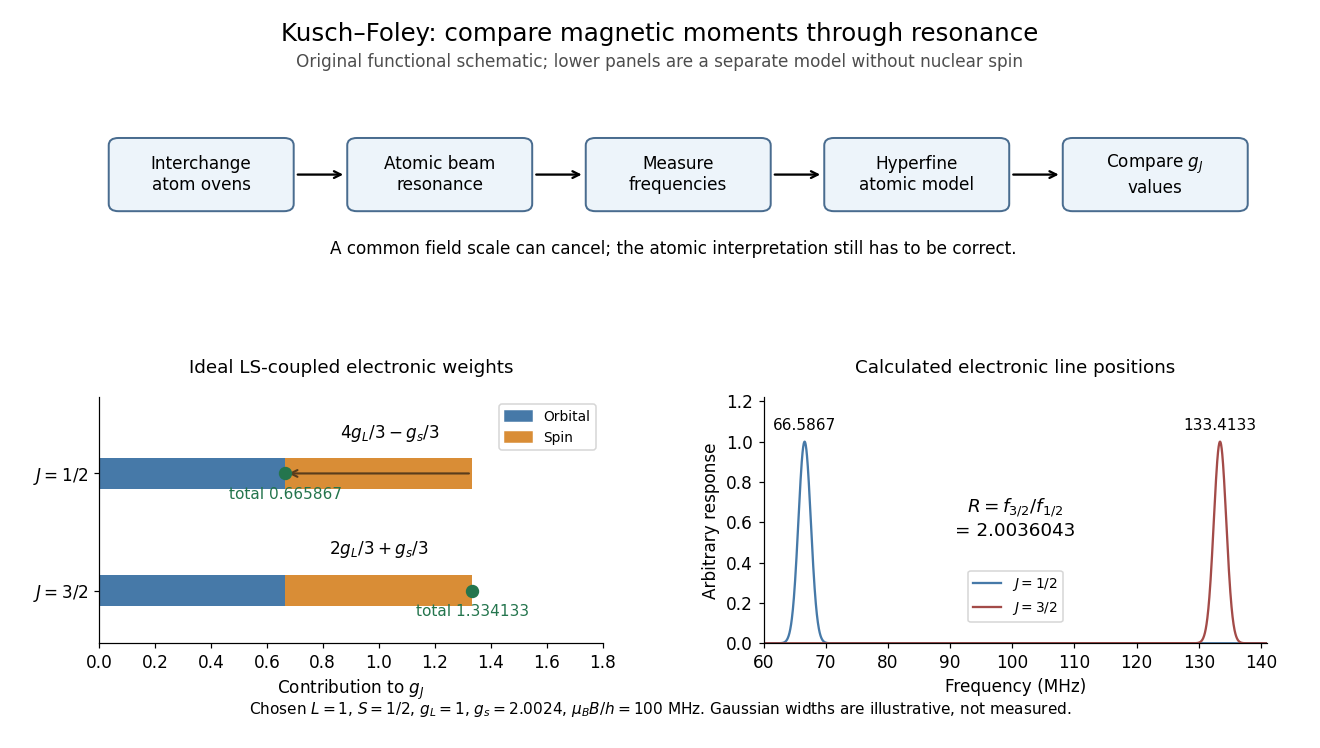
Compare differently weighted atomic magnetic moments
. Original functional diagram of the Kusch-Foley magnetic moment experiment and a separate ideal LS coupling calculation. The upper flow identifies the functions of beam preparation, resonance readout and atomic modeling; it is not a surviving apparatus drawing. The lower weights are calculated for , , and chosen , without nuclear spin. The frequencies in the teaching model cannot be substituted directly for measured hyperfine lines. Details.Real hyperfine structure lines are not simply bare electronic times field. Nuclear magnetic moments, known interaction constants and nonlinear field dependence enter the inference.[ref]
The magnetic moment of the electron by Polykarp Kusch. pp. 303–305: hyperfine modeling and atomic-state perturbations
Field homogeneity controls line broadening; alternating species addresses drift. Neither control removes an error in the atomic model. The beauty of the comparison is the separation of two problems: cancelling a shared calibration scale and testing whether several physical systems imply the same electron spin g-factor.An original reduced model makes the cancellation explicit. Assume LS coupling, neglect nuclear spin, and write the electronic magnetic dipole moment as . For , , the projection used to derive the Landé g-factor givesThese coefficients follow by substituting or into the angular-momentum projection formula; neither level measures pure spin alone. In a weak uniform magnetic field, adjacent electronic projections have spacing when . ThereforeThe common magnetic field and Bohr magneton cancel. The ratio determines , not without further knowledge of . For , it gives . Small departures from are magnified differently from small departures of from ; the two fractional changes should not be identified.
With the stipulated inputs , and , the two electronic frequencies are and . Their ratio is approximately , and inversion recovers . These are ideal electronic lines, not historical gallium data. Nuclear spin, mixing between levels and other deviations from LS coupling require a more complete model in an actual atom.
Even a shared field does not cancel if it is sampled at different times. Write and , where . As an original proposed diagnostic, bracket the -state reading at with -state readings at :If , the denominator is exactly , so . A single earlier reading instead gives . For the preceding numerical model and , this unpaired comparison falsely gives approximately ; interpolation recovers . The sequence illustrates cancellation and is not asserted to be Kusch and Foley's exact historical timing protocol.
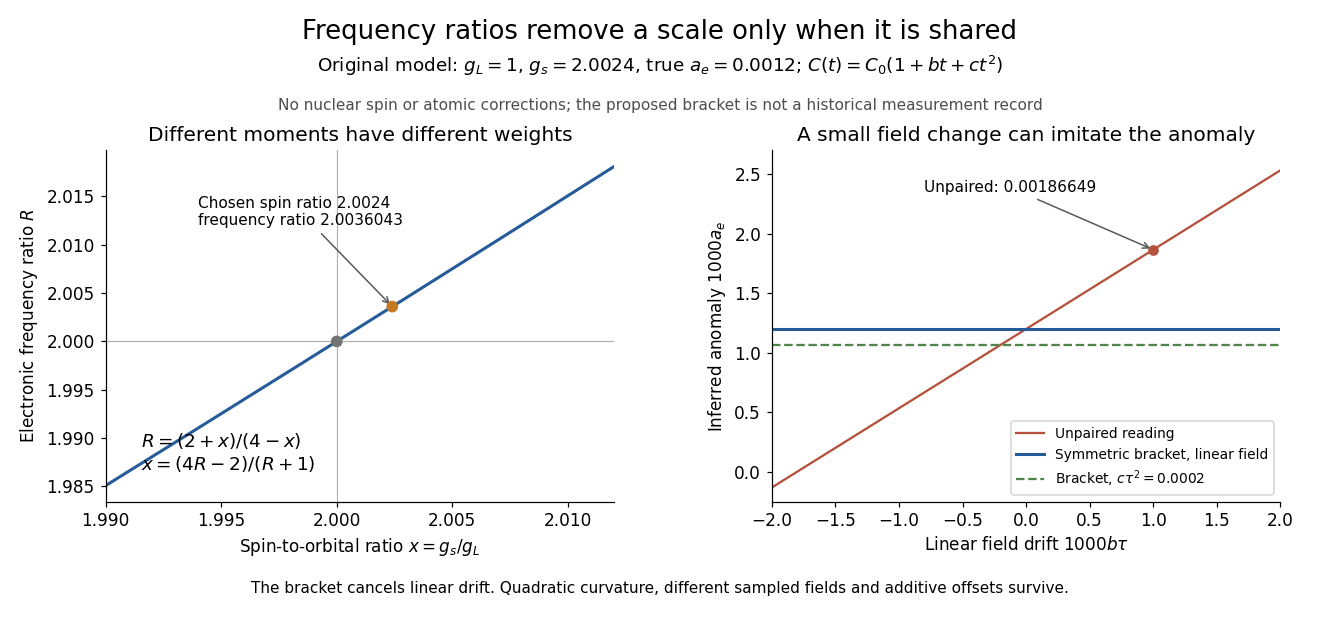
Cancel a shared calibration scale without hiding its limitations
. Original calculations for spin-orbit g-factor ratio from two P states and drift cancellation in a g-factor comparison. All inputs are stipulated. The left plot shows the nonlinear inversion from a frequency ratio to a spin-to-orbital g-factor ratio. The right plot contrasts an unpaired reading with a symmetric bracket under linear field drift; the dashed curve adds chosen quadratic curvature . No curve is a measured resonance or a historical fit. Details.For a curved field , the same calculation givesThe linear drift cancels but the curvature remains. Different fields sampled by the two beams, additive frequency offsets and incorrect atomic corrections also survive. For a small ratio error , direct differentiation of the inverse relation givesRepeated readings can reduce random measurement uncertainty; agreement among genuinely different state comparisons is what tests shared systematic errors in their interpretation.
Articles by others on the same topic

The electron magnetic moment is a fundamental property of electrons that describes their behavior in a magnetic field. It can be thought of as a measure of the strength and orientation of an electron's intrinsic magnetic field, which is linked to its spin and charge. ### Key points about the electron magnetic moment: 1. **Intrinsic Property**: The electron magnetic moment arises from two key factors: the electron's electric charge and its spin. It is a quantum mechanical property that does not depend on the electron's motion.


