For a qubit, use the dimensionless Pauli matrices as observables , . Their Pauli matrix multiplication law givesThese observables have eigenvalues ; the physical spin components are , where is the reduced Planck constant, so their standard deviations acquire a factor .
In the computational basis, prepare , an eigenstate of with eigenvalue . Direct multiplication givesBoth Pauli measurements return and with equal probabilities, and the Robertson uncertainty principle is saturated: .
Instead prepare . Now the expectation values are , , so , . The Pauli measurement of is certain, and both sides of the bound vanish. The commutator is still nonzero as an operator: noncommuting observables do not guarantee a positive lower bound independent of the quantum state. This example is useful for distinguishing the algebra of the observables from the expectation values in a particular preparation.
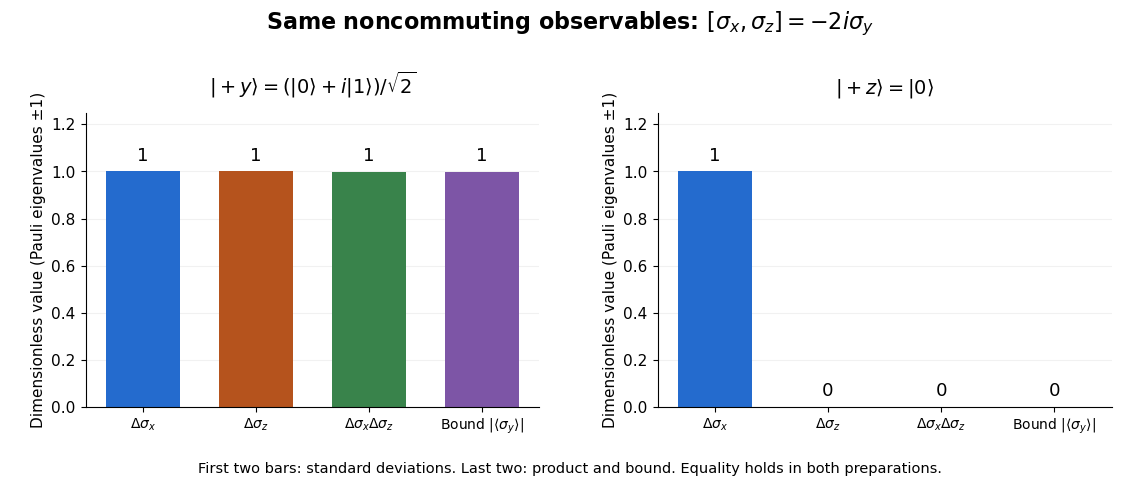
Pauli standard deviations, their product, and the Robertson bound in two preparations: the same noncommuting observables give bounds of one and zero
. Details. 
Articles by others on the same topic
There are currently no matching articles.