Let be an inverse length. In three spatial dimensions, seek the Green's function that decays at infinity and satisfieswhere is the Laplacian and the three-dimensional Dirac delta function. The point source and the differential operator have spherical symmetry. For , the radial Laplacian givesWriting reduces this to . Decay at infinity removes the growing exponential function, leaving .
The Dirac delta function fixes the coefficient. Integrating over a ball and using the divergence theorem givesThe first term tends to , while the second is . Hence andThis solves the source equation in the sense of distributions, including at the origin. Merely verifying the equation for would leave the normalization undetermined. The limit at fixed is , the Green function of the Laplacian for the convention .
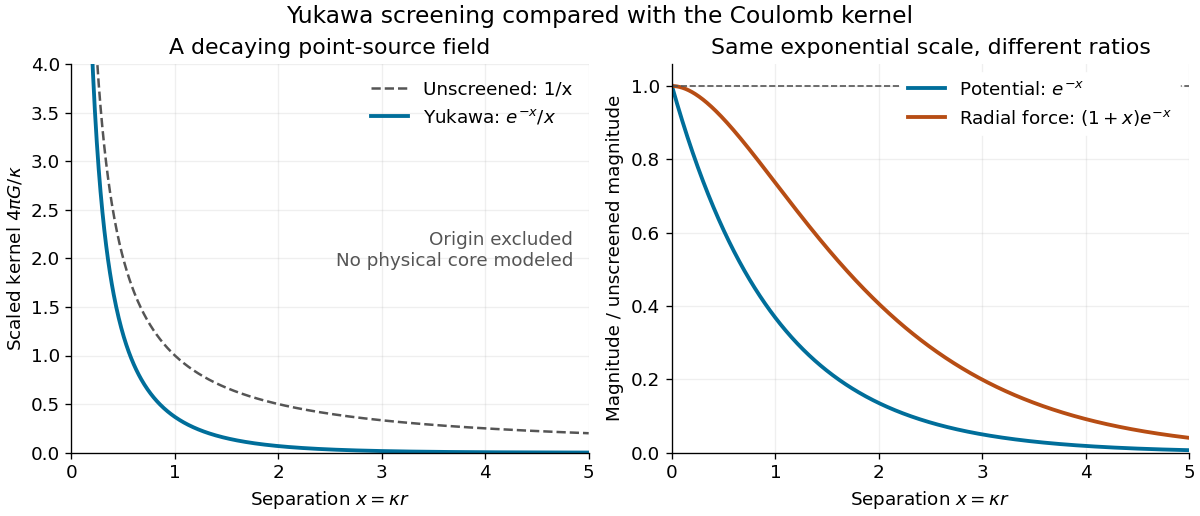
For an attractive scalar toy interaction, absorb constants into and setHere has units of energy times length, and negative points inward. At equal , comparison with the unscreened model givesThus the potential energy and force have the same exponential scale but different suppression factors. At , these ratios are approximately and ; at , they are and . Finite range means rapid decay, not an abrupt cutoff.

Articles by others on the same topic
There are currently no matching articles.