In 1935, Hideki Yukawa proposed a new massive exchange quantum to explain nucleon binding. His paper began with the inadequacy of an Electron–neutrino exchange description of the binding strength. It then required a potential energy falling faster with distance than a Coulomb potential, introduced an exponentially decaying field, and related its inverse range to the exchange particle's rest mass. This was a theoretical proposal, not a detection with an apparatus of his own.[ref]
On the Interaction of Elementary Particles. I by Hideki Yukawa. On the Interaction of Elementary Particles. I, opening motivation, equations (1)–(3) and (12); text inspected in a retypeset mirror
The crucial idea is that a finite rest mass supplies a length scale even in empty space. In a scalar model, the static limit of a Klein-Gordon equation produces the modified Helmholtz equation. Its decaying Green's function gives the Yukawa potential. The derivation below isolates this range mechanism; one-pion exchange also carries spin and isospin structure.
The nuclear emulsion track experiment used developed photographic emulsions exposed to cosmic rays and inspected microscopically. Stopping pions gave daughter muon tracks with closely grouped ranges. Comparing penetrating muons with pion-induced nuclear breakup distinguished their interactions; this was not a direct static force measurement. The muon is a lepton, not Yukawa's strongly interacting meson.[ref]
The Cosmic Radiation by Cecil Frank Powell. The Cosmic Radiation, printed pp. 144–145 and 151–152, especially Fig. 5; inspected in the Columbia-hosted Nobel volume
Let be an inverse length. In three spatial dimensions, seek the Green's function that decays at infinity and satisfieswhere is the Laplacian and the three-dimensional Dirac delta function. The point source and the differential operator have spherical symmetry. For , the radial Laplacian givesWriting reduces this to . Decay at infinity removes the growing exponential function, leaving .
The Dirac delta function fixes the coefficient. Integrating over a ball and using the divergence theorem givesThe first term tends to , while the second is . Hence andThis solves the source equation in the sense of distributions, including at the origin. Merely verifying the equation for would leave the normalization undetermined. The limit at fixed is , the Green function of the Laplacian for the convention .
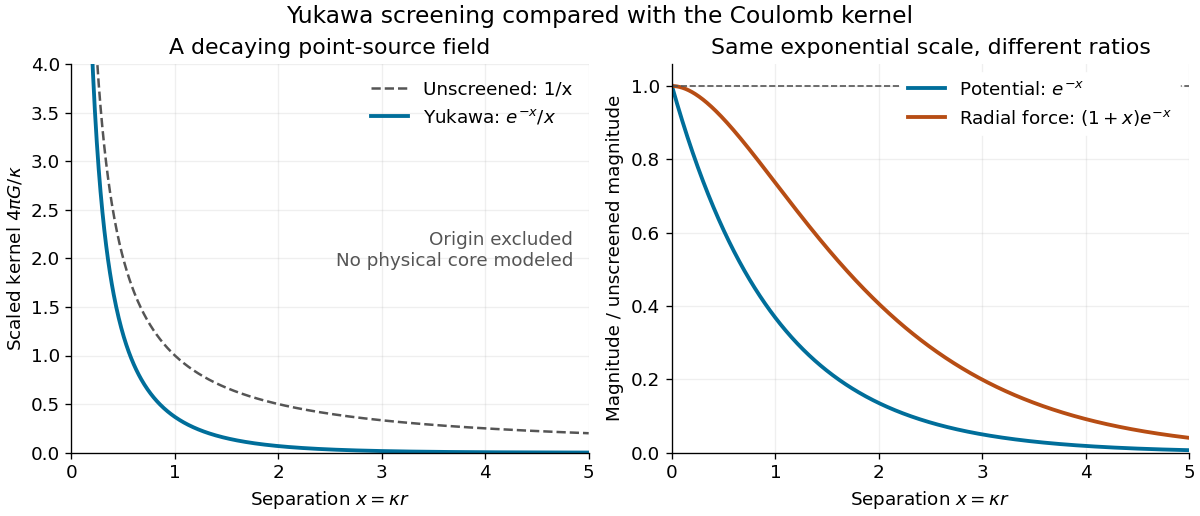
For an attractive scalar toy interaction, absorb constants into and setHere has units of energy times length, and negative points inward. At equal , comparison with the unscreened model givesThus the potential energy and force have the same exponential scale but different suppression factors. At , these ratios are approximately and ; at , they are and . Finite range means rapid decay, not an abrupt cutoff.

A free scalar Klein-Gordon equation with rest mass isHere is the speed of light and the reduced Planck constant. In the static limit, comparison with the static Yukawa Green function identifiesThis is the reduced Compton wavelength, rather than ; the two differ by . It is an exponential decay length of this exchange field, not the geometric size of a nucleon or an exact radius of a bound state. This article uses for a length; the 1935 paper used that letter for its inverse.
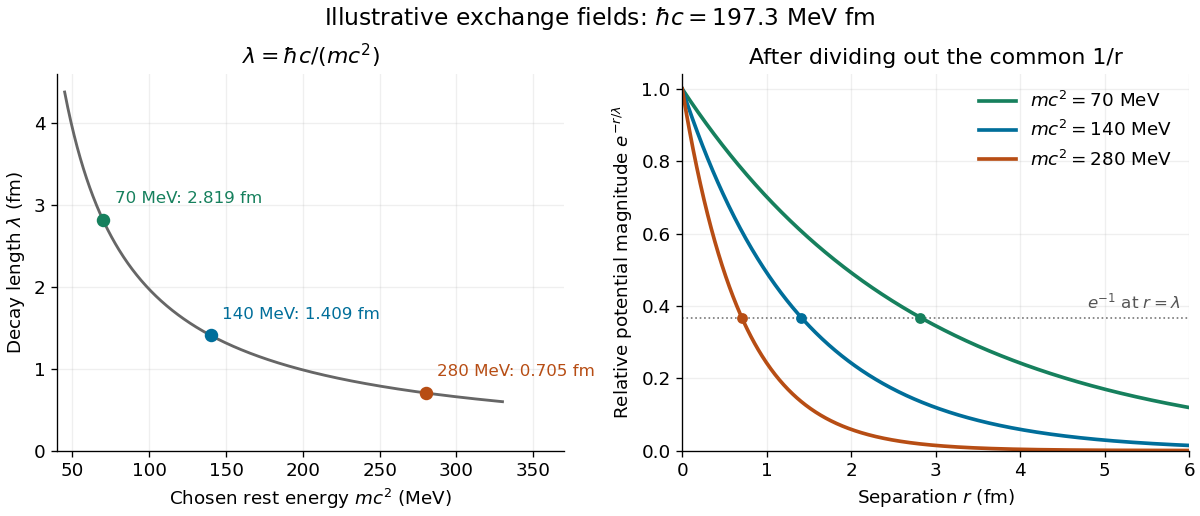
For a deliberately rounded worked example, stipulate and . ThenA femtometre is . The chosen rest energy is a convenient pion-scale input; neither it nor the resulting Yukawa potential is asserted to be an exact measured nuclear interaction. Holding fixed, chosen rest energies , and give lengths , and . Doubling the exchange rest mass halves the decay length.

Range alone does not guarantee binding: the potential energy must overcome the kinetic energy cost of localizing a wavefunction. The existing exponential variational bound for the Yukawa potential makes this precise. For the same toy , with reduced mass , choosing a normalized exponential wavefunction proportional to with yieldsFor additional stipulated inputs and , this gives . A negative value proves a bound state in this scalar model by the quantum variational principle; it is an upper bound on its ground-state energy, not a prediction for the deuteron. A nonnegative trial value would not prove the absence of binding.
Articles by others on the same topic
There are currently no matching articles.