Take independent random variables , each with the continuous uniform distribution on , and set . Then , and the events are mutually independent events. The product probability space supplies a model for the entire infinite sequence; a finite list of simulated values is only an illustration.
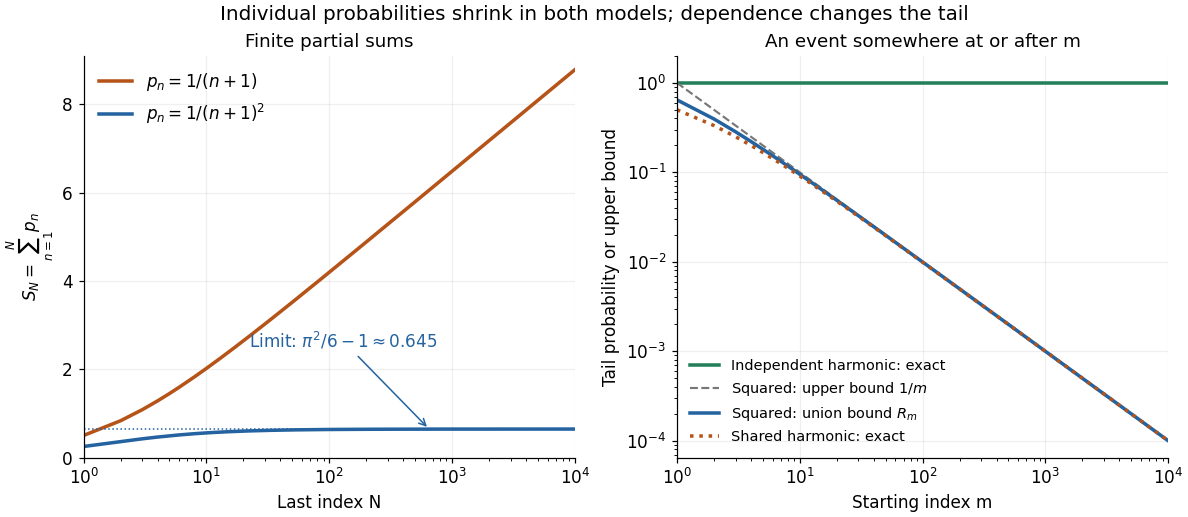
For , the p-series is summable:The Basel problem supplies the total sum, and the integral test for convergence gives the displayed tail bound. The First Borel-Cantelli lemma makes the limsup of events have probability zero. In fact, the tail bound implies that the probability of even one alarm at or after is at most ; for , it is at most . This bound remains valid for dependent events with the same individual probabilities.
For , the harmonic series diverges, so the Second Borel-Cantelli lemma makes the limsup of events have probability one. There is also an exact finite-horizon calculation using independent events:For any fixed , this finite product of numbers tends to zero as . Every infinite tail therefore contains an alarm almost surely, even though the individual probabilities tend to zero.

Articles by others on the same topic
There are currently no matching articles.