The same initial distance can lead to strikingly different orbits. Let and launch tangentially in one orbital plane. Then periapsis is the launch point, specific angular momentum is , andwhere is true anomaly. These follow by combining the initial specific orbital energy with the orbital eccentricity relation and the Kepler orbit equation. With and , the initial speeds , , , and give : a circular orbit, an elliptic orbit with apoapsis distance , a parabolic trajectory, and a hyperbolic Kepler orbit. The two open paths have asymptotic speeds zero and respectively. Their different directions at large distance are part of the Kepler orbit, not an extra scalar escape threshold.
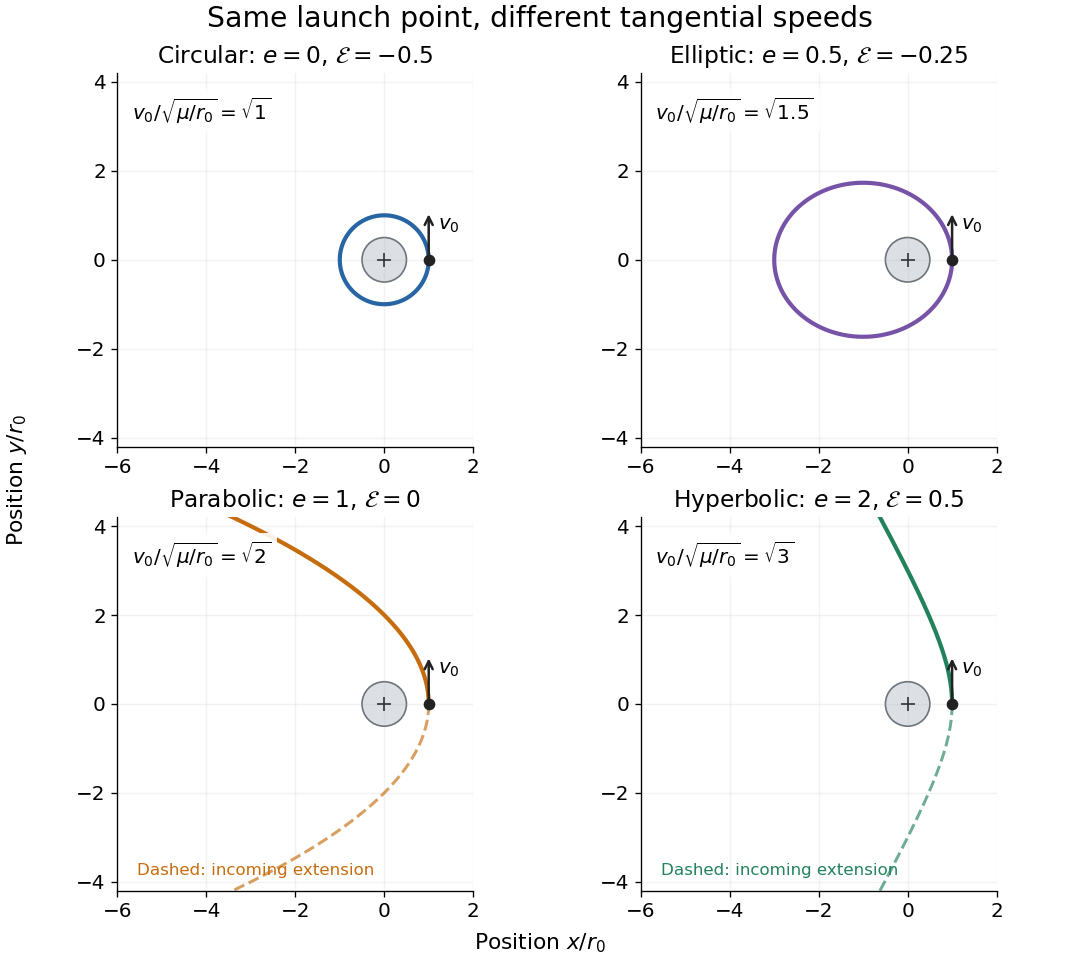
Tangential launches give circular, elliptic, parabolic, and hyperbolic Kepler orbits
. All panels use equal spatial scales, a fixed attracting centre at the origin, a launch point , and an initially upward velocity. The gray body's radius is stipulated as , so all displayed paths remain exterior. Colored solid curves follow motion after launch; dashed curves on the open orbits are their incoming extensions, not an additional part of the launch. Open curves continue beyond the viewing window. The normalized launch speeds and specific orbital energies are computed from the stated isolated model. Details.
Articles by others on the same topic
There are currently no matching articles.