
Gravity deflection of an atomic beam 2026-10-18
Immanuel Estermann, O. C. Simpson and Otto Stern used gravitational deflection to measure atomic speeds. Stern describes scanning a hot-wire surface ionization detector through a cesium beam and recording ion electric current.[ref]
The Method of Molecular Rays by Otto Stern. The method of molecular rays, lecture 12 December 1946, pp. 9–11: collaborators, falling beam and ion-current readout
Their 1947 paper reports potassium and cesium beams; a deficit of slow arrivals increased with oven pressure, supporting a source-slit collision explanation.[ref]The Free Fall of Atoms and the Measurement of the Velocity Distribution in a Molecular Beam of Cesium Atoms by Immanuel Estermann, Oliver Cecil Simpson, and Otto Stern. Estermann, Simpson and Stern, Physical Review 71 (15 February 1947), p. 238, abstract: gravity deflection, modified Maxwellian distribution and pressure-dependent slow-atom deficit
First consider an original point-launch model, with horizontal speed , zero initial vertical velocity, flight distance , and uniform gravitational acceleration . Downward displacement follows from flight time :Slow particles fall farther. However, a detector scan counts arrivals per interval of height, not per interval of speed. Change of variables for probability densities supplies the Jacobian determinant:Here denotes the effusive beam speed distribution; the unadorned constant in denotes gravitational acceleration. The integral of is one: substituting reduces it to . Its mode is . Simply mapping the most probable arrival speed into a fall distance instead gives . The peaks differ because equal height bins cover unequal speed intervals.
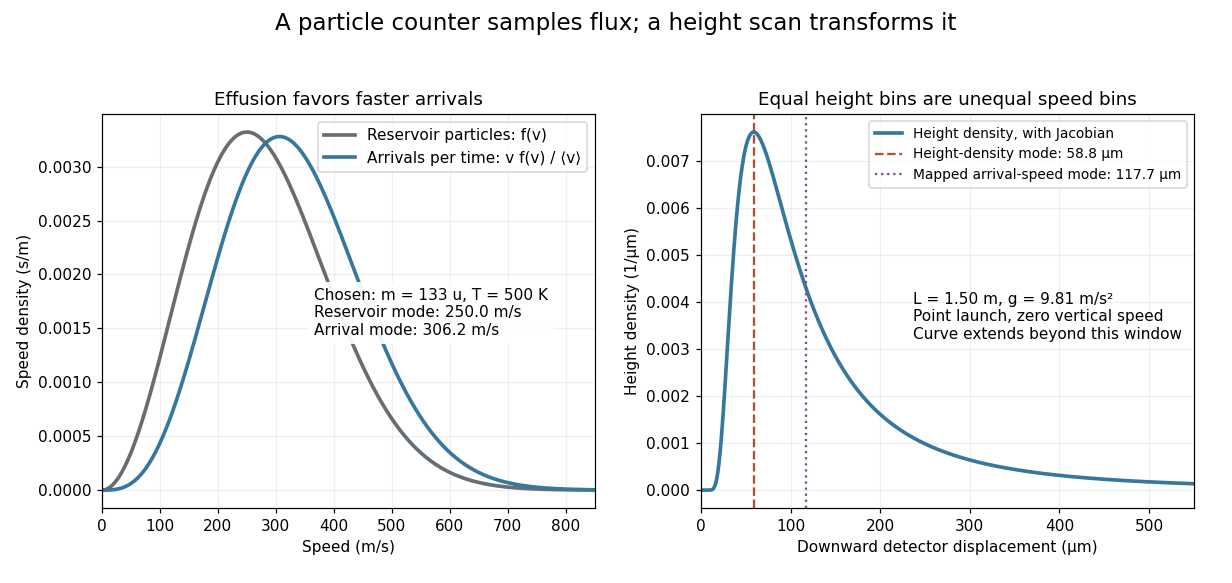
Effusion changes the arrival speed distribution, and a detector-height scan requires another Jacobian determinant
. Original calculated distributions with chosen , , and . These are not historical measurements. Details.
For those chosen parameters, , so the detector-height probability density peaks near . A detector covering only accepts the fractionAt this is about , even before allowing for imperfect detection. Discarding the remainder changes the observed normalization.
Real slits transmit a range of launch heights and vertical velocities. Their geometrical response must be combined with the gravitational deflection and detector width; the point-launch formula is not an exact reduction of the historical apparatus. In the point-launch model, an initial vertical velocity would add to . Source collisions, detector efficiency and alignment can also distort a profile. Varying oven pressure helps distinguish such source losses from an incorrect thermal distribution; inferring a source temperature from the peak alone ignores both selection and the detector's coordinate transformation.
Immanuel Estermann Created 2026-10-18 Updated 2026-11-05
An experimental atomic physicist who coauthored measurements of the gravitational deflection of long atomic beams. Slower potassium and caesium chemical atoms spend longer in flight and fall farther; the beam's vertical intensity profile therefore reveals its velocity distribution. The experiment turned a small gravitational displacement into a measurement of thermal beam statistics.[ref]
The Free Fall of Atoms and the Measurement of the Velocity Distribution in a Molecular Beam of Cesium Atoms by Immanuel Estermann, Oliver Cecil Simpson, and Otto Stern. Abstract: gravitational deflection and modified Maxwellian velocity distribution
Oliver Cecil Simpson Created 2026-10-18 Updated 2026-11-05
Oliver Cecil Simpson coauthored atomic-beam measurements using gravitational free fall to investigate the velocity distribution of cesium atoms. Gravity makes a particle's displacement depend on its travel time, so slower atoms are deflected more during a given path. For an ideal horizontal flight of length at speed , the downward displacement is . The measurement connects a beam's spatial distribution with its microscopic velocities, using gravity as a timing-dependent probe.[ref]
Physics and solid state science.[ref]
https://physicstoday.aip.org/obituaries/oliver-cecil-simpson. Independent professional profile
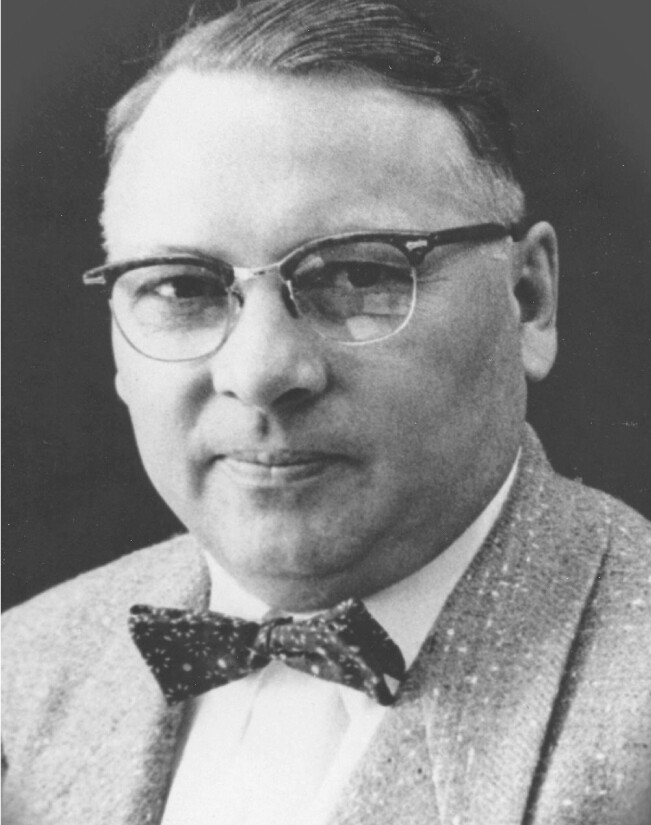
Portrait of Oliver Cecil Simpson
.