Let be the number of projectiles actually incident on the foil during an exposure, its foil areal number density, and the probability of detecting an accepted particle. For a sufficiently small detector patch of area at distance from the scattering point, with its normal at angle to the line of sight,The product is a dimensionless scattering probability in this approximation; is an expected value of counts, so it need not be an integer. The approximation requires a nearly constant differential scattering cross-section and efficiency across the patch and incident beam. For finite acceptance use , including the incident beam's spread if appreciable. A screen facing the foil has .
For an original numerical model, stipulate monoenergetic alpha particles with , , and a gold target with . Use the rounded model constant , where electronvolts and . Thus and . Choose , , , and . For example, facing the foil at gives this small-patch solid angle.
At , and , using barn . The expected signal is counts. At it is four times larger, about counts. Doubling foil areal number density or detector solid angle doubles these expected signals as long as the approximations continue to hold.
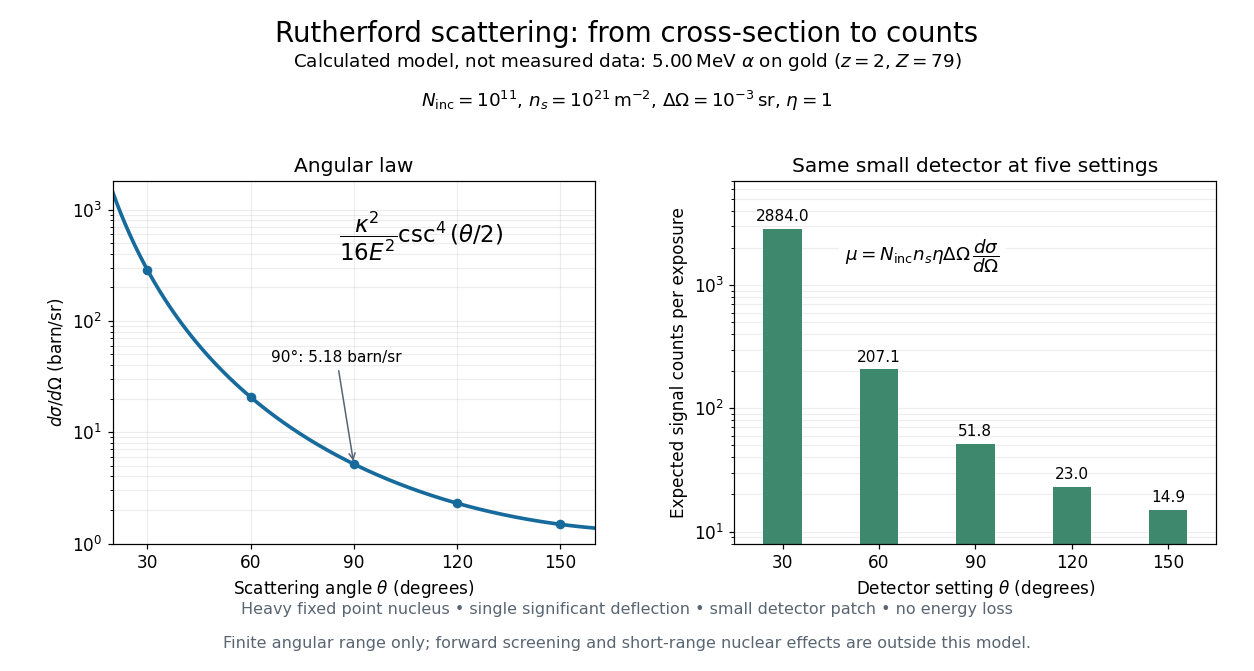
Calculated Rutherford angular cross-section and finite-detector counts
. Original calculation for the stated ideal monoenergetic alpha beam and thin gold foil. The curve is a differential cross-section; the bars are expected counts for the specified small detector solid angle at separate settings. They are not measured 1909 or 1913 data, and do not sum to a total scattering probability. The curve is shown only from 20 to 160 degrees. Details.
An observation also contains backgrounds. For a stable source and matched geometry, an estimator is , where denotes exposure duration. If source activity changes, normalize by incident exposure as well. Background subtraction removes an estimated background; it does not make finite counting fluctuations disappear.
The number of target chemical atoms per incident area along the beam. For a uniform foil at normal incidence, number density and thickness give , in . At oblique incidence the traversed path must replace . The single-encounter count model requires the chance of two significant deflections to be negligible and energy loss through the foil to be small. A small probability in one detector patch alone does not establish either condition.
Articles by others on the same topic
There are currently no matching articles.