Rutherford scattering is elastic scattering by a Coulomb potential. In the repulsive classical case, a positively charged projectile bends around a positively charged atomic nucleus. A close approach can turn it backwards without a contact collision. The calculation connects an invisible impact parameter with a measurable outgoing angle, then with a differential scattering cross-section and a detector count.
Assume a projectile of mass and electric charge , a stationary point atomic nucleus of electric charge , and positive . Here is the elementary charge. Neglect nuclear recoil, Electron screening effect, energy loss, and the nuclear force. With vacuum permittivity , defineHere and are the incident kinetic energy and speed far from the atomic nucleus, is the impact parameter, and is the magnitude of angular momentum. The nonrelativistic limit requires , with the speed of light. The fixed-target approximation requires the target mass to be much greater than . In SI, has units , has units , and has units .
For a head-on repulsive Rutherford scattering encounter, relative kinetic energy becomes Coulomb potential energy at closest approach. With projectile charge and target charge , conservation of energy gives the displayed separation. If the Coulomb description remains valid down to that separation, it bounds the target's interaction radius from above, treating the projectile as pointlike. For a stationary target of mass and incident projectile mass , use centre-of-mass energy ; neglecting nuclear recoil amounts to .
Let be the scattering angle between incoming and outgoing velocities, so forward scattering is and exact reversal is . Define the length . ThenFor , this gives ; is the head-on limiting case . Large deflections select small impact parameters, rather than requiring every incident alpha particle to reverse.
A short derivation uses conservation of angular momentum and conservation of energy. Choose the polar angle at closest approach, and write . The Binet equation for the repulsive Coulomb potential givesThe last equality follows by substituting this orbit into . The hyperbola reaches infinity at , with . Its scattering angle is , henceThis proves the relation without assuming that the deflection is small. The symbol here is a dimensionless orbital parameter, distinct from .
For an incident beam uniform across its relevant impact parameters, an incident annulus has area . Rotational symmetry maps it to outgoing solid angle . The central-potential classical differential cross-section and the Rutherford impact-parameter relation therefore giveThis is a differential scattering cross-section, with units of area per steradian, conventionally , not a detector count and not an area per degree. It applies for , with a finite limiting value at . Doubling incident kinetic energy divides it by four at fixed angle; doubling either electric charge number multiplies it by four.
A useful independent check integrates over all azimuths between two positive angles. For ,This equals the incident annulus area directly. A detector covering only a small patch at one angle does not collect this full azimuthal band.
At fixed incident flux, projectile energy and detector geometry, the Rutherford differential cross-section gives count rate , where is the target nuclei per unit area. Equal gives a rate ratio. Equal foil mass per area instead gives , with the atomic mass number, while equal physical thickness also requires the material mass density. An empirical log-log plot with slope supplies a different, experimentally normalized relation . These normalizations must be specified before comparing different target elements.
Let be the number of projectiles actually incident on the foil during an exposure, its foil areal number density, and the probability of detecting an accepted particle. For a sufficiently small detector patch of area at distance from the scattering point, with its normal at angle to the line of sight,The product is a dimensionless scattering probability in this approximation; is an expected value of counts, so it need not be an integer. The approximation requires a nearly constant differential scattering cross-section and efficiency across the patch and incident beam. For finite acceptance use , including the incident beam's spread if appreciable. A screen facing the foil has .
For an original numerical model, stipulate monoenergetic alpha particles with , , and a gold target with . Use the rounded model constant , where electronvolts and . Thus and . Choose , , , and . For example, facing the foil at gives this small-patch solid angle.
At , and , using barn . The expected signal is counts. At it is four times larger, about counts. Doubling foil areal number density or detector solid angle doubles these expected signals as long as the approximations continue to hold.
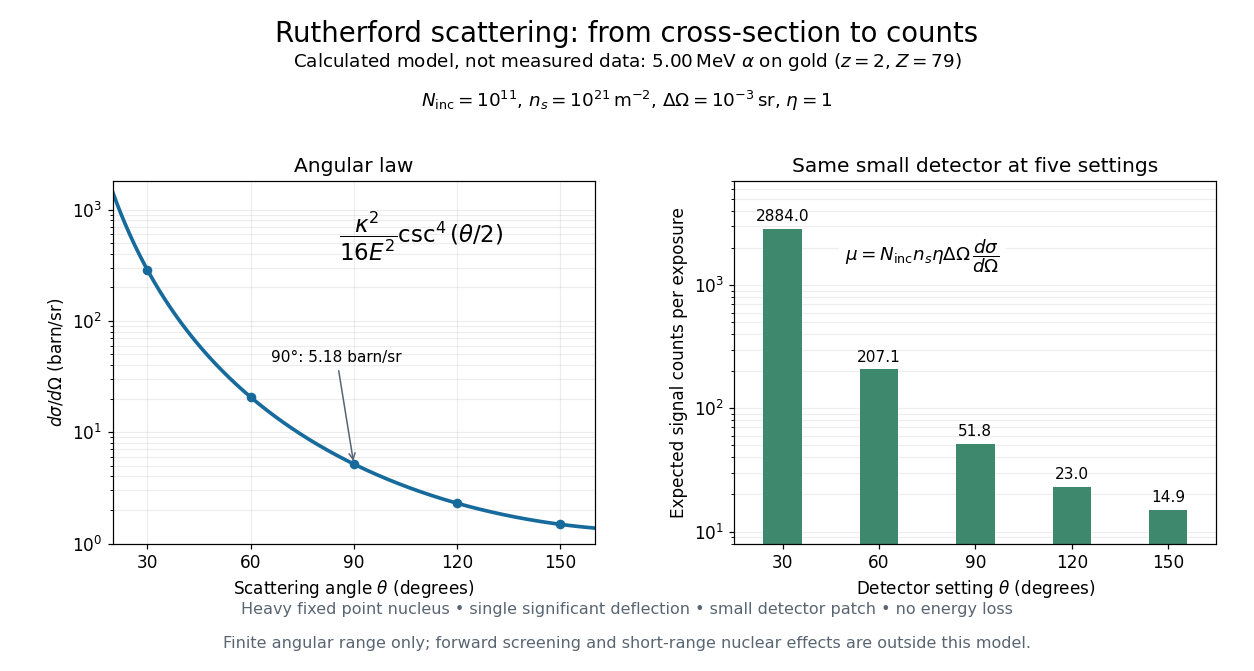
Calculated Rutherford angular cross-section and finite-detector counts
. Original calculation for the stated ideal monoenergetic alpha beam and thin gold foil. The curve is a differential cross-section; the bars are expected counts for the specified small detector solid angle at separate settings. They are not measured 1909 or 1913 data, and do not sum to a total scattering probability. The curve is shown only from 20 to 160 degrees. Details.An observation also contains backgrounds. For a stable source and matched geometry, an estimator is , where denotes exposure duration. If source activity changes, normalize by incident exposure as well. Background subtraction removes an estimated background; it does not make finite counting fluctuations disappear.
The number of target chemical atoms per incident area along the beam. For a uniform foil at normal incidence, number density and thickness give , in . At oblique incidence the traversed path must replace . The single-encounter count model requires the chance of two significant deflections to be negligible and energy loss through the foil to be small. A small probability in one detector patch alone does not establish either condition.
Articles by others on the same topic


Rutherford scattering is a phenomenon observed in the early 20th century that provided critical insights into the structure of the atom. It was first conducted by the physicist Ernest Rutherford in 1909 during experiments designed to investigate the properties of atomic structure, particularly the nucleus. In the experiment, Rutherford directed a beam of alpha particles (which are positively charged helium nuclei) at a thin foil of gold.