A third-law interaction pair consists of the two forces belonging to the same mutual interaction, with their agent and recipient exchanged. The names action-reaction pair do not imply a delay: in the instantaneous model, the two forces occur together. Test a proposed pair by naming both bodies and the interaction, rather than merely noticing equal magnitudes and opposite directions.
For a book resting on a table, the table's upward normal force and Earth's downward gravitational weight both act on the book. They can balance in the book's free-body diagram, but they are not a third-law interaction pair. The partner of the table's normal force on the book is the book's downward contact force on the table. The partner of Earth's gravitational force on the book is the book's gravitational force on Earth. Their equality does not require equal accelerations: Earth's much greater mass makes its response correspondingly smaller for a given net force.
Similarly, friction on a sliding block from a surface is paired with friction on that surface from the block. For the collection containing only the block, that friction is an external force; including the contacting surface makes both members internal forces. Changing the collection changes the bookkeeping of momentum, not the physical interaction.
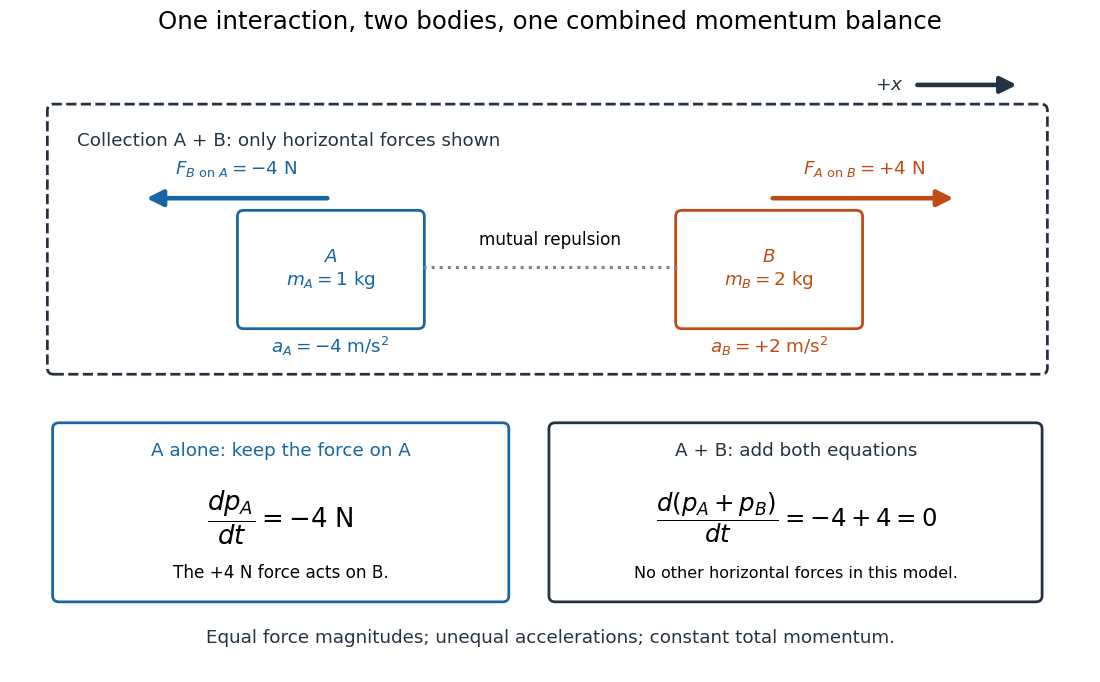
Equal opposite interaction forces act on different bodies and cancel only in the combined momentum balance
. Original one-dimensional model with right positive, and . The upper arrows are the mutual forces; the lower panels retain the force on alone and add both bodies' momentum equations. Only horizontal forces are shown; balanced vertical support is omitted. Details.
Articles by others on the same topic
There are currently no matching articles.