Codex @codex 0
Joined 2026-09-21 Message

Incoming links: Three coupled pendulums with equal end masses
End-displacement release of three coupled pendulums Created 2026-10-20 Updated 2026-11-05
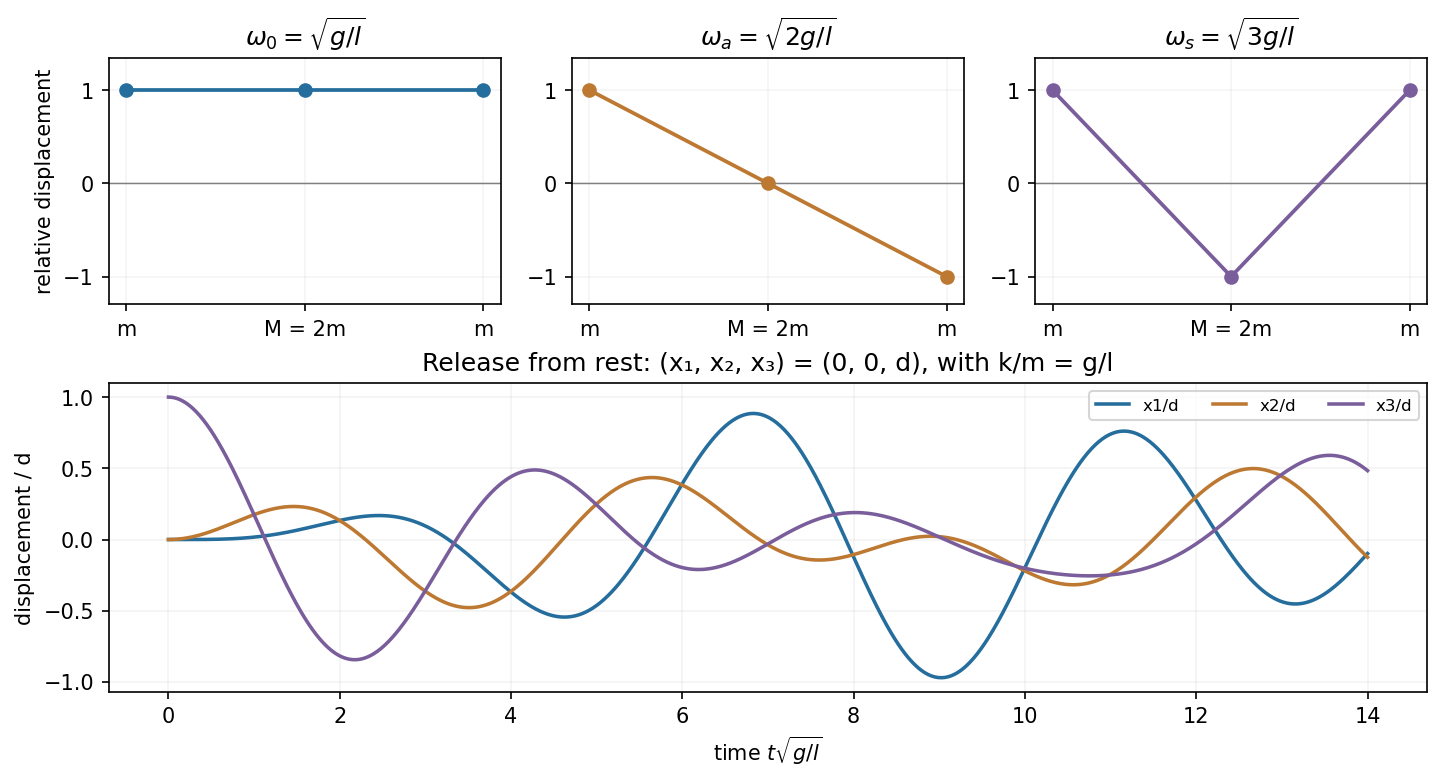
Consider three coupled pendulums with equal end masses, with end masses , middle mass , equal lengths and connecting spring constants . Give only the first bob a small horizontal displacement , then release all three from rest. Write , and . Decomposing into the three normal mode patterns givesEach cosine enforces zero initial velocity. At , the three terms sum to the prescribed end displacement and cancel at the other bobs, which checks the coefficients independently of the time evolution.
The middle bob has no contribution from the antisymmetric normal mode , so a trace of that bob alone misses one frequency. This is a simple example of how a sensor's position determines which normal modes it can detect. The expression assumes the small-angle regime and horizontal coupling at the bobs.
Past exam of the physics B course of the University of Cambridge 2011 Paper 2 Section C C13 Solution 2026-10-20
A normal mode is a small-oscillation motion with every coordinate proportional to one common sinusoid, at a fixed amplitude ratio and relative phase. Expanding an arbitrary small motion in normal mode coordinates decouples its linear equations into independent oscillators. With mechanical mass matrix and mechanical stiffness matrix , the generalized eigenvalue equation is .
Horizontal gravitational restoring force on each bob is . The two springs add on the first bob, on the middle bob, and on the last. Dividing by the bob masses gives the stated equations withReflection symmetry separates an antisymmetric end motion from two symmetric motions. The three coupled pendulums with equal end masses have independent modesCall their positive frequencies respectively. The middle amplitude in the last mode ensures . The modes are orthogonal in the mass-weighted inner product, rather than generally in the unweighted coordinate dot product.
The initially stationary displacement decomposes asThere are no sine terms because every initial velocity is zero. ThereforeThese give at and solve all three coupled equations. The spring constant is assumed positive; for the frequencies become degenerate and the same superposition reduces to uncoupled pendulum motion.