At fixed positive bias ratio with , the Josephson coupling energy and work of the ideal bias source combine intoThis is the effective potential energy for an unwrapped Gauge-invariant Josephson phase; it includes the bias source and decreases by on advancing one period. A local minimum and the adjacent downhill barrier areTo verify the barrier, solve , select and , and subtract their potential energies. The small-oscillation angular frequency is fixed by the curvature:Thus the barrier and oscillation frequency both vanish as , but with different powers. For , expanding and givesThe first approximation is for a nearly critical bias. At the exact downhill barrier is ; at there is no confining local minimum in this model.
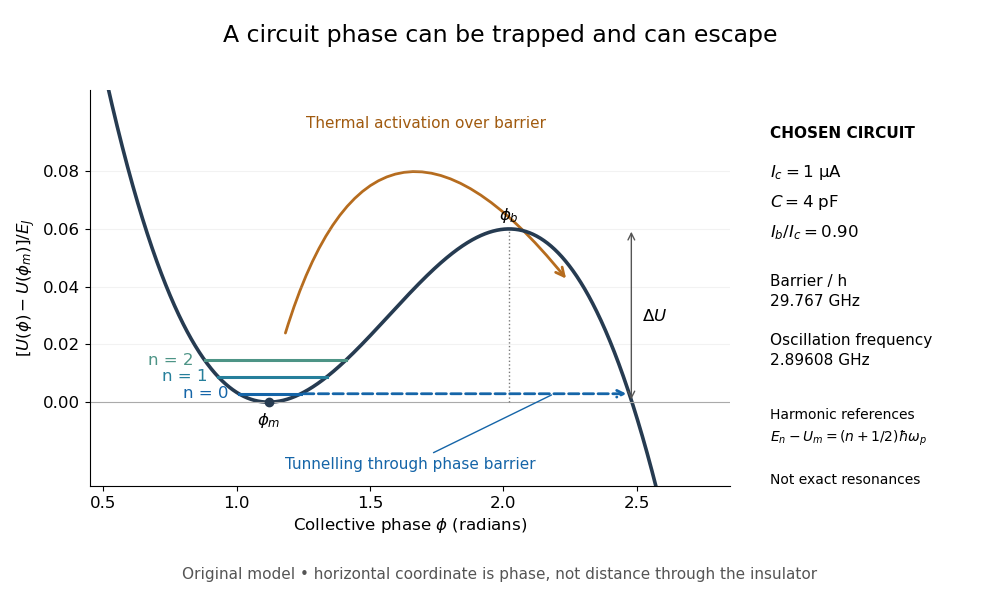
A tilted phase potential confines low energy levels and permits escape
. Original chosen model with , and . Three horizontal lines are quantum harmonic oscillator approximations , for ; they are not exact energy levels or measured data. The horizontal axis is a quantum phase, not distance through an insulator. Arrows distinguish over-barrier thermal activation and below-barrier quantum tunnelling. Details.
For those stipulated parameters, direct evaluation gives , , and . Hence . The nearly critical barrier approximation gives , about below the exact result. These are original circuit calculations, not parameters assigned to the historical samples.
Articles by others on the same topic
There are currently no matching articles.