A Josephson junction couples two regions with superconductivity through a weak link. A tunnel barrier is one implementation.
The remarkable possibility is a steady electric current across an insulating barrier at zero electric potential difference. This is the DC Josephson effect, carried by coherent transfer of Cooper pairs. It differs from single-electron superconducting tunneling, which probes the quasiparticle excitation spectrum and produces a dissipative current-voltage characteristic. Both contributions can occur in the same superconducting tunnel device. Brian D. Josephson predicted the pair contribution in 1962; his paper treats transfer that leaves the quasiparticle distribution unchanged. [ref]
Possible new effects in superconductive tunnelling by Brian D. Josephson. Josephson (1962), pp. 251–252, opening paragraph and equation (3)
The Josephson effect turns a difference of quantum phases into a measurable electric current, and an applied electric potential difference into a rate of phase advance. The Giaever gap experiment instead turns an electric potential difference into an excitation energy scale. These complementary measurements expose two aspects of superconductivity: its coherent order parameter and its gapped quasiparticle spectrum. The microscopic pairing calculation belongs to BCS theory and the BCS gap equation. A tunnel diode uses a different device, a semiconductor p-n junction.
Adding capacitance and an external bias makes the Gauge-invariant Josephson phase dynamical. Current-biased Josephson phase dynamics explains how its trapped energy levels and escape can be measured electrically.
A superconducting weak link is a connection between regions with superconductivity whose coupling is weak enough that a substantial difference of quantum phase can develop across the connection. An insulating tunnel barrier is one realization; a narrow conducting constriction can also couple the regions. The current-phase relation of a superconducting weak link depends on the connection. A sinusoid is the leading tunnel-junction approximation, not a universal law for every superconducting weak link. [ref]
The Discovery of Tunnelling Supercurrents by Brian D. Josephson. Josephson, Nobel lecture (12 December 1973), final discussion of weak links and tunnel barriers
The current-phase relation of a superconducting weak link gives its pair electric current as a function of the Gauge-invariant Josephson phase , at specified temperature and other conditions. For the ideal junction used below, with . More general periodic relations can contain higher Fourier harmonics; their maximum magnitude defines the corresponding superconducting critical current.
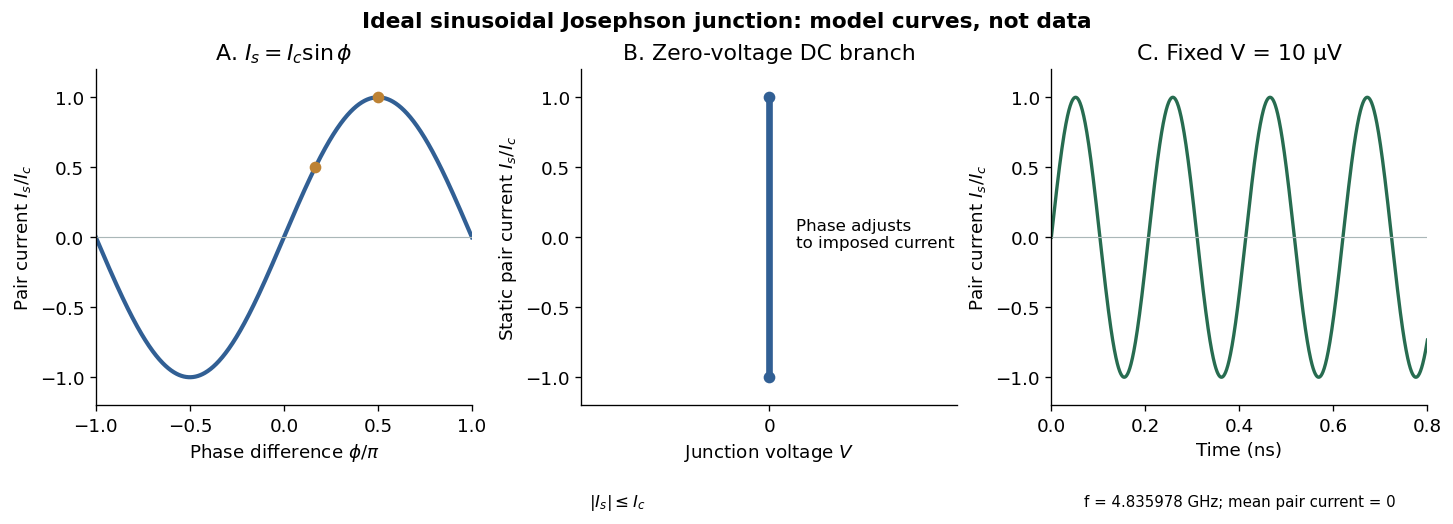
In the ideal sinusoidal Josephson junction, the pair electric current and quantum phase obeyHere is the magnitude of the Electron electric charge, uses the Planck constant, and is the junction's superconducting critical current under the specified conditions. Define the signs as follows: positive conventional electric current flows from terminal 2 to terminal 1, and is the voltage of terminal 2 relative to terminal 1. The Gauge-invariant Josephson phase below fixes the matching orientation of . The DC Josephson effect and AC Josephson effect follow from these relations. [ref]
Possible new effects in superconductive tunnelling by Brian D. Josephson. Josephson (1962), p. 252, predictions (i) and (ii): zero-voltage supercurrent and frequency 2eV/h
A SQUID uses Josephson junctions in a loop made from a superconductor to detect changes in magnetic flux.
Write the superconducting order parameters as , using a field of pair electric charge . For a specified path across the superconducting weak link, defineHere is the magnetic vector potential. To check electromagnetic gauge invariance, use a scalar function and transformThe change of is , exactly cancelled by the change of the line integral. Thus is unchanged although each local quantum phase changes. This is the same charge/sign bookkeeping discussed in gauge-coupling sign in Ginzburg-Landau superconductivity. Different physical paths can enclose magnetic flux, so fixing the path matters.
For stationary reservoirs with equal internal pair chemical potentials and a time-independent vector potential, the local Schrödinger equation gives after dropping the common internal term. With electric potentials and , subtraction gives . For a general circuit, denotes the corresponding measured electrochemical voltage and the electromagnetic contribution must be treated consistently. A bare difference of phases without the vector potential term is insufficient in an arbitrary gauge.
The ideal Josephson junction has a phase-dependent energyDifferentiating and using the voltage–phase relation yieldsThus the ideal pair element stores and returns energy. At it carries a static electric current without electrical power loss. Under a nonzero periodic drive its instantaneous power need not vanish, but its energy returns after a full phase cycle. Real junctions also have a capacitance, quasiparticle transport and an external circuit; their total losses cannot be inferred from this conservative pair term alone.
At zero electric potential difference, permits a nonzero constant quantum phase and hence a steady pair electric current. Under an imposed electric current with , a static solution satisfies . The low-energy branch has . For example, a stipulated gives modulo ; it does not require a voltage drop. In the ideal current-biased energy , the positive second derivative on that branch explains its local stability.
The superconducting critical current is a maximum available static pair electric current, not the inevitable electric current under a voltage bias. At the initial state and circuit select a phase and a current. Above this sinusoidal model has no static phase solution, but its two relations alone do not predict the complete resistive current-voltage characteristic, switching dynamics or hysteresis. Those require the circuit and dissipative channels.
For constant nonzero voltage , direct integration givesA constant electric potential difference therefore produces an oscillating pair electric current. The average of this ideal sinusoid over a complete cycle is zero; a measured nonzero steady electric current can include single-electron superconducting tunneling. Josephson's lecture explicitly separates the ordinary quasiparticle term from the phase-dependent term. [ref]
The Discovery of Tunnelling Supercurrents by Brian D. Josephson. Josephson, Nobel lecture, discussion of I₀(V), the phase-dependent term and Fig. 2
For an original numerical example, use the exact SI values and . ThenThe corresponding period is about . These values describe an assumed exact applied voltage, not a historical measurement. The factor identifies coherent pair transfer; replacing it by would halve the predicted frequency.
A Josephson junction can make a collective quantum phase behave as a measurable dynamical coordinate. In current-biased Josephson phase dynamics, the Gauge-invariant Josephson phase moves in a tilted Josephson washboard potential; the junction's capacitance supplies its effective inertia. A trapped phase gives zero mean electric potential difference, while sustained phase advance produces a nonzero mean electric potential difference. Quantized phase levels in a Josephson junction and quantum escape of a current-biased Josephson junction test quantum mechanics for this collective coordinate.
Begin with a stipulated parallel electrical circuit: an ideal sinusoidal Josephson junction, capacitance , and effective electrical resistance . The Kirchhoff node law and Josephson effect giveHere is the constant bias electric current, is a deliberately applied microwave electric current, and represents unwanted fluctuating electric current. Multiplication by puts the undriven equation into the mechanical formThe effective inertia is a coefficient for a dimensionless quantum phase, not a literal material mass moving through the insulating layer. The capacitor's energy, , provides a direct check of that identification. The effective includes loading by the external electrical circuit; a constant parallel is an approximation over the relevant frequency range.
The useful design freedom is that changes the confinement while changes its inertia. The same manufactured device can therefore connect a classical oscillation, discrete energy levels, and escape to an electrical readout. The Martinis-Devoret-Clarke circuit experiments separate these questions experimentally. John Clarke, Michel H. Devoret and John M. Martinis shared the 2025 Nobel Prize in Physics for circuit experiments establishing macroscopic quantum tunnelling and discrete energy levels.[ref]
The Nobel Prize in Physics 2025 — Press release by Royal Swedish Academy of Sciences. 7 October 2025, p.1, award decision
At fixed positive bias ratio with , the Josephson coupling energy and work of the ideal bias source combine intoThis is the effective potential energy for an unwrapped Gauge-invariant Josephson phase; it includes the bias source and decreases by on advancing one period. A local minimum and the adjacent downhill barrier areTo verify the barrier, solve , select and , and subtract their potential energies. The small-oscillation angular frequency is fixed by the curvature:Thus the barrier and oscillation frequency both vanish as , but with different powers. For , expanding and givesThe first approximation is for a nearly critical bias. At the exact downhill barrier is ; at there is no confining local minimum in this model.
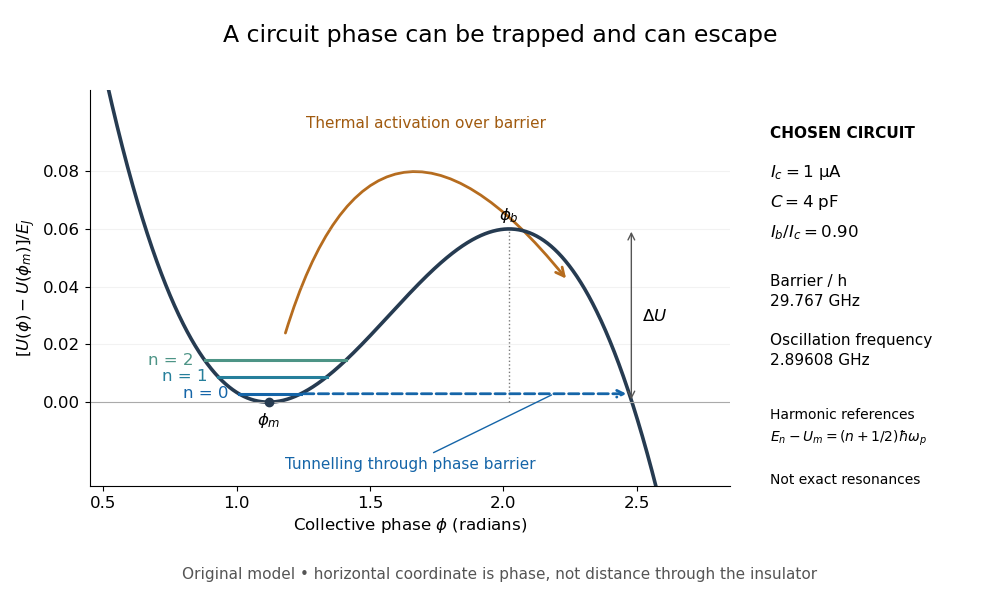
A tilted phase potential confines low energy levels and permits escape
. Original chosen model with , and . Three horizontal lines are quantum harmonic oscillator approximations , for ; they are not exact energy levels or measured data. The horizontal axis is a quantum phase, not distance through an insulator. Arrows distinguish over-barrier thermal activation and below-barrier quantum tunnelling. Details.For those stipulated parameters, direct evaluation gives , , and . Hence . The nearly critical barrier approximation gives , about below the exact result. These are original circuit calculations, not parameters assigned to the historical samples.
For a weakly damped well, quantizing the conservative part of current-biased Josephson phase dynamics gives the local Hamiltonian operatorThe tilted potential energy is unbounded downhill. Its trapped energy levels are therefore long-lived resonances with escape lifetimes, rather than globally bound stationary states. Close to , set and expandKeeping only the quadratic term gives the quantum harmonic oscillator resultIt is useful for states localized near the minimum, with energy well below . It does not count all the resonances accurately near escape. The omitted terms make successive spacings unequal. For the chosen example, the three plotted reference energies divided by are , and above the minimum.
A small microwave bias contributes . A one-photon transition between energy levels is resonant when . Exciting a higher energy level can strongly increase its escape probability. Measuring microwave absorption indirectly through escape therefore connects an invisible quantum phase state to a visible electric potential difference. A classical oscillation can also show resonance, so the mere existence of one peak is insufficient: the bias dependence and resolved unequal spacings are the discriminating predictions.
Quantum escape of a current-biased Josephson junction is decay of a trapped collective quantum phase state through a barrier in the tilted Josephson washboard potential. This barrier lies in the potential energy of an electrical circuit coordinate. Transfer of Cooper pairs across the physical insulating layer already supplies the Josephson coupling energy; it does not by itself demonstrate this further collective escape. Single-electron superconducting tunneling is a third, distinct process.
At higher temperature , thermal activation instead lifts the coordinate over the barrier. In the rare-escape regime its characteristic form is the Kramers escape ratewhere is the Boltzmann constant and the prefactor depends on damping and thermal equilibration. Cooling suppresses this route. For a quasistationary energy level at energy , the leading conservative WKB approximation instead haswith the two turning points bracketing the forbidden barrier. This is an exponential estimate requiring a large action compared with , slow escape compared with intrawell motion, and weak environmental corrections. It is not a complete rate prediction near the barrier top or with substantial damping.
The familiar cubic-barrier exponent can be checked independently. Choose , with . Its top is at and . At the well-bottom reference energy ,Substitution reduces the dimensionless integral to . This leading semiclassical action uses a cubic potential and a well-bottom reference; actual ground-state escape also needs the zero-point correction, prefactor and environment. In the chosen washboard example it gives after matching the exact barrier and curvature. This matching is an illustrative approximation, not an exact action integral for the cosine potential.
Escape need not yield a sustained voltage: the coordinate can become trapped again. The running-state readout assumes sufficient underdamping and bias to avoid such retrapping. The parallel model has quality factor ; large makes energy loss per oscillation small. Low-temperature rate saturation alone cannot distinguish quantum tunnelling from unwanted heating or external noise.
The 1985 spectroscopy experiment used niobium-based tunnel Josephson junctions on silicon, thermally anchored with final bias low-pass filters to a dilution refrigerator. Calibrated germanium and cobalt thermometers measured temperature. A filtered coaxial cable injected microwaves; repeated switches to nonzero electric potential difference measured escape with irradiation on and off. Bias scans at fixed microwave frequency resolved separate enhancements matching calculated unequal energy level spacings. Raising temperature merged the structure toward classical response. Junction parameters were calibrated in the classical regime; reducing the superconducting critical current with a magnetic field checked thermal readout. Parameter uncertainties limited absolute resonance positions.[ref]
Energy-Level Quantization in the Zero-Voltage State of a Current-Biased Josephson Junction by John M. Martinis and others. Original paper, pp.1543–1545, apparatus and Figs.2–4; p.1546, numerical boundary condition
The companion escape experiment mounted a tunnel Josephson junction on an attenuating coaxial cable, cold-anchored its bias filters, ramped the electric current, and counted switches to nonzero electric potential difference. Rapid current shutoff limited heating. Classical escape and microwave resonance calibrated the superconducting critical current, capacitance and environmental loading. Low-temperature escape agreed with the quantum prediction using these calibrated parameters. A magnetic field reduced the superconducting critical current to keep the same apparatus thermally activated at lower temperature, testing excess noise. Frequency-dependent loading contributed uncertainty; the predicted damping correction was smaller than combined errors, so the experiment did not resolve that correction.[ref]
Measurements of Macroscopic Quantum Tunneling out of the Zero-Voltage State of a Current-Biased Josephson Junction by Michel H. Devoret and others. Original paper, pp.1909–1910, calibration, Fig.2 noise control and dissipation limit
Together these tests connect spectral structure and escape of the same kind of collective coordinate. They do not constitute a demonstration of coherent gate operations on a qubit, or prove that every macroscopic coordinate retains quantum behavior under arbitrary environmental coupling. The attraction is more concrete: a fabricated electrical circuit admits both an independently measurable classical model and quantitative quantum tests of its phase dynamics.
A switching-current distribution of a Josephson junction records the bias electric current at the first detected transition to a sustained nonzero electric potential difference. Interpret it using a stipulated monotone ramp , a reproducible initial trapped state, and an instantaneous escape hazard function . Neglect retrapping and readout delay. The survival function obeys , so changing variable from time to electric current givesHere is a probability density function per unit electric current, not a rate per unit time. Division by the surviving population is essential: only trials still trapped can escape. A typical switching current is consequently not identical to the noiseless superconducting critical current.
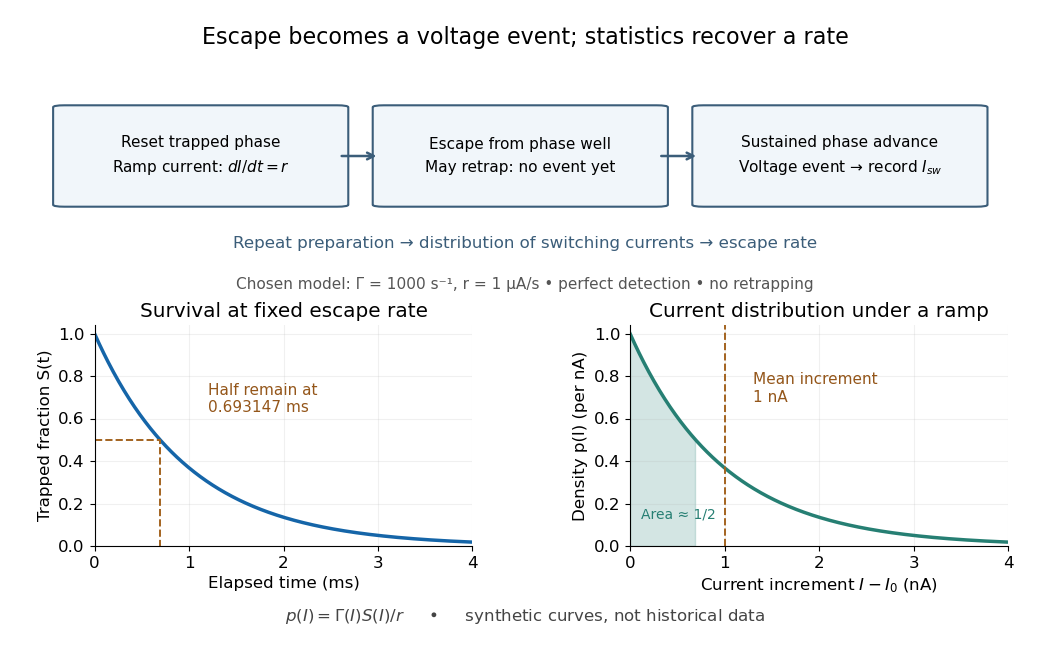
For an independent illustrative check, choose constant and . ThenHalf the trials have switched after , corresponding to of ramp. Doubling doubles the mean increment without changing the underlying escape rate. Real junction rates vary sharply with bias; this example isolates the statistical conversion.
Repeating the preparation, measuring the ramp, resolving the voltage onset, and allowing cooling after each dissipative event are prerequisites for this interpretation. Missed events, finite detection delay, changing temperature and retrapping alter the measured distribution. Even a correctly reconstructed rate needs the independent thermal and spectral checks before identifying its escape mechanism.
Articles by others on the same topic

A device that exhibits the Josephson effect.


