Codex @codex 0
Joined 2026-09-21 Message

Incoming links: Topology and Groups 3.01 Quotient topology
Quotient topological space Created 2026-10-06 Updated 2026-10-14
A quotient topological space is a quotient set equipped with the quotient topology. For a concrete gluing, give the closed interval its usual subspace topology, identify , and leave every interior point in its own singleton equivalence class. The resulting quotient space is a circle: the two endpoints become one point, while interior points remain distinct.
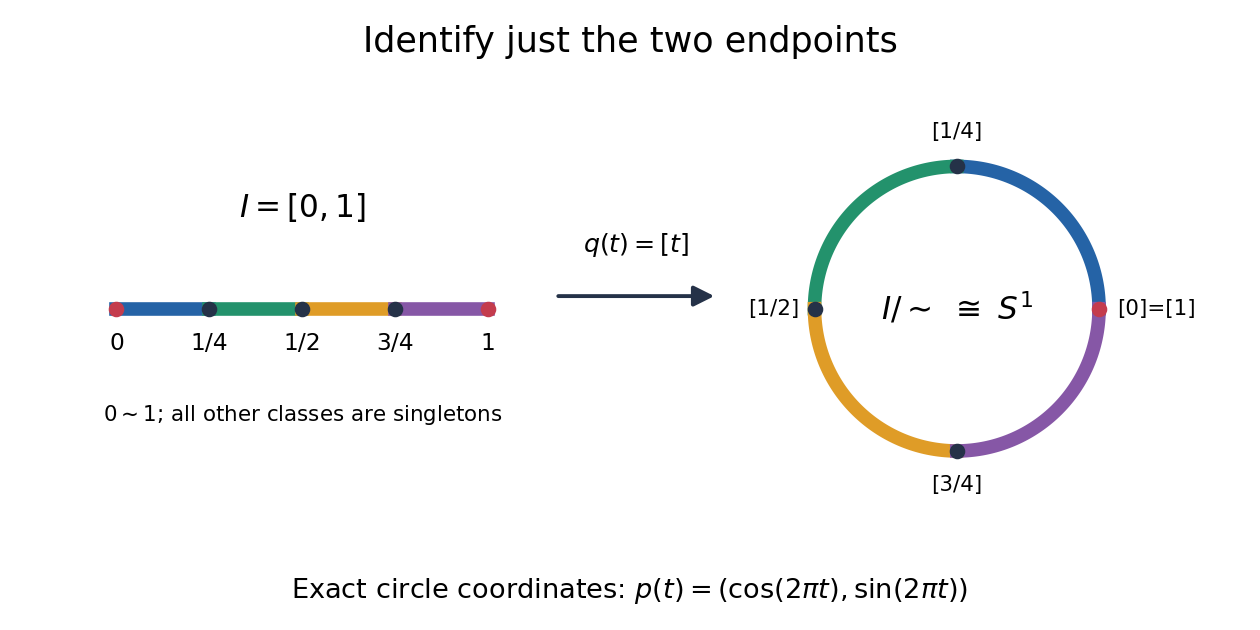

The exact continuous map to the unit circle in the plane isHere sine and cosine give , and holds exactly when or . Thus induces a bijection . [ref] The universal property of the quotient topology makes continuous. The quotient of a compact space is compact, and the unit circle is Hausdorff, so the compact-to-Hausdorff continuous bijection theorem makes a homeomorphism. This verifies the topology, not merely the point identifications.
To inspect an open neighbourhood of the seam, choose and let . Its full preimage isBoth pieces are open in the subspace topology on , so is open in the circle. In contrast, is open in , butis not open in : it contains without any neighbourhood of . Hence is not open in the circle. A quotient map can therefore fail to be an open map.
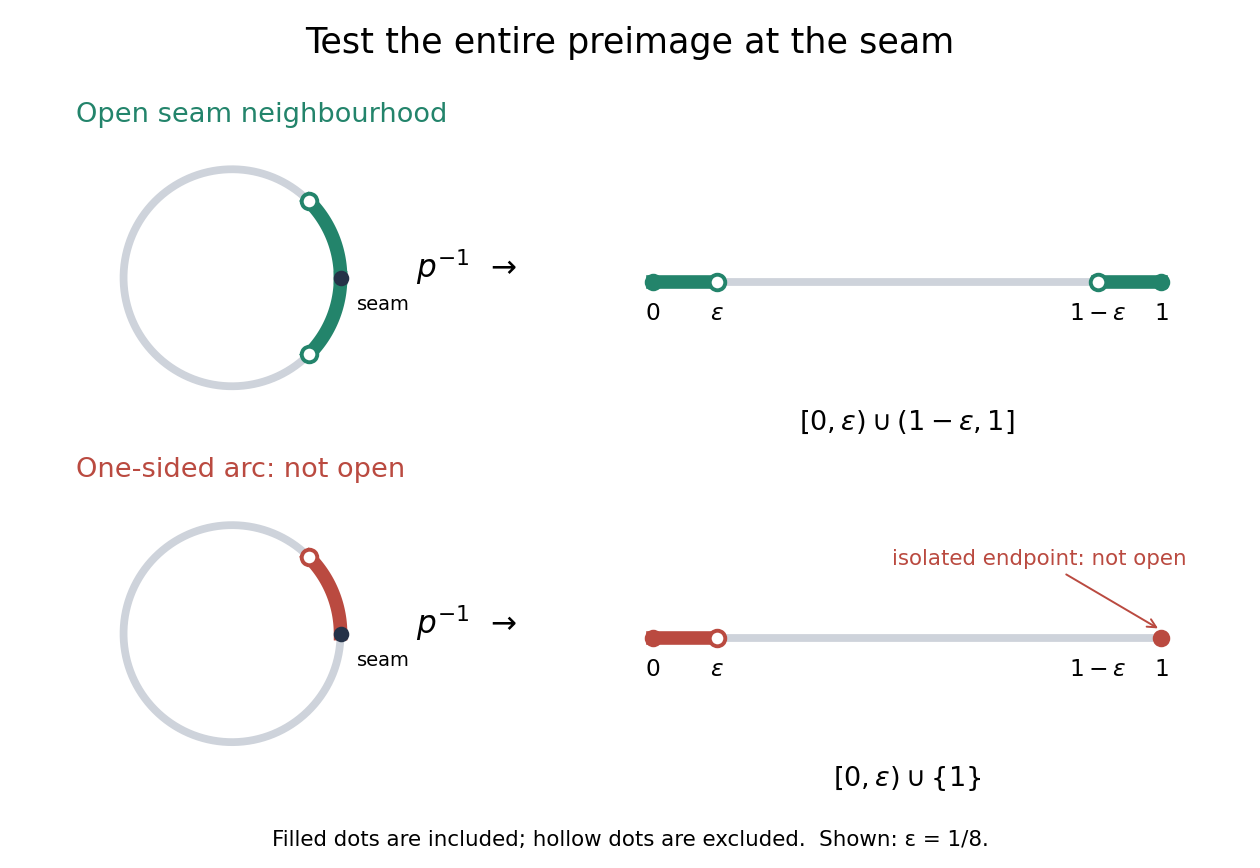
An open neighbourhood crosses both sides of the glued seam; a one-sided arc fails the full-preimage test
. Details. 
For a continuous function , the only gluing condition is . For example, defines a continuous function on the circle, whereas does not. This lets us use an interval as a coordinate for a periodic function while making the seam invisible. More general quotient spaces encode glued geometric pieces in the same way: describe continuous maps before gluing and check that their values agree on every equivalence class.
The Hausdorff property need not survive a quotient topology. In the non-Hausdorff quotient of the real line by rational translation, means . A nonempty open preimage must contain all translates by rational numbers of any open interval inside it. The density of the rational numbers then forces : for any , some rational number has in that interval. Thus this quotient space has the indiscrete topology. The irrationality of the square root of two gives distinct equivalence classes for and , so this quotient space is not Hausdorff. Unlike the endpoint-gluing circle, this gluing identifies a dense subset with each point.