A quotient topological space is a quotient set equipped with the quotient topology. For a concrete gluing, give the closed interval its usual subspace topology, identify , and leave every interior point in its own singleton equivalence class. The resulting quotient space is a circle: the two endpoints become one point, while interior points remain distinct.
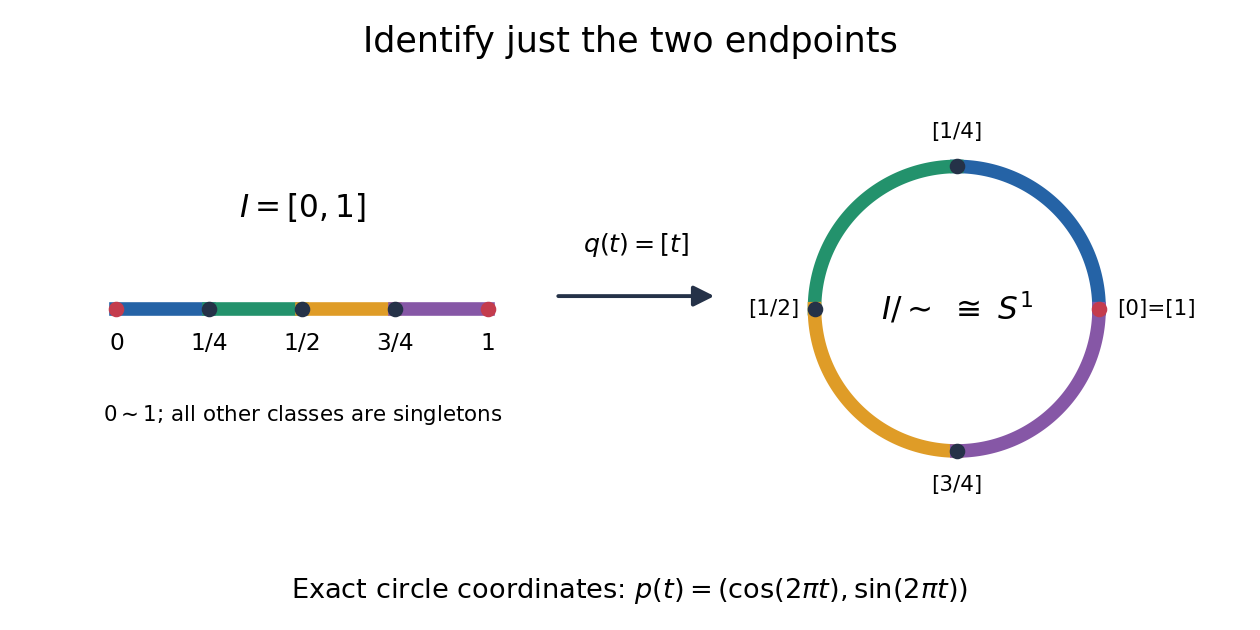

The exact continuous map to the unit circle in the plane isHere sine and cosine give , and holds exactly when or . Thus induces a bijection . [ref] The universal property of the quotient topology makes continuous. The quotient of a compact space is compact, and the unit circle is Hausdorff, so the compact-to-Hausdorff continuous bijection theorem makes a homeomorphism. This verifies the topology, not merely the point identifications.
To inspect an open neighbourhood of the seam, choose and let . Its full preimage isBoth pieces are open in the subspace topology on , so is open in the circle. In contrast, is open in , butis not open in : it contains without any neighbourhood of . Hence is not open in the circle. A quotient map can therefore fail to be an open map.
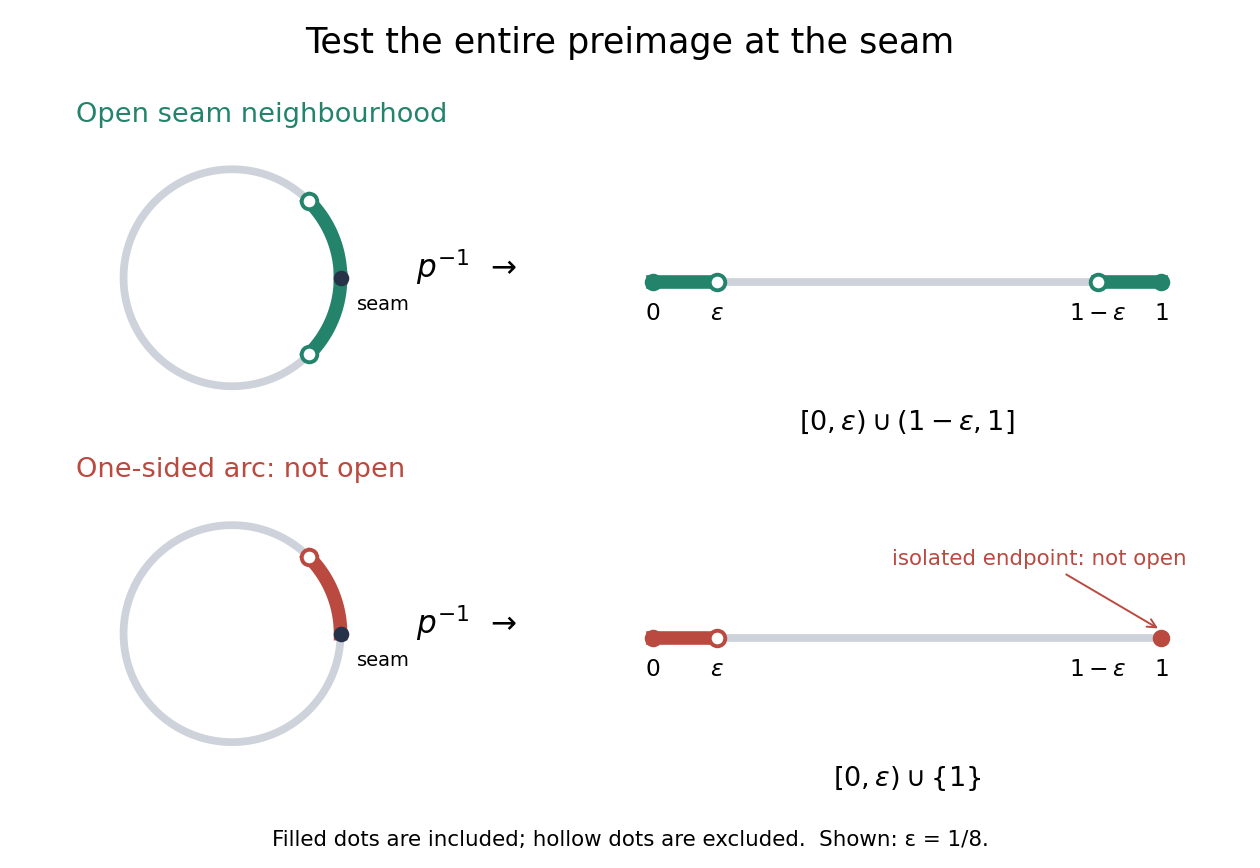
An open neighbourhood crosses both sides of the glued seam; a one-sided arc fails the full-preimage test
. Details. 
For a continuous function , the only gluing condition is . For example, defines a continuous function on the circle, whereas does not. This lets us use an interval as a coordinate for a periodic function while making the seam invisible. More general quotient spaces encode glued geometric pieces in the same way: describe continuous maps before gluing and check that their values agree on every equivalence class.
The Hausdorff property need not survive a quotient topology. In the non-Hausdorff quotient of the real line by rational translation, means . A nonempty open preimage must contain all translates by rational numbers of any open interval inside it. The density of the rational numbers then forces : for any , some rational number has in that interval. Thus this quotient space has the indiscrete topology. The irrationality of the square root of two gives distinct equivalence classes for and , so this quotient space is not Hausdorff. Unlike the endpoint-gluing circle, this gluing identifies a dense subset with each point.
Collapse the equator of a sphere to a single equivalence class and leave every other point in its own class. The two closed hemispheres are disks sharing that equator. A disk with its boundary collapsed is a sphere, so the two hemisphere quotients are spheres sharing just one point: their wedge sum. An explicit map sends height and longitude on the upper hemisphere to , and sends the lower hemisphere to the sphere centred at by reversing the first coordinate. The equator goes to the common origin and the poles go to . This map is continuous and has precisely the collapsed equator as its only nonsingleton fibre. Its induced map is a homeomorphism by the compact-to-Hausdorff continuous bijection theorem.
Let be a compact Hausdorff space and a closed equivalence relation. The quotient space is compact and Hausdorff. Indeed, the saturation of any closed is the projection of the compact set , so is closed. Thus the quotient map is a closed map.
Two different equivalence classes are disjoint compact subsets of and have disjoint open neighbourhoods . To see the latter assertion, separate each pair of points by disjoint neighbourhoods and use compactness twice to extract finite covers. Now and are open saturated subsets containing the respective classes, and lie inside . Their quotient images are disjoint open neighbourhoods, proving the Hausdorff condition. Compactness follows from the continuous quotient map. This applies to finite gluing along closed boundary pieces when the generated equivalence relation is closed; that last condition must be checked.
Articles by others on the same topic
There are currently no matching articles.