Work in Minkowski spacetime, neglect gravity, and choose the stay-at-home clock's inertial frame. Let departure be and reunion be . The home clock follows . A traveller moves outward with velocity and returns with velocity , where and is the speed of light. The ideal world line has a sharp turnaround at :Each straight leg lies in an inertial frame, but no single traveller inertial frame covers both legs.
For any differentiable timelike curve in this home inertial frame, its clock accumulates proper time through the integralApply it separately to the traveller's two legs. With the Lorentz factor ,For and , the Lorentz factor is . The turnaround is light-years away at home time . The traveller records outward and returning: the reunited clocks read and . These are illustrative model values, not experimental measurements.
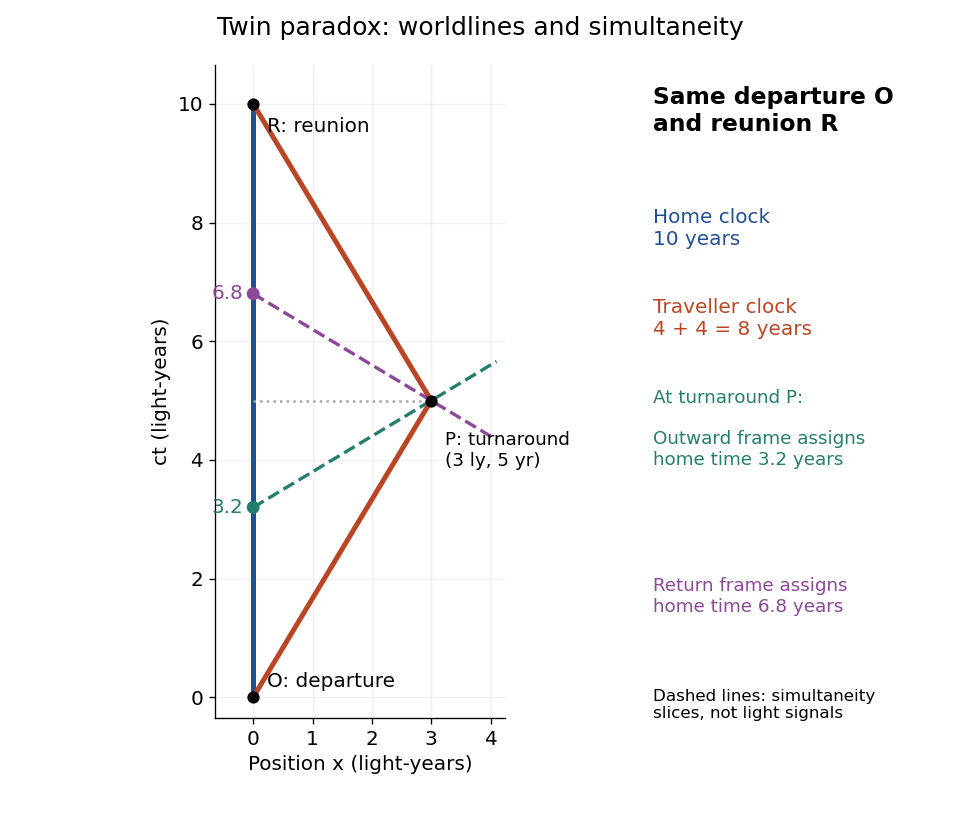
Fixed departure and reunion events: a 0.6c traveller records eight years while the inertial home clock records ten; turnaround simultaneity slices meet the home world line at 3.2 and 6.8 years
. Details. 
The same integral gives a short geometric explanation: , so every such competing timelike curve between these fixed spacetime events has . Equality requires zero velocity throughout, apart from sets of zero duration. Thus the straight home world line maximizes proper time in this Minkowski spacetime problem. This statement concerns fixed endpoints and an inertial home clock; in a gravitational field, compare paths using the appropriate metric tensor.
Articles by others on the same topic
There are currently no matching articles.