The twin paradox compares proper time along the different world lines of a travelling observer and a stay-at-home observer who reunite. Reciprocal inertial time dilation produces an apparent contradiction only if the traveller's change of inertial frame is ignored.
The decisive experiment is local: put two clocks together at departure, separate them, then compare their readings together at reunion. Everyone agrees on those two spacetime events and on the final difference. The twin paradox asks why two clocks can accumulate different proper times between the same spacetime events, despite reciprocal time dilation during uniform motion. Its answer is the geometry of their complete world lines, together with the relativity of simultaneity when comparing distant clocks.
Consider a change of distant-time convention , where is constant and . This changes time labels and simultaneity slices while leaving the world lines and the metric tensor as geometric objects unchanged. In one spatial dimension,Substitute into the Minkowski interval to obtain the formula. For a timelike curve, the proper time calculated from this transformed metric tensor equals the old value. At shared departure and reunion events with , the labels also obey . Thus a distant synchronization convention cannot alter the twin paradox's reunited clock readings. It would be an error to change time labels while retaining the old diagonal metric components.
Work in Minkowski spacetime, neglect gravity, and choose the stay-at-home clock's inertial frame. Let departure be and reunion be . The home clock follows . A traveller moves outward with velocity and returns with velocity , where and is the speed of light. The ideal world line has a sharp turnaround at :Each straight leg lies in an inertial frame, but no single traveller inertial frame covers both legs.
For any differentiable timelike curve in this home inertial frame, its clock accumulates proper time through the integralApply it separately to the traveller's two legs. With the Lorentz factor ,For and , the Lorentz factor is . The turnaround is light-years away at home time . The traveller records outward and returning: the reunited clocks read and . These are illustrative model values, not experimental measurements.
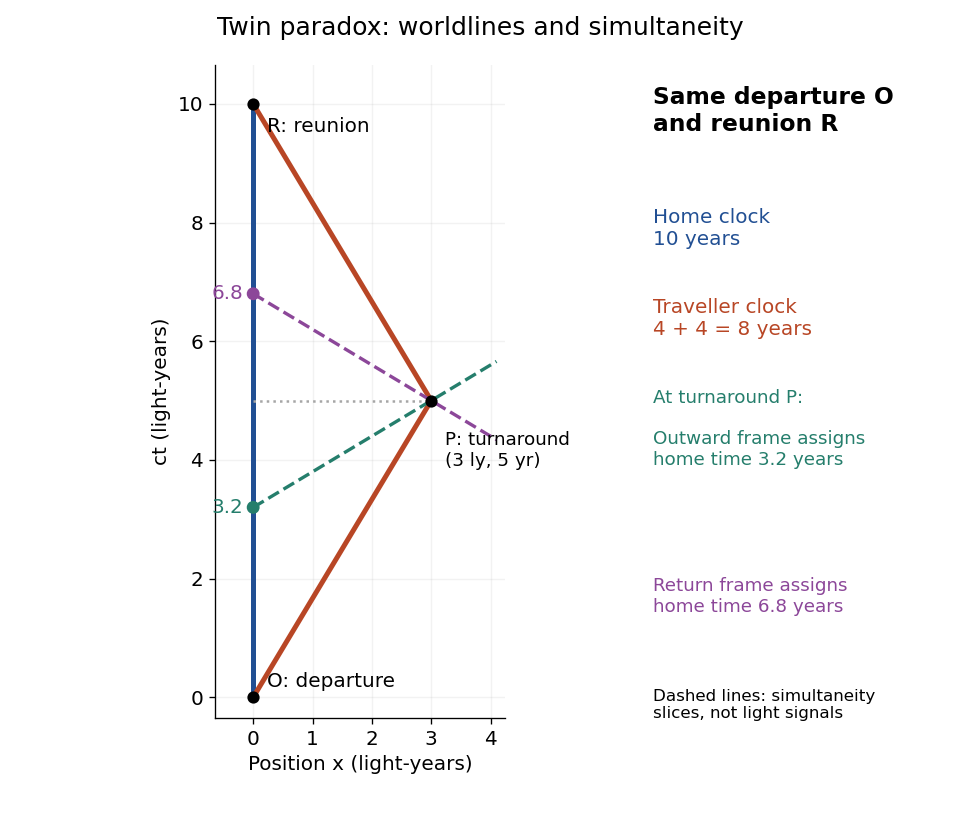
Fixed departure and reunion events: a 0.6c traveller records eight years while the inertial home clock records ten; turnaround simultaneity slices meet the home world line at 3.2 and 6.8 years
. Details. The same integral gives a short geometric explanation: , so every such competing timelike curve between these fixed spacetime events has . Equality requires zero velocity throughout, apart from sets of zero duration. Thus the straight home world line maximizes proper time in this Minkowski spacetime problem. This statement concerns fixed endpoints and an inertial home clock; in a gravitational field, compare paths using the appropriate metric tensor.
During either inertial leg, the traveller can correctly say that the moving home clock runs slowly. The missing step is deciding which distant home-clock reading is simultaneous with turnaround. By the Lorentz transformation, the outward inertial frame's constant-time line through obeys . At it meets the home world line atFor the return inertial frame, use through the same spacetime event ; its home-clock assignment isThe dashed lines in the spacetime diagram illustrate this relativity of simultaneity. For and , they assign and to the home clock. The difference of is a change in the traveller's distant-time assignment, not a sudden physical advance of the home clock.
On each leg, the traveller's of proper time corresponds to of home-clock advance according to that leg's inertial frame. Including the twin paradox simultaneity change gives , exactly the reading at reunion. Actual received light signals remain continuous across a physical turnaround; their arrival times are distinct from the distant spacetime events assigned as simultaneous by Einstein synchronisation.
An instantaneous reversal is an idealization. A real traveller changes velocity over a finite time, follows a smooth world line, and has finite proper acceleration. Special relativity still calculates the elapsed proper time using the home inertial frame and the same integral; general relativity is not needed merely because the traveller accelerates in otherwise flat spacetime. The clock hypothesis identifies an ideal clock's reading with this geometric proper time.
One explicit smooth trip between the same and starts and ends at rest in the home inertial frame. ChooseIts velocity reverses continuously at , and its proper acceleration is bounded because and is finite. With and , numerical integration givesThis comparison fixes the reunion spacetime events and maximum speed, not the turnaround distance: the smooth trip reaches light-years, whereas the ideal trip reaches light-years. The smooth traveller spends less time at high speed and therefore accumulates more proper time than the ideal traveller, while still accumulating less than the home clock.
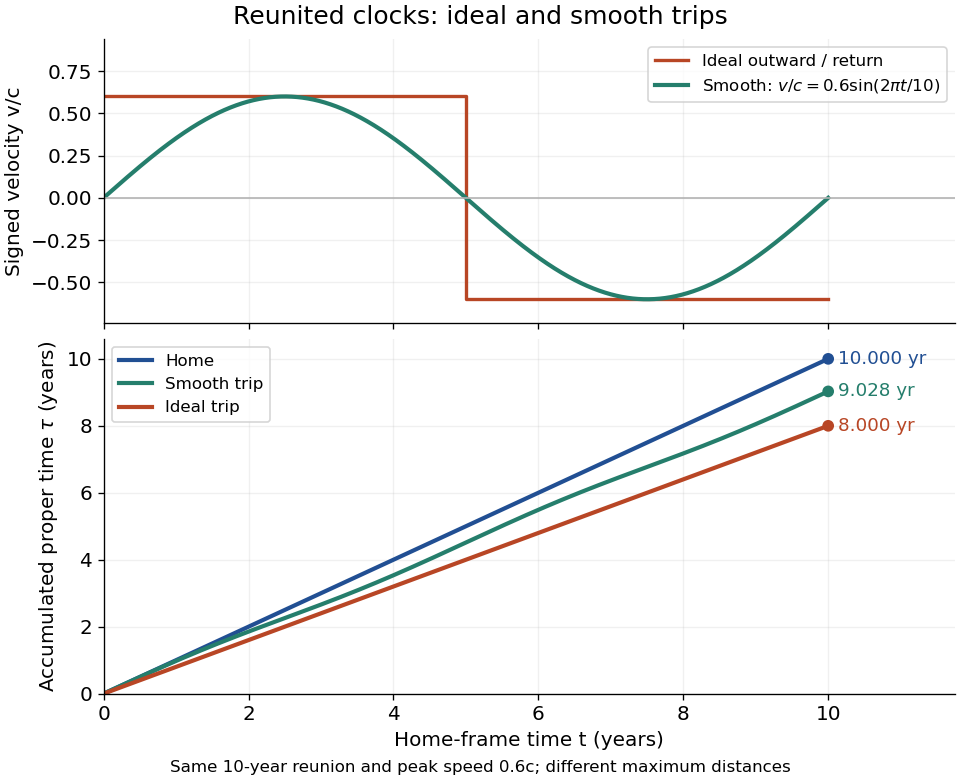
Signed velocity and accumulated proper time for ideal and smooth trips with the same ten-year reunion and maximum speed 0.6c; their turnaround distances differ
. Details. For a sufficiently short smooth reversal replacing the corner, the proper time approaches the piecewise inertial result. A reversal interval of home duration contributes between zero and to the clock reading; shrinking that interval cannot create a finite extra loss concentrated at the corner. The finite difference survives in the long coasting legs. Keeping the same reversal manoeuvre while lengthening those legs changes the age difference. Conversely, two travellers following mirrored paths with the same speed history accumulate equal proper times, even though both accelerate. Thus acceleration distinguishes paths and enables reunion here, but an amount of acceleration alone does not determine the age difference.
The changing simultaneity assignment also becomes continuous. At a traveller spacetime event with instantaneous velocity , the momentarily comoving inertial frame assigns home time . Differentiating givesDuring the reversal at positive , the last term advances the assigned home time rapidly. It describes the traveller's changing relativity of simultaneity, not a locally measured alteration of the home clock's ticking.
The clock hypothesis says that an ideal clock following a timelike curve measures its proper time: its instantaneous rate depends on velocity through , with no separate acceleration term. Acceleration still changes the world line and hence the accumulated proper time. A physical clock may suffer disturbances under forces or environmental changes, so experiments must distinguish its mechanism's errors from the geometric prediction.
The 1972 paper Around-the-World Atomic Clocks: Observed Relativistic Time Gains by J. C. Hafele and others reports four cesium-beam atomic clocks flown around the world in October 1971, eastward and westward. Their readings were compared with the U.S. Naval Observatory reference time scale before and after travel. An electronic time-interval counter resolved differences to the nearest nanosecond; intercomparisons among the flying clocks continued during travel. The final ensemble results were eastward and westward; the quoted spreads are standard deviations. These are corrected clock offsets, not raw readings or aircraft travel times. Four clocks allowed identification of individual rate changes through patterns in their mutual differences. The authors also report magnetic shielding and laboratory orientation checks. Their analysis could not detect a disturbance common to every flying clock, and the small ensemble limits statistical conclusions. This is a concrete reunited-clock experiment with apparatus, readout and drift controls.[ref]
Around-the-World Atomic Clocks: Observed Relativistic Time Gains by J. C. Hafele and others. pp. 168–170: Table 1, electronic counter, correlated rate-change analysis, magnetic shielding and common environmental effects
The companion paper Around-the-World Atomic Clocks: Predicted Relativistic Time Gains by J. C. Hafele and others computes eastward and westward from the recorded flight paths. These are predictions, with flight-data uncertainty estimates. Both time dilation from motion and gravitational time dilation matter: aircraft clocks at altitude experience a different gravitational potential, while the rotating Earth means a ground clock is not the inertial home clock of our simple model. Eastward and westward motion change the aircraft's velocity relative to an approximately nonrotating inertial frame, not merely its speed relative to the ground. The measured agreement therefore tests combined special relativity and general relativity; the westward gain does not contradict the maximum-proper time result for fixed endpoints in Minkowski spacetime.[ref]
A complementary microscopic test is Measurements of relativistic time dilatation for positive and negative muons in a circular orbit by J. Bailey and others. The authors measured muon decay lifetimes in a storage ring at Lorentz factor : for positive muons and for negative muons. The reported positive-muon lifetime agrees with the independently measured lifetime at rest and special relativity to a fractional error of at 95% confidence. This is a decay-lifetime readout under continuous centripetal acceleration, rather than a reunion of portable clocks. It supports the clock hypothesis for this physical process and regime; the inspected abstract does not establish universal immunity of every clock mechanism to acceleration. [ref]
An atomic clock uses an atomic transition as a frequency reference for an oscillator; counting its calibrated cycles realizes a time interval. In a passive beam implementation, the chemical atoms are repeatedly prepared, interrogated and detected, while feedback control corrects the continuously running oscillator. The Ramsey separated oscillatory fields experiment explains how internal quantum phase becomes a measurable population signal.
The SI second fixes the unperturbed ground state hyperfine structure transition frequency of caesium-133 to exactly . This is a defining value for the ideal transition, rather than a guarantee that an operating apparatus has no shifts.[ref]
SI base unit: second (s) by Bureau International des Poids et Mesures. SI base unit: second (s), defining paragraph and equivalent duration in periods of the unperturbed caesium-133 ground-state hyperfine transition
An oven supplies a collimated caesium beam. State-selecting magnets precede and follow two coherent microwave interaction regions; a weak static magnetic field separates sublevels. The clock transition connects and . Transferred atoms reach a heated ionizing collector. A detector scan identifies the resonance before locking.[ref]
The Physical Basis of Atomic Frequency Standards by A. S. Risley. April 1971 edition, §5.3, pp. 36–38, Fig. 7
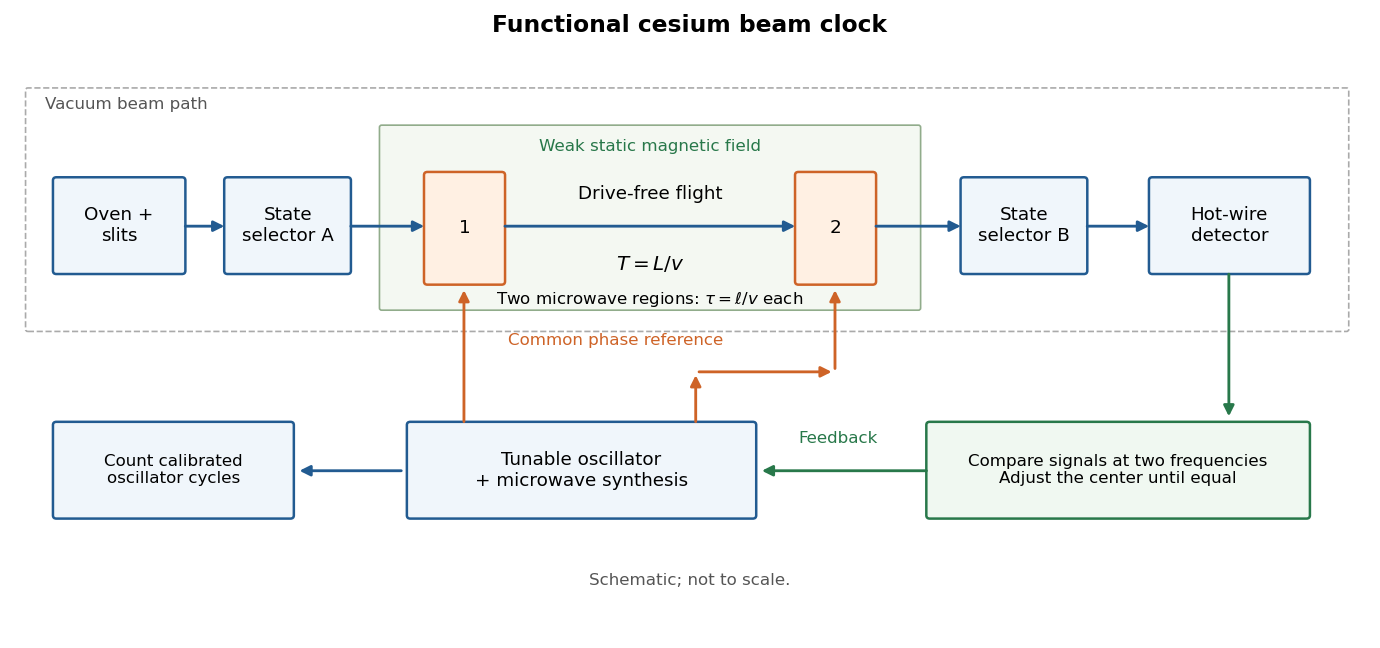
Here labels the total angular momentum and its projection. The selected pair is a two-level system inside a larger set of atomic energy levels; treating every oven atom as a prepared qubit would overstate the preparation. A measured detector signal may be modeled as , with background and gain . Background subtraction and stable transmission are necessary before interpreting the signal as a transition probability. The velocity-averaged Ramsey line provides one explicit ideal example; its chosen dimensions are not historical specifications.
A peak has zero slope at its center, so a single peak-height reading does not tell feedback control which way to tune. Instead sample the two sides at ordinary frequencies , where is a chosen modulation offset, and subtract:For an even signal around the true center , write . A Taylor expansion gives . On the descending side of a positive central peak , so the update has restoring sign for and is locally stable in this ideal discrete update when . A detector dip requires the opposite sign. These conditions follow from linearizing the update, not from assuming any particular electronics.
For the ideal signal , choose . Then . With and , a center error of gives exact . The sign directs the update toward lower frequency. Constant background cancels, but background drift between samples or asymmetric neighboring spectral lines can bias the zero. An initial scan matters because other fringes can also supply zeros.
A narrow fringe makes the center easier to resolve statistically; it does not certify an unbiased frequency. For example, with ideal pulses and a second-pulse oscillation phase offset , the finite-pulse Ramsey transition probability approachesThis sign uses exactly the Rabi detuning convention and pulse Hamiltonian operator above, with the second pulse replacing by . The factor converts angular frequency to ordinary frequency. For the original example, rad and give a shift of about . For finite pulses or distributed flight times, use the full signal and its atomic clock frequency lock rather than inserting an unweighted mean .
NIST-7 used optical pumping and fluorescence. Controls included field-sensitive transitions, independent beam-speed measurements, microwave power stabilization, and beam reversal for cavity quantum phase errors.[ref]
Primary Atomic Frequency Standards at NIST by D. B. Sullivan and others. §2.2, pp. 50–52: optical readout and frequency-shift controls
The connection to special relativity is quantitative. A freely moving emitter's proper time advances more slowly than laboratory time by . With first-order propagation effects removed in the ideal comparison, its internal laboratory frequency is thereforeCorrecting an ensemble signal requires the effective velocity weights of preparation, interrogation and detection, not simply the oven's mean speed. Additional shifts from Zeeman splitting, unwanted light, collisions and cavity fields likewise require separate evaluation; feedback control locks to the observed line, including any uncorrected bias. Comparing clocks at different gravitational potentials additionally requires gravitational time dilation. The moving-clock experiments in twin paradox clock experiments compare calibrated clock readings along different world lines; the beam atoms' internal motion is part of the clock mechanism's own correction.
Articles by others on the same topic

The Twin Paradox is a thought experiment in the realm of special relativity, famously introduced by Albert Einstein. It involves two twins, one of whom makes a journey into space in a high-speed rocket and then returns home, while the other twin remains on Earth. Due to the effects of time dilation predicted by Einstein's theory of relativity, the traveling twin will age more slowly compared to the twin who stayed on Earth.

The key question is: why is this not symmetrical?
One answer is: because one of the twin accelerates, and therefore changes inertial frames.
But the better answer is: understand what happens when the stationary twin sends light signals at constant time intervals to each other. When does the travelling twin receives them?


Another way of understanding it is: you have to make all calculations on a single inertial frame for the entire trip.
Supposing the sibling quickly accelerates out (or magically starts moving at constant speed), travels at constant speed, and quickly accelerates back, and travels at constant speed setup, there are three frames that seem reasonable:
- the frame of the non-accelerating sibling
- the outgoing trip of the accelerating sibling
- the return trip of the accelerating sibling
If you do that, all three calculations give the exact same result, which is reassuring.
Another way to understand it is to do explicit integrations of the acceleration: physics.stackexchange.com/questions/242043/what-is-the-proper-way-to-explain-the-twin-paradox/242044#242044 This is the least insightful however :-)
Bibliography: