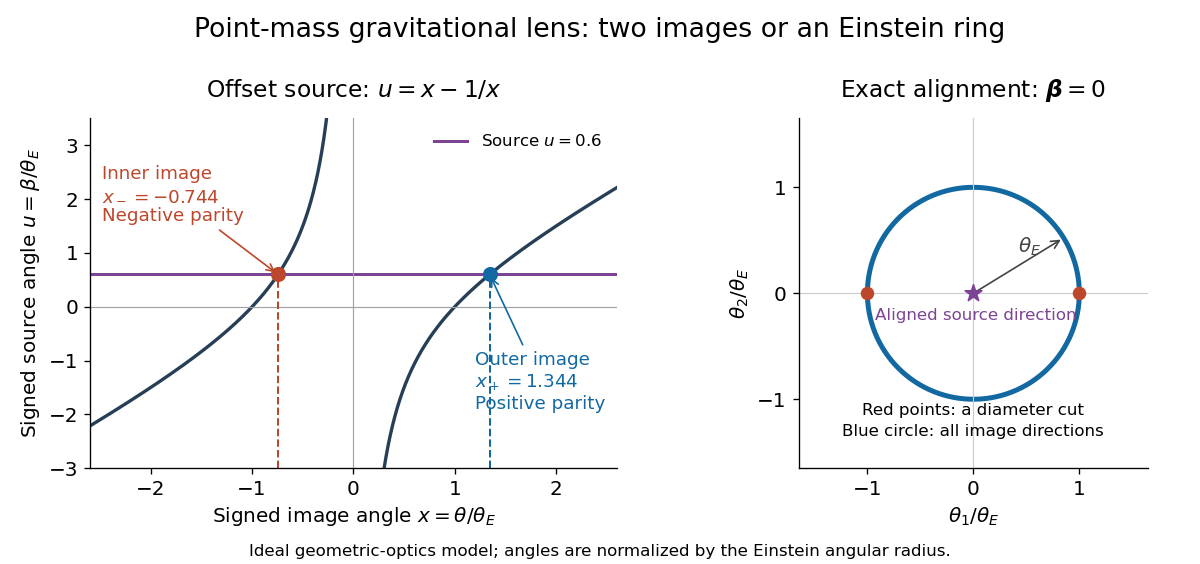
Choose a signed angular coordinate along the source-lens line. The point-mass gravitational lens becomesFor , multiplication by gives the quadratic equation . Its positive discriminant yields the two displayed roots. Their product is , so they lie on opposite sides of the lens. With , and : the outer image lies on the source side. For , the outer image is instead the minus root. These are image directions seen by the observer, not two emitting objects.[ref]
Gravitational Lensing by Matthias Bartelmann. Section 2.2, printed pp. 15-16, equations (100)-(110): point-mass model, two roots, critical circle and magnification
For a dimensionless example, set and . Solving gives and , with separation . The lensing magnification follows from image parity in gravitational lensing: , , and total amplification . Changing or the distances rescales the angles through the Einstein angular radius, while these dimensionless values remain the same.
For , the quadratic equation gives and . Using , the outer image tends to unit lensing magnification and the inner image has . Two mathematical images can therefore look like one at finite sensitivity or angular resolution. Furthermore, the inner impact parameter eventually becomes too small for the stated weak-field approximation or passes through the opaque lens: the ideal formula must then be replaced by an appropriate physical model.

Articles by others on the same topic
There are currently no matching articles.