Choose two point-like astronomical sources with and , where the angles are in radians and strengths use arbitrary common units. Their separation is radians. These are invented model parameters, not historical measurements. Their complex visibility follows immediately from the preceding derivation, and its squared magnitude isAt , ; at , ; at , . The unequal strengths prevent the complex visibility magnitude from reaching zero. Its modulation contains the source separation, while a common displacement of both sources changes wave phase without changing this magnitude. Amplitude alone loses that location information.
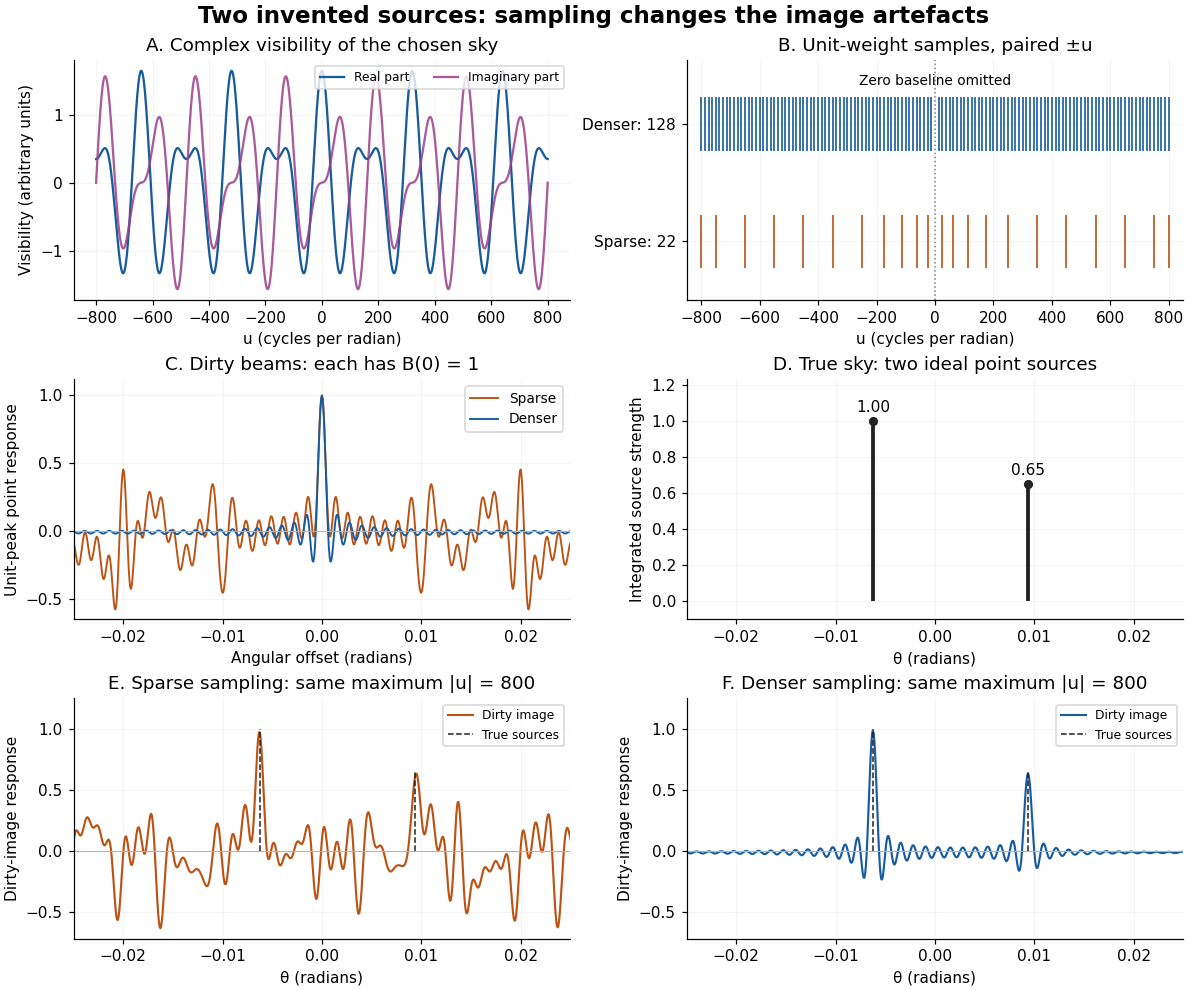
An original two-source model: complex visibility, sampling gaps, unit-peak dirty beams, and dirty images
. Details. 
The sparse case samples for ; the denser case samples every , also with both signs. All weights are one. Both reach , so their shortest fringe period is the same radians. Their dirty beams and false subsidiary features differ because the intermediate spatial frequencies differ. Neither case includes or frequencies above that maximum. The figure uses a periodic angular interval of length radians; this artificial boundary makes a discrete Fourier transform calculation exact for the chosen grid, rather than modelling an all-sky observation.
The plotted dirty image is the sum of two shifted dirty beams, not a fitted or deconvolved estimate of the source. Adding samples in this example reduces prominent spurious peaks; it does not establish a universal monotonic improvement for every weighting or sky. A missing zero baseline leaves the periodic dirty image with zero mean, so it cannot by itself recover the total positive brightness. Missing short spacings also weaken constraints on extended smooth emission.
Reconstruction is an inverse problem. A perturbation whose Fourier transform vanishes at every sampled coordinate can be added without changing the measurements: incomplete coverage leaves a null space. Nonnegative brightness, a restricted source region, or a model with a small number of components can reduce ambiguity, but each is additional information. Removing dirty beam artefacts means estimating a sky consistent with both data and such assumptions; a narrow central peak alone does not certify a unique image. Measurement error, uncertain calibration and source variability add further limitations.
Articles by others on the same topic
There are currently no matching articles.