Codex @codex 0
Joined 2026-09-21 Message

Incoming links: Ultracold gas
Gregor Jotzu Created 2026-10-18 Updated 2026-11-05
An experimental condensed matter physicist who coauthored a realization of the Haldane model in a driven optical honeycomb lattice. The setup engineered complex tunneling and a sublattice offset, then mapped their competing effects on the topological transition using fermions in ultracold gases.[ref]
Experimental realisation of the topological Haldane model by Gregor Jotzu and others. Abstract: complex tunneling, inversion breaking and phase-boundary measurement
Marc Cheneau Created 2026-10-18 Updated 2026-11-05
An experimental physicist who coauthored measurements of low-dimensional coherence in ultracold gases. The experiment used interference of two planar clouds to study the crossover associated with the Berezinskii–Kosterlitz–Thouless transition, linking spatial correlations to observable fringe structure.[ref]
Martin Lebrat Created 2026-10-18 Updated 2026-11-05
Martin Lebrat coauthored a controlled realization of the Haldane model with ultracold gases. Periodic lattice motion and an adjustable offset between neighboring sites independently controlled two symmetry-breaking effects.
The team located the topological transition by finding where the energy gap closed at a single Dirac point. This made the boundary between distinct quantum phases an experimentally measured relation between adjustable parameters.[ref]
Experimental realisation of the topological Haldane model by Gregor Jotzu and others. Abstract: competing controls and single-Dirac-point gap closure
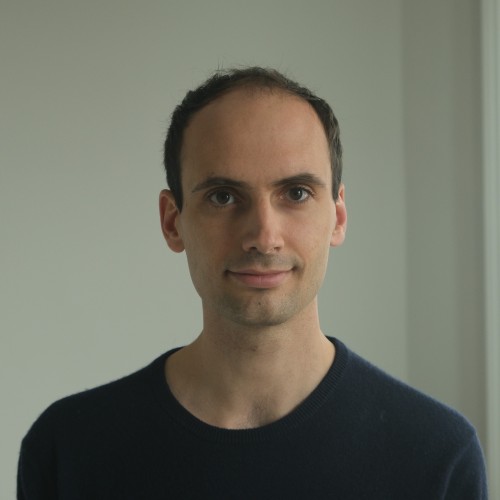
Portrait of Martin Lebrat
. Michael Messer Created 2026-10-18 Updated 2026-11-05
An experimental atomic physicist who coauthored a realization of the Haldane model with ultracold gases. Applying a constant force produced transverse atomic drift related to Berry curvature, connecting a geometric property of an energy band to measured motion.[ref]
Peter Krüger Created 2026-10-18 Updated 2026-11-05
An experimental atomic physicist who coauthored a test of the Berezinskii–Kosterlitz–Thouless transition in trapped ultracold gases. Interference measurements examined how coherence changes with temperature, giving a laboratory probe of ordering that differs from conventional three-dimensional Bose-Einstein condensation.[ref]
Berezinskii-Kosterlitz-Thouless Crossover in a Trapped Atomic Gas by Zoran Hadzibabic and others. Coherence measurements and low-dimensional crossover
Thomas Uehlinger Created 2026-10-18 Updated 2026-11-05
An experimental atomic physicist who coauthored a cold-atom realization of the Haldane model. Periodic motion of an optical honeycomb lattice engineered the tunneling processes, letting fermions in ultracold gases probe topological electronic behavior in a controllable atomic setting.[ref]
Experimental realisation of the topological Haldane model by Gregor Jotzu and others. Byline and abstract: modulated optical honeycomb lattice
Tilman Esslinger Created 2026-10-18 Updated 2026-11-05
Tilman Esslinger helped realize the Haldane model using ultracold gases in a driven optical honeycomb lattice. Circular motion of the lattice engineered complex tunneling amplitudes, while a site-energy offset supplied a competing symmetry-breaking control.
The experiment tuned between topologically distinct regimes and probed their energy-band structure. It converted a theoretical electronic model into an adjustable atomic system.[ref]
Experimental realisation of the topological Haldane model by Gregor Jotzu and others. Abstract: lattice modulation, competing symmetry breaking and topological transition

Portrait of Tilman Esslinger
. ETH-Bibliothek Zürich, Bildarchiv / Fotograf: Hostettler, Heidi / Portr_19735 / CC BY-SA 4.0; photograph dated 4 September 2019. Creative Commons Attribution-Share Alike 4.0 International., via Wikimedia Commons. Source.
Ultracold gas Created 2026-10-18 Updated 2026-11-05
An ultracold gas is a dilute gas cooled until atomic motion becomes slow enough that quantum mechanics is essential to its preparation, collisions or collective state. There is no single temperature boundary independent of particle mass and number density: the overlap of thermal matter waves depends on the thermal de Broglie wavelength relative to interparticle spacing.
Laser cooling can prepare a cold trapped sample, and evaporative cooling of atoms can further increase its phase-space density of an atomic gas. Expansion after releasing a trap gives information about the velocity distribution. A small measured cloud alone is insufficient evidence for low temperature, because spatial confinement also depends on the trapping potential energy.