F. Duncan M. Haldane's 1988 tight-binding model adds complex second-neighbour hopping and opposite sublattice offsets to a honeycomb lattice. Directed phases break time-reversal symmetry while each primitive cell has zero net magnetic flux. Smaller loops can enclose magnetic flux; ordinary Bloch states remain available.[ref]
Model for a Quantum Hall Effect without Landau Levels: Condensed-Matter Realization of the Parity Anomaly by F. Duncan M. Haldane. Haldane (1988), pp. 2015–2016, Fig. 1 and Eq. (1)
Extend the nearest-neighbour model of graphene, ignoring physical spin and interactions. With bond length , , and ordered sublattice basis , chooseThe following Bloch Hamiltonian defines ; reversing directed second-neighbour hopping sends :The Pauli matrices act on sublattice amplitudes, as in sublattice pseudospin in graphene. The identity matrix term shifts both energy eigenvalues equally at each momentum; it changes neither the eigenvectors nor the direct separation . A genuine band insulator additionally needs . We use in the figures, within the original paper's sufficient nonoverlap restriction .[ref]
Model for a Quantum Hall Effect without Landau Levels: Condensed-Matter Realization of the Parity Anomaly by F. Duncan M. Haldane. Haldane (1988), p. 2016, immediately after Eq. (1): nonoverlapping bands
The only zeros of , modulo the reciprocal lattice, are the two Dirac valleys in graphene,At these momenta . Thus the two Dirac mass coefficients, measured in energy units, are , with . For ,The two Dirac cones have opposite orientation, encoded by . A scalar sublattice offset gives equal-sign Dirac masses; imaginary second-neighbour hopping at gives opposite-sign Dirac masses. Both mechanisms open valley gapsAn observed band gap alone therefore cannot establish a Chern insulator. In particular, the gapless nearest-neighbour model of graphene and its sublattice-mass deformation should not be confused with the topologically nontrivial Haldane model.
A band gap closes when all three components of vanish. Since only at the two valleys, the phase boundaries are exactly . Usually one valley becomes massless; at , , both do. The occupied-band Chern number is undefined at every such touching, even if a numerical momentum grid misses its location.
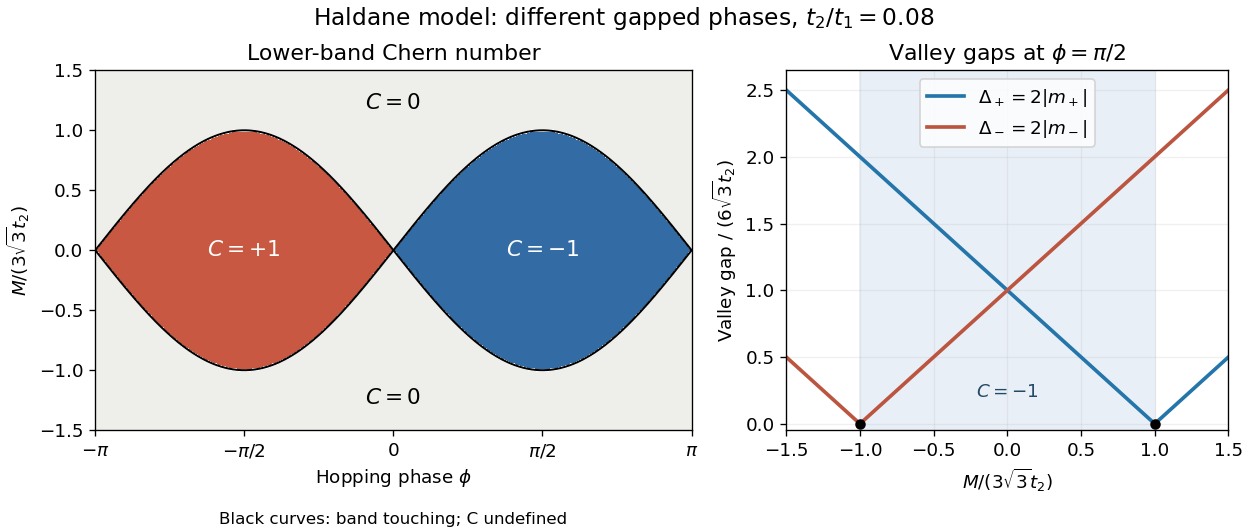
Haldane phases meet where a valley gap closes
. Original model calculation with the stated lower-band Berry-connection convention and . Left: integer Chern numbers; black curves denote singular parameters, where no Chern number is assigned. Right: the two valley gaps along ; the vertical axis shows valley gaps, rather than an assumption about global band extrema. No experimental data are plotted. Source. Details.
For , put . The lower-band orthogonal projector is . Applying the Pauli matrix multiplication law to givesThus the Chern number is the signed number of times the Brillouin zone covers a two-sphere under . The lower energy eigenstate's actual Bloch vector is . The Berry curvature has the displayed positive sign for this lower band and the stated Berry connection; switching to the upper band changes its sign.
A useful local calculation exposes what each valley contributes. Write . The linear Dirac Hamiltonian givesEach unbounded continuum cone gives a half-integer in this calculation. It is not a separately realizable half-integer Chern number of an isolated lattice energy band. The full honeycomb lattice supplies both valleys and the large-momentum completion. Starting with a trivial large- state, each single-valley mass crossing changes the lattice integer by the corresponding unit. There are no other band touchings. This establishes the exact lattice resultfor , excluding the boundaries. This sign belongs to our explicit bond vectors, orientation and occupied-band convention.
For an original worked example, choose , , and . Then , , both valley gaps are , and . Choosing instead , gives exactly the same valley-gap magnitudes but . The first state's two valley contributions reinforce; the second state's cancel.
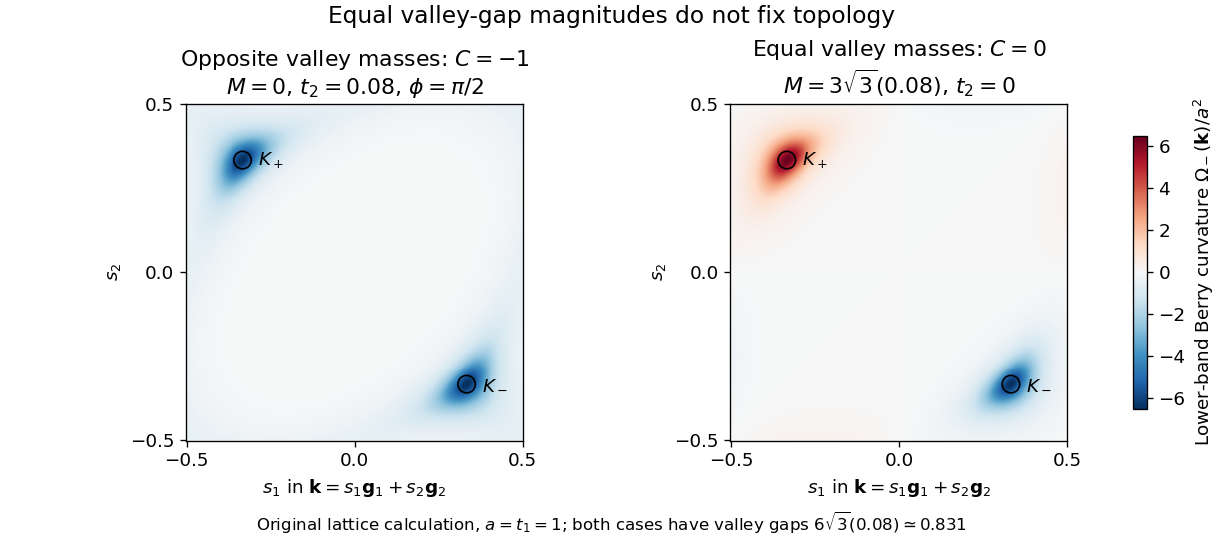
Equal valley gaps can conceal different Berry-curvature topology
. Original calculation of the lower-band Berry curvature of the two explicitly defined lattice Hamiltonians, using the same colour scale. One reciprocal primitive cell is shown in fractional coordinates, with , , and . The bond length is . The coloured surfaces are model results, not measured curvature or a reconstruction of experimental data. Source. Details.
An independent eigenvector-overlap calculation on periodic , and momentum grids gives for the first example and for the second. Reversing in the first example gives . Direct integration of the analytic lattice Berry curvature agrees. For the overlap calculation one can remove the embedding phase from , replacing it by ; this makes the cell-basis Hamiltonian periodic and prevents a false boundary-seam contribution. The local Berry curvature can depend on this basis convention; the integrated Chern number agrees. All mass-zero parameters are excluded before evaluating any integer.
Gregor Jotzu and collaborators realized an artificial Haldane model in 2014. They loaded spin-polarized potassium-40 fermions into a laser-made honeycomb lattice. Piezoelectric mirrors shook the optical lattice along two axes; their relative phase controlled time-reversal symmetry breaking. Optical phase control adjusted the sublattice offset.[ref]
A magnetic field gradient drove Bloch oscillations. Band mapping measured interband transfer to locate valley-gap closures. Opposite-force drift measurements distinguished cancelling from reinforcing Berry curvature contributions; reversing shaking handedness reversed the drift. Interband transfer and harmonic confinement affected this readout, including drift beyond ideal transition lines. This neutral-atom Floquet Hamiltonian realization did not measure electrical sheet conductivity. Magnetic fields were used for preparation and forcing.[ref]
Articles by others on the same topic
There are currently no matching articles.