Now take one equation for two unknowns:The linear system has an entire affine line of exact solutions. Since has full row rank, its Moore-Penrose inverse isThe kernel is , and all exact solutions areBecause is orthogonal to ,The Euclidean norm is therefore smallest exactly at . The zero residual alone cannot select a solution; the minimum-norm rule supplies the additional criterion.
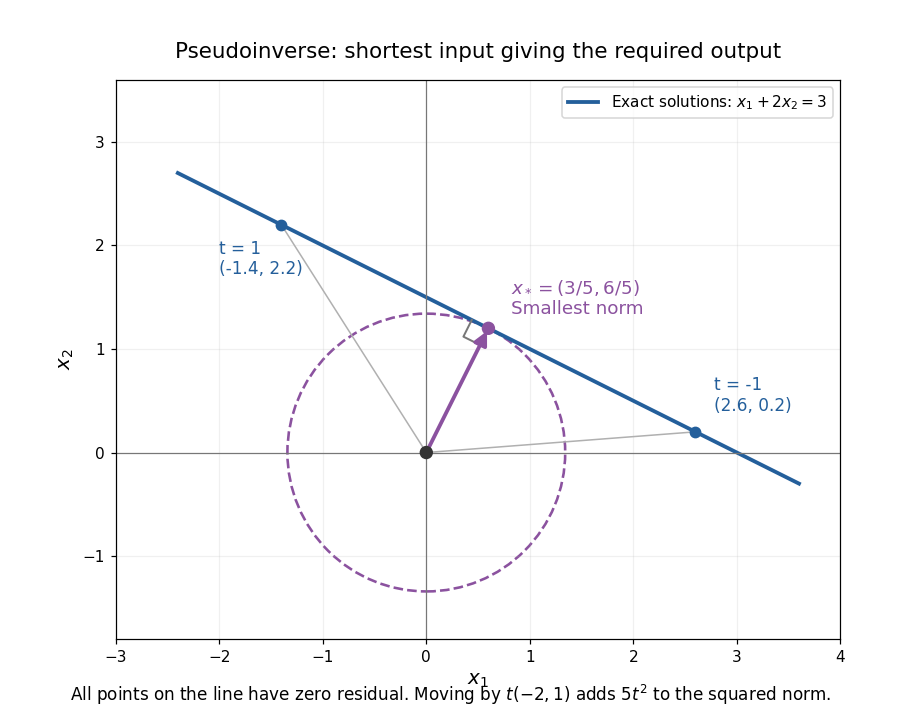
The minimum-norm solution is the closest point of the solution line to the origin
. The affine line is perpendicular to . Moving along the line changes only a kernel component and increases by . Details.
This selection depends on the specified inner product. Rescaling one unknown changes what counts as a small Euclidean norm, so units and weighting matter in an application. A minimum-norm answer is mathematically canonical for the chosen geometry, rather than an automatic guarantee of physical plausibility.
Articles by others on the same topic
There are currently no matching articles.