For each positive integer , put on . Its supremum norm is exactly , so this sequence of functions converges to zero by uniform convergence. Nevertheless,Each of its complete sine oscillations contributes : rise from zero to , fall through zero to , then return to zero. Taking a partition of an interval through all extrema attains . Every further partition refinement merely subdivides monotone function segments, so the same reasoning as in partition example of total variation proves the upper bound too.
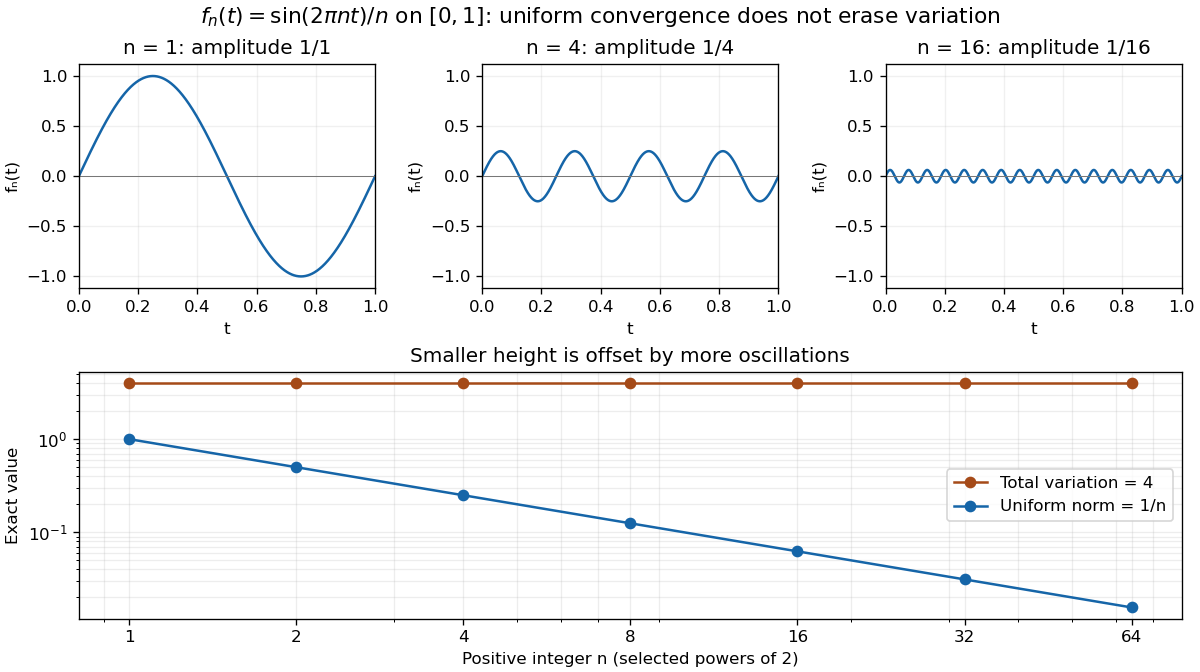
The functions sin(2πnt)/n converge uniformly to zero while their total variation remains 4; all three function plots use the same vertical scale
. Details. 
For a continuously differentiable function on a closed bounded interval, total variation also satisfiesApplied here, the derivative is , and integrating its absolute value over periods gives . The differentiability hypothesis matters: the partition definition applies much more widely than this derivative formula.[ref]
1 Algebraic and Analytic Methods. NIST Digital Library of Mathematical Functions; §1.4(v), equations 1.4.33–1.4.34, Functions of Bounded Variation
Small pointwise size and small accumulated movement are different approximation goals. Articles by others on the same topic
There are currently no matching articles.