For a subset of a partially ordered set, its infimum is its greatest lower bound and its supremum is its least upper bound. An upper bound only has to lie above every member; the supremum is the smallest such bound. A lower bound lies below every member; the infimum is the largest such bound. These definitions identify the exact edges of a set even when neither edge belongs to it.
For example, and both have infimum zero and supremum one. Only has a minimum and a maximum: those must be actual members of the set. The set has infimum zero without a minimum, but its supremum one is also its maximum. Such examples distinguish a bound from an attained extremal value. [ref].
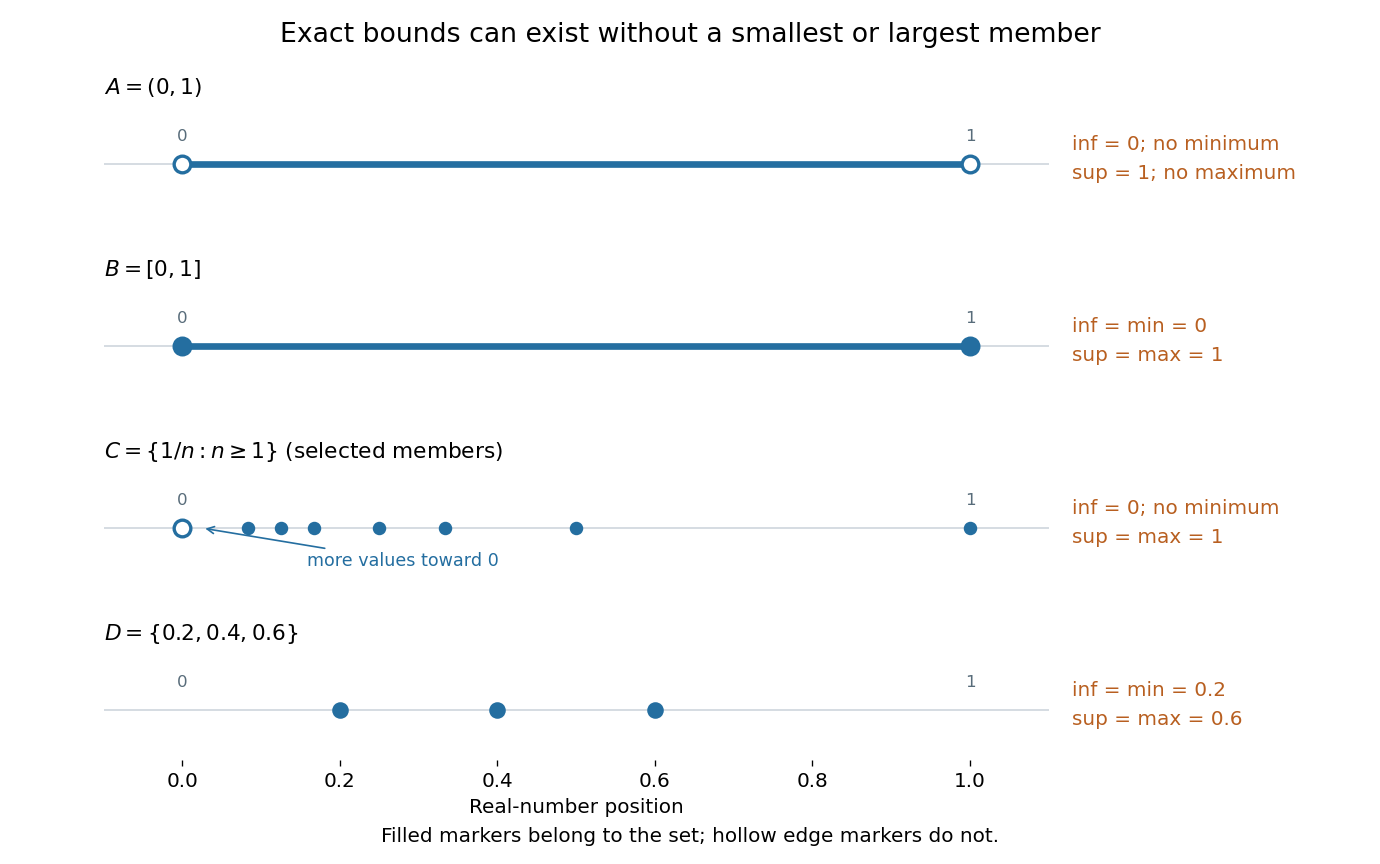
For a nonempty subset of the real numbers, completeness of the real numbers guarantees a real supremum when it is bounded above, and a real infimum when it is bounded below. The bound and the ambient partially ordered set both matter: has supremum in the real numbers, but no supremum in the rational numbers. The detailed explanation belongs to completeness of the real numbers.
Why are unattained bounds useful? They specify a precise limiting target. In mathematical optimization, on has infimum zero but no global minimizer. The inputs for give a minimizing sequence: their objective values approach zero without ever reaching it. Bounds therefore describe what approximation can achieve even when no feasible input is best. The approximation property of an infimum and approximation property of a supremum express this idea quantitatively.

