Vascular stenosis is narrowing of the lumen of a blood vessel. The location, length, shape and cause of the narrowing matter, as does the reference used to express its severity. Narrowing can leave an open lumen; it is not synonymous with complete occlusion. A vascular stent supports an existing route, while a bypass graft creates an alternative route around a diseased region.
Diameter versus area stenosis illustrates an important measurement distinction. If is the narrowest measured diameter and is the stated reference diameter, define the illustrative diameter reductionFor circular lumens the associated area reduction isA narrowing from to is therefore by diameter and by area. These are geometric calculations using a specified reference, not interchangeable clinical grading conventions. Different reference segments or reconstruction methods can give different reported percentages.
An original ideal-flow example connects geometry to an observation. For incompressible flow with the same instantaneous volume flow through both sections, conservation of mass gives . Reducing circular diameter by half reduces area to one quarter and raises mean velocity fourfold at that maintained . The real circulation can change , so this ratio is conditional, not a universal diagnostic cutoff or prediction of tissue perfusion.
Ultrasound can examine both vessel appearance and moving blood. The Society for Vascular Surgery’s carotid-duplex description identifies a hand-held sound-wave probe and coupling gel, used to look for narrowing and examine flow. Such an apparatus makes anatomy and flow-related observations available together; a velocity estimate is not itself a direct measurement of every lumen dimension.[ref]
Characterizing vascular stenosis therefore combines the geometric convention, imaging method and physiological question. A percentage alone does not establish the pressure loss, the cause of symptoms or the best intervention. Persistent patency and clinical consequences require separate follow-up observations.
Diameter versus area stenosis distinguishes two geometric ways to express vascular stenosis relative to a stated reference lumen. A percentage reduction in diameter is generally not the same percentage reduction in area.
For a circular narrowed lumen with diameter and a circular reference with diameter , define the fractional reductionsSince , the conversion isMultiply a fraction by 100 to report a percentage. A diameter change from to gives and . Conversely, a area reduction corresponds to about diameter reduction in this circular model. Converting a geometric definition is not the same thing as converting clinical grading systems.
Eccentric lumen stenosis shows why the shape assumption matters. Suppose the reference is a circle of diameter , while the narrowed lumen is an ellipse with full axes and . Its area is , half the reference area. A single view measuring the axis would show a diameter reduction, but treating that view as a circular lumen would incorrectly infer a area reduction.
The reference also matters. For the same measured narrow diameter , references and give diameter reductions and . A report should therefore identify the measurement plane or projection, the reference segment, the geometric convention and the imaging method.
For a small uncertainty in , the circular-model sensitivity is . Uncertainty in the reference and narrow diameters, including shared measurement errors, must be propagated through their ratio rather than treating the percentage as a directly measured primitive quantity.
Ultrasound can supply vessel images and flow-related observations using a probe and coupling gel.[ref] A geometric stenosis estimate and a flow observation remain distinct measurements. Even a correctly converted lumen area does not determine the pressure loss or tissue perfusion without an appropriate model of the vessel and circulation.
Eccentric lumen stenosis concerns a narrowed vessel lumen whose geometry breaks the symmetry of a circular, concentric reference model. Noncircular shape and displacement away from the reference centre are distinct geometric features; neither alone identifies the composition of the surrounding tissue. The practical issue is that one observed diameter may not characterize the remaining lumen area.
For an original noncircular model, take an elliptical lumen with semiaxes and . Its area and area-equivalent lumen diameter areIf full principal diameters are and , then . This circle has the same area, not necessarily the same flow resistance, as the ellipse.
The width of the ellipse projected onto an axis at angle to its major axis isWith and , principal projected widths range from to . Relative to a circular reference, those two widths would suggest diameter reductions and , although the model's true area reduction is fixed at . The area-equivalent diameter is about .
This ideal projection calculation explains why observation direction matters. It is not a complete model of a contrast-filled, curved, moving vessel. An observed image also depends on viewing geometry, overlap, resolution and the boundary-reconstruction method. Judkins' primary coronary-arteriography work used selective catheterization with serial and cine recording, providing an apparatus for observing the contrast-filled arterial route.[ref]
Selective Coronary Arteriography: Part I: A Percutaneous Transfemoral Technic by Melvin P. Judkins. 1967, Material and Technic, selective catheterization and serial/cine recording
Diameter versus area stenosis conversions that square one diameter ratio assume a circular model. They should not be applied automatically to a single width of an eccentric or noncircular lumen. Two principal diameters can determine the area of the stated ellipse, but a general irregular outline requires more shape information. Shape, percentage narrowing and the physiological consequence of vascular stenosis remain separate questions.
The area-equivalent lumen diameter is the diameter of a circle having the same area as a measured lumen. For positive area ,It converts an area observation into a length scale without asserting that the actual lumen is circular. The definition applies to an irregular outline as well as to an ideal geometric shape.
For an ellipse with full principal diameters , area is , soAn original ellipse with diameters and has area and area-equivalent diameter . The arithmetic mean of its two diameters is , which would define a circle of larger area.
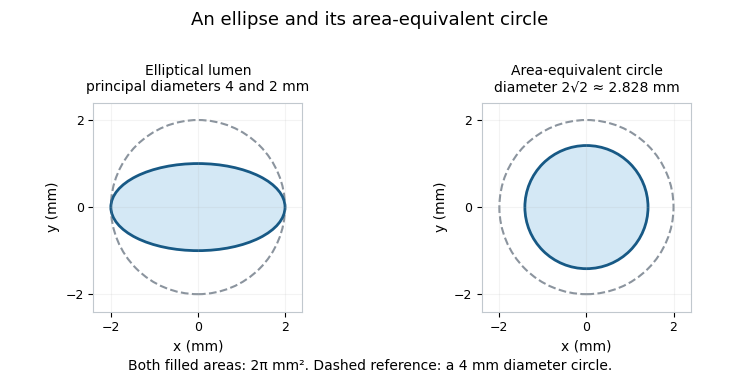

Using an equivalent diameter in a circular area-ratio formula is valid by construction:Using an arbitrary single projected width instead is not. Eccentric lumen stenosis can show different widths in different views while retaining the same area. Primary selective coronary arteriography used serial and cine recording to observe the contrast-filled arterial route; interpreting such images still requires the chosen projection and reconstruction model.[ref]
Selective Coronary Arteriography: Part I: A Percutaneous Transfemoral Technic by Melvin P. Judkins. Material and Technic, serial/cine recording
The equivalent diameter also differs from hydraulic diameter, , which includes wetted perimeter . Two equal-area outlines can have different perimeters and flow resistance. An area-equivalent circle is therefore not automatically an equivalent flow model.
For small area uncertainty, differentiation gives . A relative standard uncertainty in area gives approximately in the derived diameter if other inputs are fixed. This propagates area uncertainty; it does not correct an incorrectly segmented outline or a mismatched reference region.
Articles by others on the same topic
There are currently no matching articles.