The viscous Burgers equation combines a nonlinear transport equation with diffusion with constant . On the infinite line, a bounded initial condition gives a smooth function solving the equation for every positive time; a jump in the initial condition is smoothed rather than retained as a discontinuity. Small can nevertheless produce a steep layer, as the Viscous Burgers travelling shock illustrates. The Cole-Hopf transformation , with positive , converts this equation to the heat equation .[ref]
Positive diffusion also explains the admissibility of the inviscid limit. For the entropy flux for a scalar conservation law associated with , direct multiplication by givesThe last term is nonpositive. With convergence sufficient to pass to the limit, the vanishing viscosity approximation therefore retains an entropy inequality rather than just the weak solution equation. For general bounded data, the full Kruzhkov entropy inequalities specify the entropy solution; the quadratic identity is a useful illustration of dissipation.[ref]
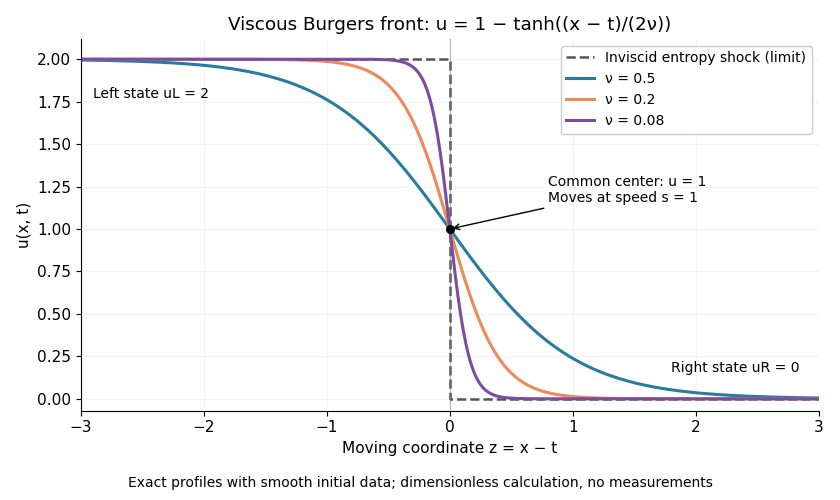
A travelling wave of the viscous Burgers equation can connect constant states through a smooth decreasing layer. Require , , , , and at both ends. Substitution and one integration giveThe speed follows by evaluating the integration constant at both end states. It is precisely the Rankine-Hugoniot condition for conservation law flux . Choosing the center gives the displayed hyperbolic tangent profile. Its characteristic width scales as ; a smaller positive makes a thinner smooth layer.
For an original worked example in dimensionless quantities, take , and :This is an exact classical solution on with its own smooth initial condition and limiting states . It is a family of moving profiles, not the finite- solution starting from an exact discontinuous step. For that different initial condition, the Cole-Hopf transformation supplies the evolution. At , this front starts from the same profile as the Burgers characteristic breaking example: positive diffusion maintains a smooth moving layer while the inviscid profile breaks at .
To check the partial differential equation explicitly, set and . ThenThe independent Rankine-Hugoniot condition check gives , using and . At fixed , the vanishing viscosity approximation tends to the entropy shock for and for . At the center the smooth profiles stay at ; changing the value on the discontinuity does not change the limiting weak solution.

For , the same integrated ordinary differential equation has between the two states when , so it cannot supply an increasing connecting front. The inviscid admissible expansion is the rarefaction wave of the Burgers Riemann problem with positive flux.
The cubic-flux variant replaces the quadratic conservative flux of Burgers' equation by . Its inviscid characteristic speed is , while positive diffusivity regularizes shock waves. It is not linearized by the usual Cole-Hopf transformation.
For a front written in connecting at to nonzero at , one integration gives . The endpoint condition fixes . Setting gives a logistic equation and the displayed profile, with the sign of selected by . The propagation speed in the coordinate is , agreeing with the Rankine-Hugoniot condition for flux .
The Fay solution is a periodic solution of the negative-flux viscous Burgers equation for . Its Fourier series has exponentially decreasing coefficients at each positive . Expanding and summing the sine series givesFor , the first harmonic gives . The Fay shock-layer asymptotics describe its opposite, small- regime.
For and , the Fay solution becomes . The partial-fraction identity for the hyperbolic tangent sums this to the displayed smooth shock layer. It resolves the odd transition from to on angular thickness ; at both sides vanish and the comparison is read through their derivatives.
A localized negative-flux Burgers N-wave has initial profile on and zero outside, for . The Cole-Hopf solution for a Burgers N-wave expresses its viscous evolution in Gaussian interval masses. In the vanishing-viscosity limit, the interior slope becomes and its entropy-shock fronts move to .
For the negative-flux viscous Burgers equation, the Cole-Hopf transformation uses . Initial N-wave data give inside and one outside. Completing the square in the heat kernel convolution gives, with ,The Gaussian interval masses and their exponentially weighted tails must be treated together when taking the small-diffusion limit.
For positive diffusivity, the Cole-Hopf transformation with converts the negative-flux equation into the heat equation. Step data give a ratio of two Gaussian-tail integrals . At , and . Its vanishing-viscosity limit selects the shock or rarefaction wave in the Burgers Riemann problem with negative flux, depending on the sign of .
The viscous Burgers step solution with negative flux is symmetric around after subtracting . Its Gaussian-tail ratio equals one precisely at this midpoint, giving for either sign of . For this point becomes the entropy-shock center in the vanishing viscosity approximation; for it is the center of a rarefaction wave. The same trajectory therefore does not by itself identify a shock.
The Cole-Hopf transformation converts the viscous Burgers equation into the heat equation . Initial data correspond to .
Substituting into the viscous Burgers equation gives . Integration permits the arbitrary function in the title. Multiplication of by preserves and reduces its equation to the heat equation. Thus the heat-equation representation uses a permissible time normalization rather than a condition uniquely imposed on every representative .
For and initial data , the Cole-Hopf transformation gives . The Fourier series of this exponential and the heat equation give the displayed exact positive diffusion solution. Its first harmonic gives . The large-argument asymptotic expansion of a modified Bessel function makes the ratio tend to one as .
For the negative-flux viscous Burgers equation , set . A sum of exponentials in the initial heat data evolves into , giving the displayed softmax function average. Two terms produce a traveling tanh shock from the lower to the higher state, with speed minus their mean.
For ordered states , in the moving frame the first and last exponents in the finite-exponential Cole-Hopf solution have the same leading coefficient. Each interior state's coefficient is smaller by . Thus the large- moving-frame profile is the two-state shock between the extremes. At fixed , the endpoint of largest absolute value dominates; equal opposite extremes leave a stationary shock.
Articles by others on the same topic
There are currently no matching articles.