Give the geometric realization of an abstract simplicial complex the quotient topology obtained by gluing the disjoint union of its standard simplexes along their labelled faces. A subset is open exactly when is open in every closed geometric simplex . This is the weak realization topology. It is the topology of its CW complex structure; the word weak here refers to the simplexwise test, rather than to the weak topology of a topological vector space. A map out of the realization is continuous exactly when its restriction to every simplex is continuous.
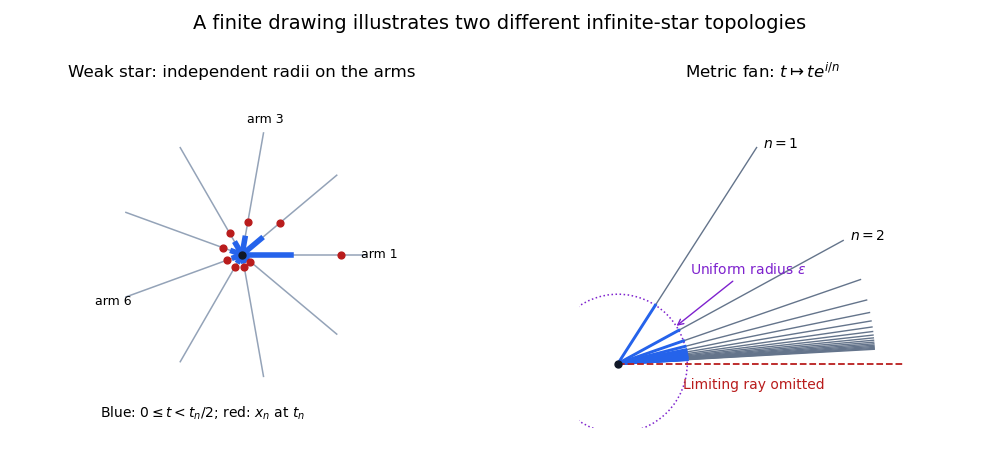
Identify the initial endpoints of countably many closed intervals to a vertex , using the quotient topology. This is the geometric realization of the complex whose only edges are . A neighbourhood of may contain a separately chosen initial interval on each arm, with no positive lower bound on the .
The space is not first countable. Given any proposed countable neighbourhood basis at , choose a point at coordinate on arm with . This is possible by the interval topology on that arm. The set whose intersection with arm is is an open neighbourhood of , by the simplexwise definition. But for every , so no lies inside . Consequently this weak star cannot embed in the plane, or in any metric space.
The terminal vertices form an infinite closed discrete subset: on each closed arm they meet only its terminal endpoint. Hence the star is not compact, by closed discrete subsets of compact spaces are finite.

Articles by others on the same topic
There are currently no matching articles.