Take one copy of the standard geometric simplex for every face of an abstract simplicial complex , label its vertices by , and identify equally labelled common faces. Give the result the quotient topology from the disjoint union of all these simplexes. Equivalently, a point is a finitely supported family of barycentric coordinates with and .
The weak topology of a simplicial realization makes open precisely when is open in every closed simplex. This definition determines the topology even for infinite complexes, when a metric realization of a simplicial complex may give a different topology.[ref]
Topology and Groups by Marc Lackenby. Definitions I.17–I.18, printed pp. 8–9: labelled simplexes and gluing of their faces
Represent a point by finitely supported barycentric coordinates with and support a simplex. Restricting the displayed Euclidean metric on these coordinates gives a metric realization. The coordinate-sum is finite because both points have finite support. For a finite simplicial complex, this agrees with the weak topology of a simplicial realization: the coordinate map from the finite quotient realization is a continuous bijection from a compact space to a Hausdorff space, hence a homeomorphism. For an infinite complex the two topologies can differ, as the countable-star examples demonstrate.
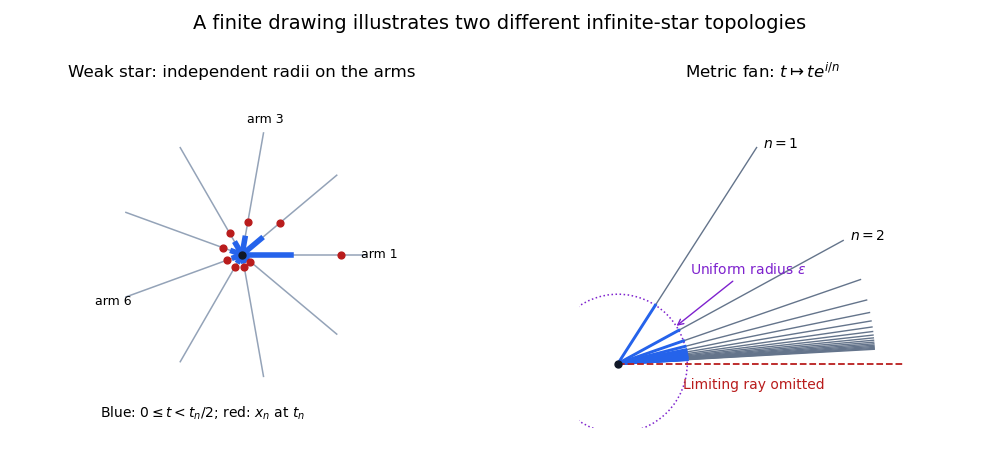
In the metric realization of a simplicial complex, the point on arm at parameter is . Its distance from the common vertex is . Consequently the vertex has a neighbourhood basis consisting of one uniformly short initial interval on every arm. Away from that vertex, each arm is locally isolated from the other arms.
The map , with all identified, is a homeomorphism ontoIt is a bijection, preserves the one-dimensional topology on each arm away from zero, and matches the uniform-radius neighbourhood bases at zero. The positive real limiting ray is omitted. The outer endpoints form an infinite closed discrete subset in the original metric realization, so the image is not compact. This planar fan and the weak realization of a countable star have different topologies at their common vertex.
Give the geometric realization of an abstract simplicial complex the quotient topology obtained by gluing the disjoint union of its standard simplexes along their labelled faces. A subset is open exactly when is open in every closed geometric simplex . This is the weak realization topology. It is the topology of its CW complex structure; the word weak here refers to the simplexwise test, rather than to the weak topology of a topological vector space. A map out of the realization is continuous exactly when its restriction to every simplex is continuous.
Identify the initial endpoints of countably many closed intervals to a vertex , using the quotient topology. This is the geometric realization of the complex whose only edges are . A neighbourhood of may contain a separately chosen initial interval on each arm, with no positive lower bound on the .
The space is not first countable. Given any proposed countable neighbourhood basis at , choose a point at coordinate on arm with . This is possible by the interval topology on that arm. The set whose intersection with arm is is an open neighbourhood of , by the simplexwise definition. But for every , so no lies inside . Consequently this weak star cannot embed in the plane, or in any metric space.
The terminal vertices form an infinite closed discrete subset: on each closed arm they meet only its terminal endpoint. Hence the star is not compact, by closed discrete subsets of compact spaces are finite.

The open star of a vertex is the union of the relative interiors of the simplices containing . The open stars of the vertices cover the geometric realization.
The topological realization of a simplicial complex with infinitely many vertices is not compact. Its vertex open star in a simplicial complex form an open cover, but a vertex belongs only to its own star. Thus every finite collection of vertex stars omits all the other vertices. The argument uses the weak topology of a simplicial realization, in which a vertex star is open because its complement is the realization of the subcomplex of simplices missing that vertex. No local finiteness assumption is required.
Articles by others on the same topic
There are currently no matching articles.