
A laboratory vacuum is a region with substantially reduced gas pressure, rather than an experimentally perfect absence of matter. Lowering the number density increases the mean free path, allowing a molecular beam to travel with fewer collisions. In molecular flow, the mean free path exceeds the apparatus dimensions, so wall encounters dominate.
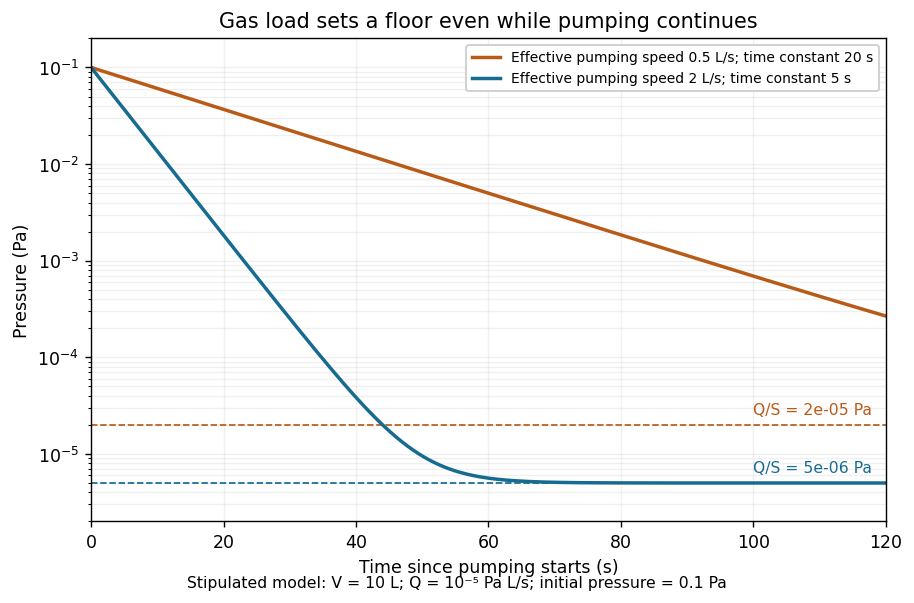
A vacuum pump competes with leaks and outgassing. For an isothermal vessel of volume , constant gas load in pressure-volume per unit time, and effective pumping speed , gas balance givesThis ideal model predicts a pump-down time constant and a limiting pressure . A restricted connecting pipe reduces the effective pumping speed; a larger pump alone need not fix it. Measuring the pressure transient tests the model, while deviations can reveal changing outgassing or pumping speed.[ref]

A vacuum is a space that is essentially devoid of matter, meaning it has very low pressure and density, and contains very few particles, such as atoms or molecules. In an ideal vacuum, there would be no air or any other substances; however, achieving a perfect vacuum is practically impossible. In physics, vacuums are often described in terms of pressure, with standard atmospheric pressure at sea level being about 101,325 pascals (or 1 atmosphere).


New to topics? Read the docs here!