
If we pick k elements of the set, the stabilizer subgroup of those k elements is a subgroup of the given permutation group that keeps those elements unchanged.
Note that an analogous definition can be given for non-finite groups. Also note that the case for all finite groups is covered by the permutation definition since all groups are isomorphic to a subgroup of the symmetric group
TODO existence and uniqueness. Existence is obvious for the identity permutation, but proper subgroup likely does not exist in general.
Group of all permutations.
Note that odd permutations don't form a subgroup of the symmetric group like the even permutations do, because the composition of two odd permutations is an even permutation.
It doesn't need to be a bipedal robot. We can let Boston Dynamics worry about that walking balance crap.
It could very well instead be on wheels like arm on tracks.
Or something more like a factory with arms on rails as per:
- Transcendence (2014)
- youtu.be/MtVvzJIhTmc?t=112 from Video "Rotrics DexArm is available NOW! by Rotrics (2020)" where they have a sliding rail
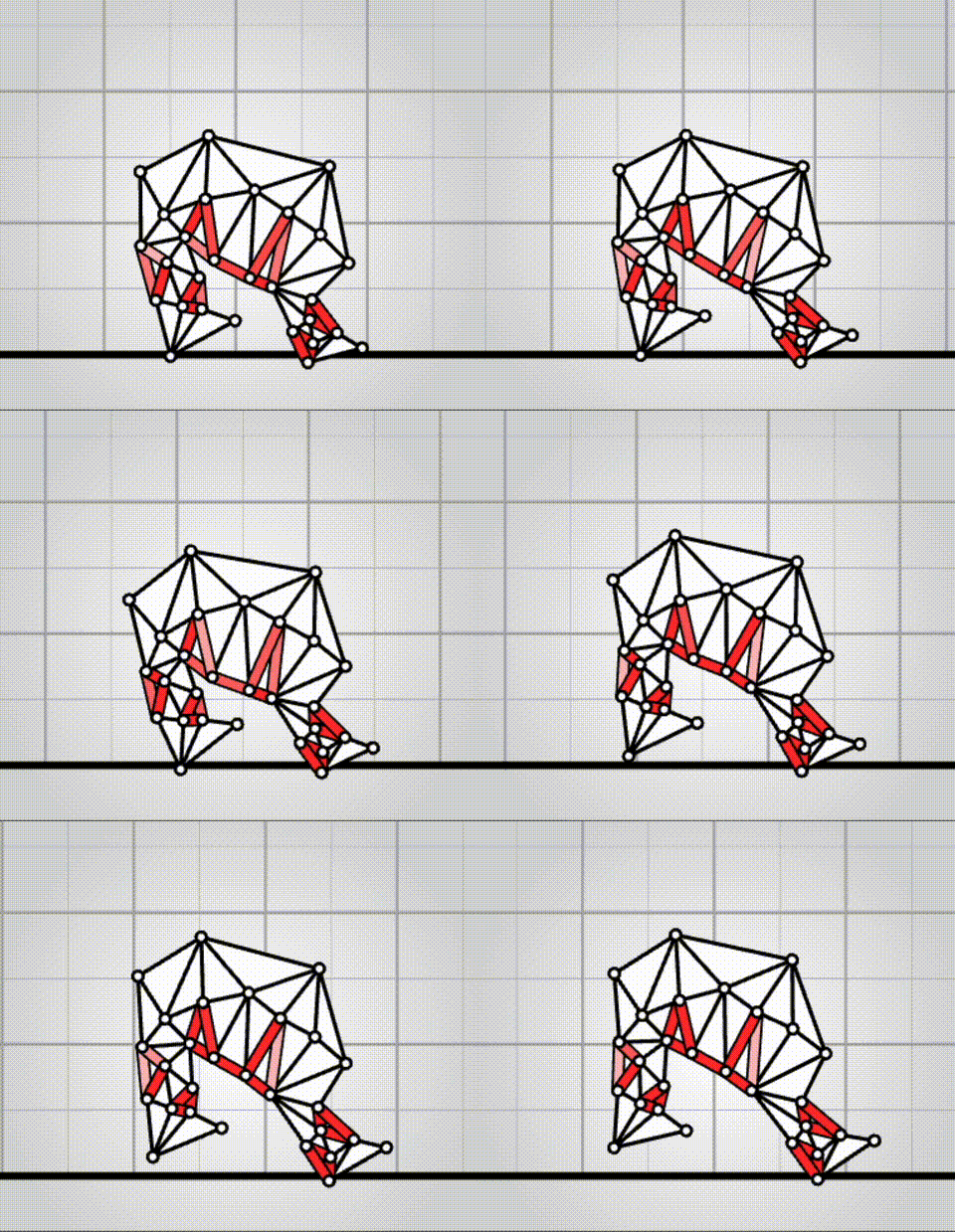
Algovivo demo
. github.com/juniorrojas/algovivo: A JavaScript + WebAssembly implementation of an energy-based formulation for soft-bodied virtual creatures.A cross browser, cross platform, and server-encrypted password manager is a must after Snowden!!! E.g. Proton Pass. And governments should obviously provide one to its citizens, or else be spied upon by the USA obviously: Governments should provide basic Internet infrastructure.
A major difficulty of getting such this to work is that may university teachers want to retain closed copyright of their work because they:
- want to publish a book later and get paid. Yes, the root problem is that teachers get paid way too little and have way too little job security for the incredibly important and difficult extremely difficult job they are doing, and we have to vote to change that
- are afraid that if amazing material is made freely available, then they would not be needed and lose their jobs. Once again, job security issue.
- believe that if anyone were allowed to touch their precious content, those people would just "screw it up" and make it worse
- don't even want to publish their notes online because "someone will copy it and take their credit". What a mentality! In order to prevent a theft, you are basically guaranteeing that your work will be completely forgotten!
- don't want students to read the notes and skip class, because spoken word has magic properties and imparts knowledge that cannot otherwise conveyed by a book
- are afraid that mistakes will be found in their material. Reputation is of course everything in academia, since there is no money.So it's less risky to have closed, more buggy notes, than open, more correct ones.This can be seen clearly for example on Physics Stack Exchange, and most notably in particle physics (well, which is basically the only subject that really gets asked, since anything more experimental is going to be blocked off by patents/interlab competition), where a large proportion incredibly amazing users have anonymous profiles.They prefer to get no reputation gains from their amazing contributions, due to the fear that a single mistake will ruin their career.This is in stark contrast for example to Stack Overflow, where almost all top users are not anonymous:List of top users: physics.stackexchange.com/users?tab=Reputation&filter=all and some notable anonymous ones:
- physics.stackexchange.com/users/2451/qmechanic
- physics.stackexchange.com/users/50583/acuriousmind
- physics.stackexchange.com/users/43351/profrob
- physics.stackexchange.com/users/84967/accidentalfouriertransform
- physics.stackexchange.com/users/56997/curiousone
- physics.stackexchange.com/users/139781/probably-someone
- physics.stackexchange.com/users/206691/chiral-anomaly
Therefore the only way is to find teachers who are:The forced option therefore seems like a more bulk efficient starting point for searches.
- enlightened to use such licenses
- forced by their organizations to use such licenses
No matter how much effort a single person puts into writing perfect tutorials, they will never beat 1000x people + an algorithm.
It is not simply a matter of how much time you have. The fundamental reason is that each person has a different background and different skills. Notably the young students have radically different understanding than that of the experienced teacher.
Therefore, those that refuse to contribute to such platforms, or at least license their content with open licenses, will inevitably have their work forgotten in favor of those that have contributed to the more open platform, which will eventually dominate everything.
Perhaps OurBigBook.com is not he killer platform that will make this happen. Perhaps the world is not yet ready for it. But Ciro believes that this will happen, sooner or later, inevitable, and he wants to give it a shot.
Also worth checking:
- jornal.usp.br/universidade/usp-de-sao-carlos-oferece-aulas-de-graduacao-em-matematica-e-estatistica-abertas-ao-publico/ "Open Classroom" program from the University of São Paulo. We should Google for "Open Classroom" a bit more actually.
- open.ed.ac.uk/about/: talk only

One major advantage: eukaryotes can do phagocytosis due to their cytoskeleton.
There are unlisted articles, also show them or only show them.