Change of basis is a concept in linear algebra that involves converting coordinates of vectors from one basis to another. In simpler terms, every vector in a vector space can be expressed in terms of different sets of basis vectors. When we change the basis, we are essentially changing the way we describe vectors in that space. A basis for a vector space is a set of linearly independent vectors that span the space.
Articles by others on the same topic

A change of basis rewrites a vector using a different ordered basis of the same vector space. The vector stays fixed; its coordinate vector changes because the measuring directions change. Both bases must describe every vector uniquely, so a change of basis is reversible.
Start with the Cartesian basis , , and choose the new basis vectors and . For the vector ,The second coordinate vector says to travel once along and once along . Their vertical contributions cancel, leaving exactly the original horizontal arrow. The diagram shows two descriptions of that same arrow, with the same origin and endpoint.
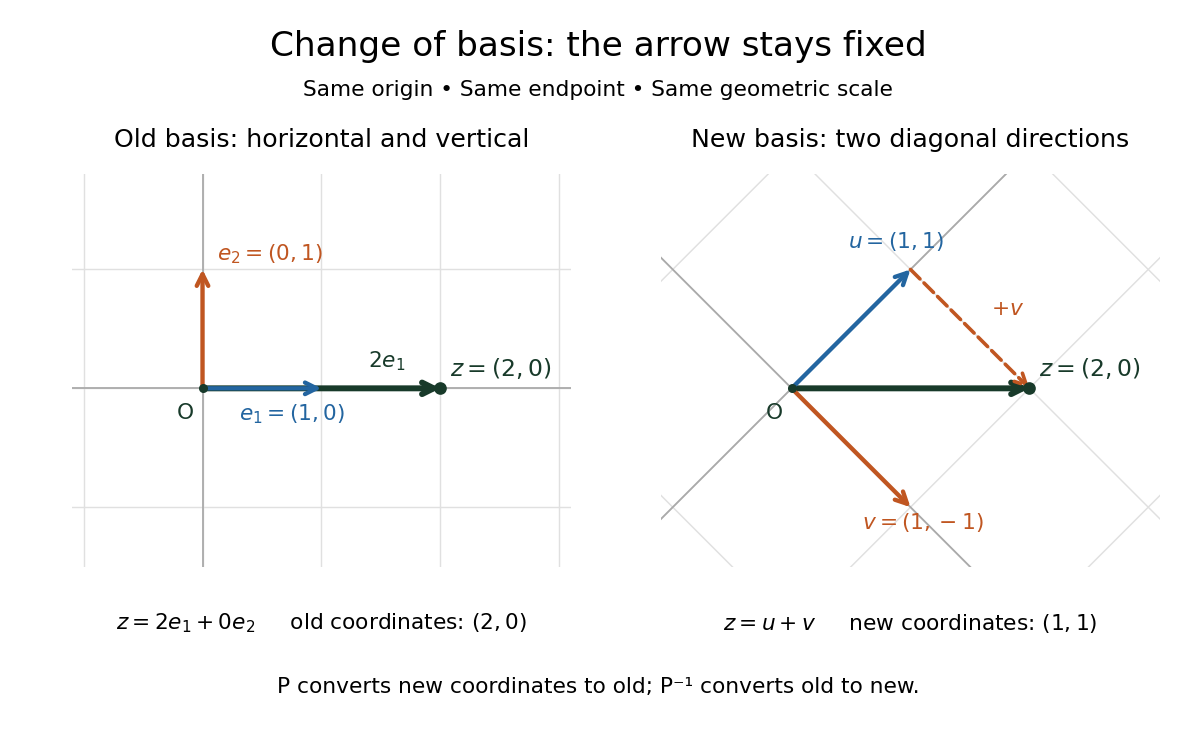
Choosing a useful basis can reveal simple structure hidden by the old coordinate vectors. Here the new basis describes common and opposing contributions. For two equal measurements , the new coordinate vector is : only the common contribution is present. In larger examples, a suitable basis can concentrate important information into a few coefficients. Strang's lecture on change of basis develops this principle through applications: the reversible change of basis preserves information, while subsequently discarding small coefficients loses information.[ref]


where:
- : matrix in the old basis
- : matrix in the new basis
- : change of basis matrix