A change of basis rewrites a vector using a different ordered basis of the same vector space. The vector stays fixed; its coordinate vector changes because the measuring directions change. Both bases must describe every vector uniquely, so a change of basis is reversible.
Start with the Cartesian basis , , and choose the new basis vectors and . For the vector ,The second coordinate vector says to travel once along and once along . Their vertical contributions cancel, leaving exactly the original horizontal arrow. The diagram shows two descriptions of that same arrow, with the same origin and endpoint.
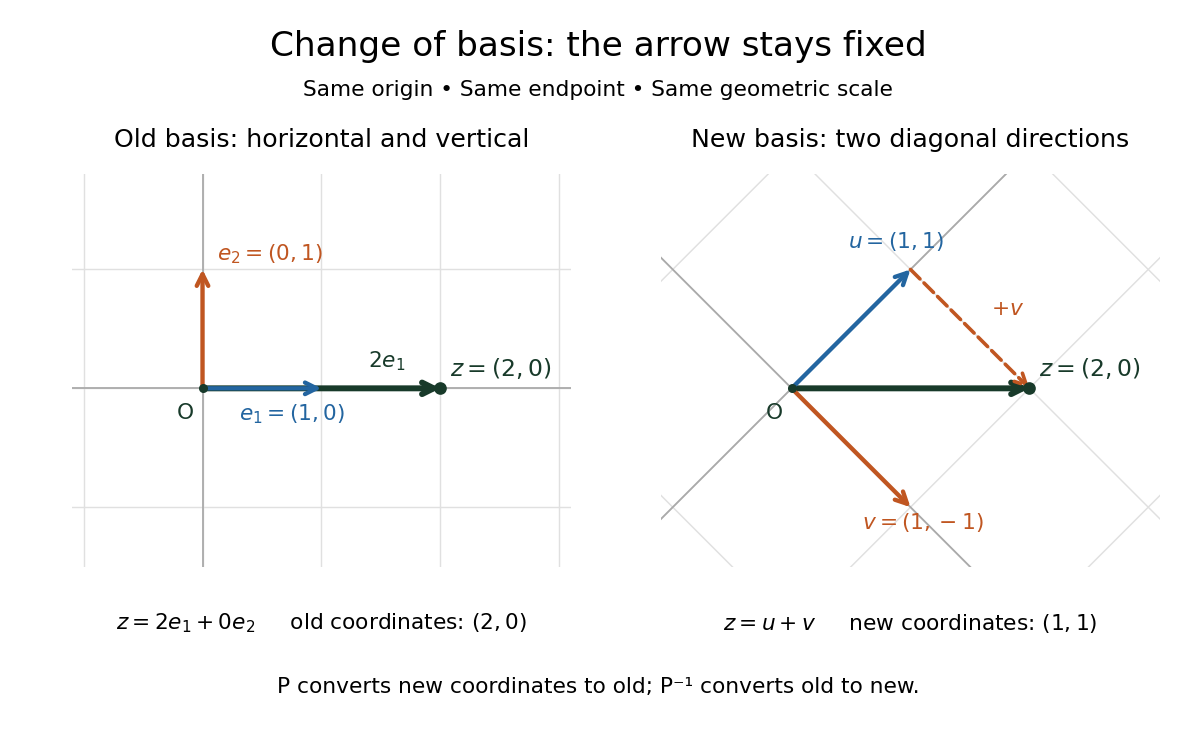
Choosing a useful basis can reveal simple structure hidden by the old coordinate vectors. Here the new basis describes common and opposing contributions. For two equal measurements , the new coordinate vector is : only the common contribution is present. In larger examples, a suitable basis can concentrate important information into a few coefficients. Strang's lecture on change of basis develops this principle through applications: the reversible change of basis preserves information, while subsequently discarding small coefficients loses information.[ref]
An orthogonal change of coordinates relates two orthonormal bases of a real inner product space. With the new basis vectors as columns of an orthogonal matrix , old and new coordinate columns obey . Then , so Euclidean norm, Euclidean distance and angles are preserved. A quadratic form becomes . For a symmetric matrix, orthogonal diagonalization chooses so that the transformed quadratic form is a sum of eigenvalues times squared coordinates. This explains the principal-axis descriptions of a quadric surface.
Fix the convention: the columns of the change-of-basis matrix are the new basis vectors written in the old basis. Thus converts new coordinate vectors into old ones; its matrix inverse converts old coordinate vectors into new ones. For the preceding basis,Its determinant is , so is an invertible matrix. Checking which direction converts is essential: different books may call either or the change-of-basis matrix.
For a linear operator, convert the input into the old basis, apply the old matrix, and convert the output back. Reading that sequence from right to left givesFor example, let the old diagonal matrix stretch horizontal components by and vertical components by . ThenThe output represents , just as . The matrices look different because their bases differ, but they encode the same linear operator. This relation is called matrix similarity; it preserves the underlying action.[ref]
https://ocw.mit.edu/courses/18-06-linear-algebra-spring-2010/46108efb43dcf33e989eb5e101fcf9b5_MIT18_06S10_L31.pdf. Strang, Lecture 31 transcript: coordinate conversion and similar matrices
Articles by others on the same topic

Change of basis is a concept in linear algebra that involves converting coordinates of vectors from one basis to another. In simpler terms, every vector in a vector space can be expressed in terms of different sets of basis vectors. When we change the basis, we are essentially changing the way we describe vectors in that space. A basis for a vector space is a set of linearly independent vectors that span the space.


where:
- : matrix in the old basis
- : matrix in the new basis
- : change of basis matrix