A Cartesian basis is an ordered basis of unit vectors along the mutually perpendicular axes of a Cartesian coordinate system. It is an orthonormal basis of a real Euclidean space: , with the Kronecker delta. In the plane, the familiar standard basis is , ; the vector is . A rotated pair of perpendicular unit vectors is also a Cartesian basis, even though its basis vectors have different standard basis entries.
The advantage is that coordinates can be measured separately by dot products, and the squared norm is the sum of their squares:These are the real Euclidean space instances of the orthonormal basis expansion.[ref]
Linear Algebra Done Right by Sheldon Axler (4th edition). §6B, Definition 6.27, printed p. 199, and Theorem 6.30(a–b), printed p. 200
An orthogonal basis only requires perpendicular basis vectors; their lengths need not be one. For example, are orthogonal, but has coordinates , while its dot products with them are . For an orthogonal basis , the coordinate along is . Dividing each nonzero basis vector by its norm makes it a unit vector without changing its direction. Unit length alone does not imply orthogonality: and are both unit vectors but have dot product .
The examples below show why these distinctions matter: rotating a Cartesian basis changes the coordinate vector while keeping lengths easy to compute; using nonperpendicular basis vectors still gives unique coordinates, but requires the dual basis or a matrix inverse to extract them.
Rotate the standard basis through using the rotation matrix whose columns are the new basis vectors:Here and , so is an orthogonal matrix with , where denotes transpose and is the identity matrix. For the same vector , its coordinate vector in this Cartesian basis isThus and : travel forwards along and a little backwards along to reconstruct . The orthogonal projections onto the two axes give these signed coordinates because the measuring vectors are both perpendicular and of unit length.
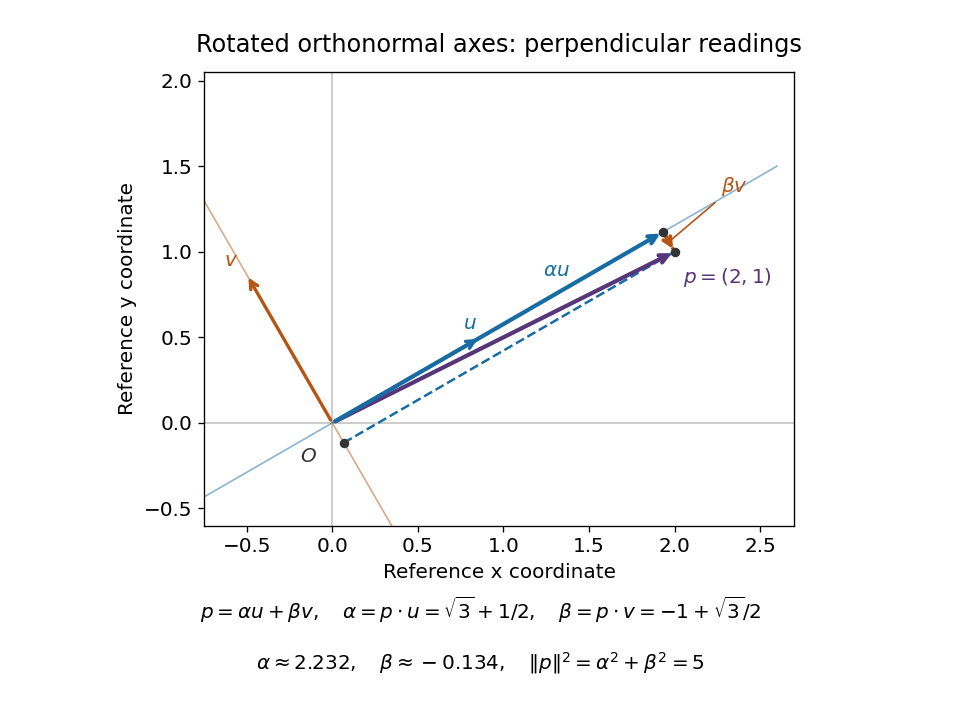
The squared norm remainsThis is useful when choosing axes aligned with a geometric feature: the coordinates change but distances and dot products retain the same sum-of-products formula. The two directions of the change of basis must be kept straight: reconstructs the vector in old coordinates, , and extracts its new coordinates. Applying to the old coordinate vector instead would actively rotate the vector.
A short proof explains both formulas. If , multiplication by gives . Then . Perpendicular unit-length columns make the matrix inverse equal the transpose; this is the computational convenience supplied by a Cartesian basis.
Keep the same origin and the same vector , but use the nonperpendicular basis vectors and . They form a basis because the column matrix has nonzero determinant:The reconstruction is . Its coordinates are read along lines parallel to the other axis, producing a parallelogram. These lines need not be perpendicular to the axis being measured. In contrast, the dot products are and ; treating those as coordinates would reconstruct , a different vector.
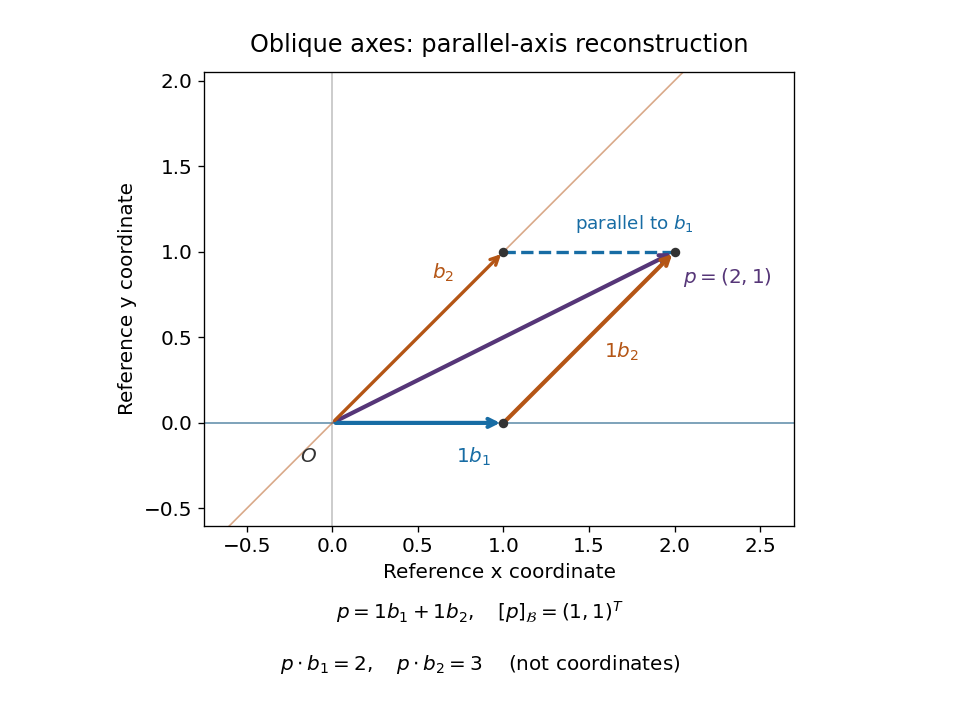


The dual basis supplies the right measuring rules for any basis.[ref]
Linear Algebra Done Right by Sheldon Axler (4th edition). §3F, Definition 3.112 and Theorem 3.114, printed p. 106: dual basis and coefficient extraction
Here these coordinate functionals are and , the rows of . They give . Equivalently, their representing vectors , satisfy and extract the coordinates as . These are Riesz dual basis in an inner product space representatives, rather than the original basis vectors.The Gram matrix records how the nonperpendicular directions interact:For any real basis represented by a square invertible matrix , writing gives these identities immediately. One can recover the coordinates either as or by solving . In this example, if , the squared norm is , not . Oblique coordinates remain useful when natural directions are not perpendicular, but the Gram matrix must accompany them when computing lengths or dot products.
A Cartesian frame combines a chosen origin point with a Cartesian basis , including its ordering as an ordered basis. A point has coordinate vector when . The basis supplies measuring directions and unit lengths; the coordinate vector is the resulting tuple of numbers; the Cartesian frame additionally fixes where measurement starts. A vector already belongs to a vector space with a zero vector, so expressing it in a basis requires no additional choice of spatial origin.
For example, keeping the standard basis but moving the origin from to changes the coordinates of the physical point from to . This happens because is a different displacement vector. By contrast, the two diagrams above keep fixed and change only the basis. In a fixed reference Cartesian frame, a new frame with origin column and basis-column matrix describes points by ; the new coordinates are when is an orthogonal matrix.
Articles by others on the same topic
There are currently no matching articles.