Electric charge is a fundamental property of matter that causes it to experience a force when placed in an electromagnetic field. It is a scalar quantity and is responsible for electromagnetic phenomena. Electric charge exists in two types: positive and negative. 1. **Types of Charge**: - **Positive Charge**: Carried by protons, which are found in the nucleus of an atom. - **Negative Charge**: Carried by electrons, which orbit the nucleus of an atom.
Articles by others on the same topic

Electric charge is an additive, signed property of matter that determines its coupling to the electromagnetic field. Write a particle's electric charge as , or a collection's total electric charge as ; the SI unit is the coulomb, . A stationary test particle in an electric field experiences electric force , while motion adds the magnetic part of the Lorentz force. Electric charge both produces an electric field and determines the response to one. For two stationary point particles in vacuum, Coulomb's law makes like signs repel and opposite signs attract. The choice of which sign to call positive is a convention, used consistently: protons carry and electrons carry , where is the elementary charge. [ref]
https://www.feynmanlectures.caltech.edu/II_01.html. Feynman, Leighton and Sands, II.1: electrical forces, fields and the Lorentz force
.Additivity means adding signed electric charges, rather than their magnitudes:for ordinary matter containing protons, electrons, and electrically neutral neutrons. A toy collection with seven protons and ten electrons has , however much neutral material accompanies it. Charge neutrality means ; it does not mean an absence of charged constituents. Nor does it guarantee an absence of electric force: the spatial arrangement of positive and negative electric charges matters, as illustrated by an electric dipole. This makes a tiny imbalance in an otherwise nearly neutral object physically important. [ref]
https://www.feynmanlectures.caltech.edu/II_01.html#Ch1-S1. Feynman, Leighton and Sands, II.1.1: neutrality, imbalance and residual electrical forces
.Charge conservation states that a collection closed to transport of electric charge keeps its total signed . If electrons move from object A to object B without other exchange, then and ; the sum is unchanged. The amount of positive electric charge alone need not be conserved: creation of an electron and a Positron adds opposite electric charges with zero sum. These bookkeeping rules let us distinguish separation or transport of electric charge from creation of net electric charge. [ref]
https://www.feynmanlectures.caltech.edu/I_04.html#Ch4-S4. Feynman, Leighton and Sands, I.4.4: conservation of net charge
.A simple motivating experiment uses two charge-producing paddles, a conducting pail on an insulating support, a grounded outer shield and a high-input-impedance electrometer. Zero the pail, then isolate it. Rub the initially neutral paddles together, keeping their charged surfaces away from other objects. Lower each deeply into the pail without touching: the electrometer gives opposite signs. Inserting both together tests cancellation. For a separate contact test, insert one charged paddle without touching and withdraw it: the reading returns to zero. Repeat after zeroing, this time touching the inner wall before withdrawal: a residual reading shows transfer of electric charge. Zero the pail and reinsert the paddle to test how much electric charge remains on it. PASCO describes these procedures in Basic Electrostatics System manual, demonstrations 1A and 1B, printed pp. 13–16.
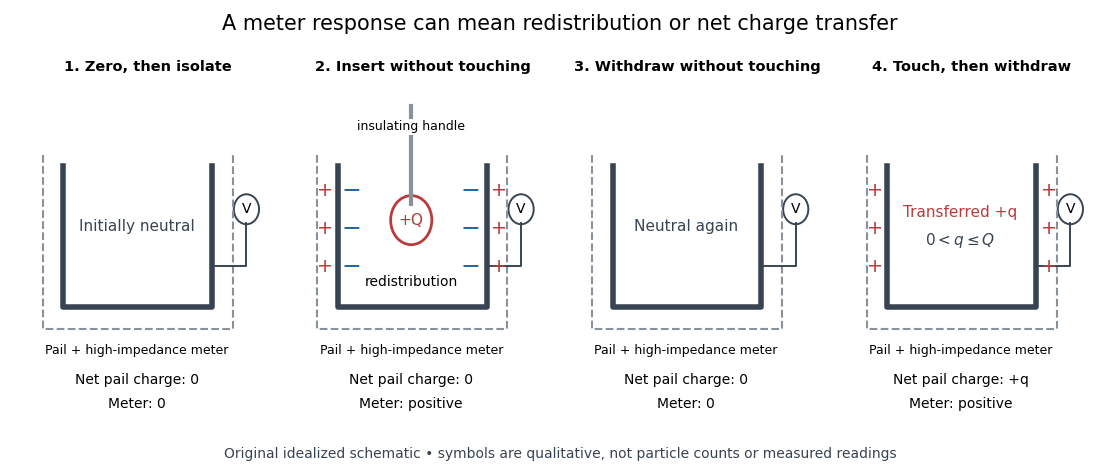
Electric charge redistribution versus transfer in a conducting pail
. Original qualitative schematic for a positively charged inserted object. Without contact, electrostatic induction separates negative inner-surface and positive outer-surface electric charges, while the pail's total remains zero. Contact can leave net positive electric charge after withdrawal. Symbols are not particle counts; no measured readings are plotted. Source. Details.The crucial control is withdrawal without contact: a response during insertion can come from electrostatic induction, which redistributes the pail's existing electric charge. In the fixed-geometry approximation, the electrometer measures electric potential difference proportional to enclosed electric charge, with conversion set by effective capacitance; a voltage reading is not already a measurement in coulombs. Opposite readings and their cancellation test additivity and charge conservation within resolution. Leakage or accidental contact spoils that interpretation, and contact need not transfer all the paddle's electric charge. This macroscopic experiment cannot resolve elementary charge steps: that requires the much smaller particles of the oil drop experiment.

