Robert Andrews Millikan's 1911 protocol alternated electrically driven ascent with timed descent after short-circuiting the plates; a changed ascent speed signalled ion capture.[ref]
These relations apply while the electric force points upward in every state. A drop may still descend, with ui<0, when that force is too weak to support it. A held drop has ui=0 and therefore Si=vf, rather than zero electrical response. A neutral drop has Si=0: its signed terminal velocity agrees with field-off descent. Thus neither raw upward speed nor the ability to hold a drop is itself a count of electrons.
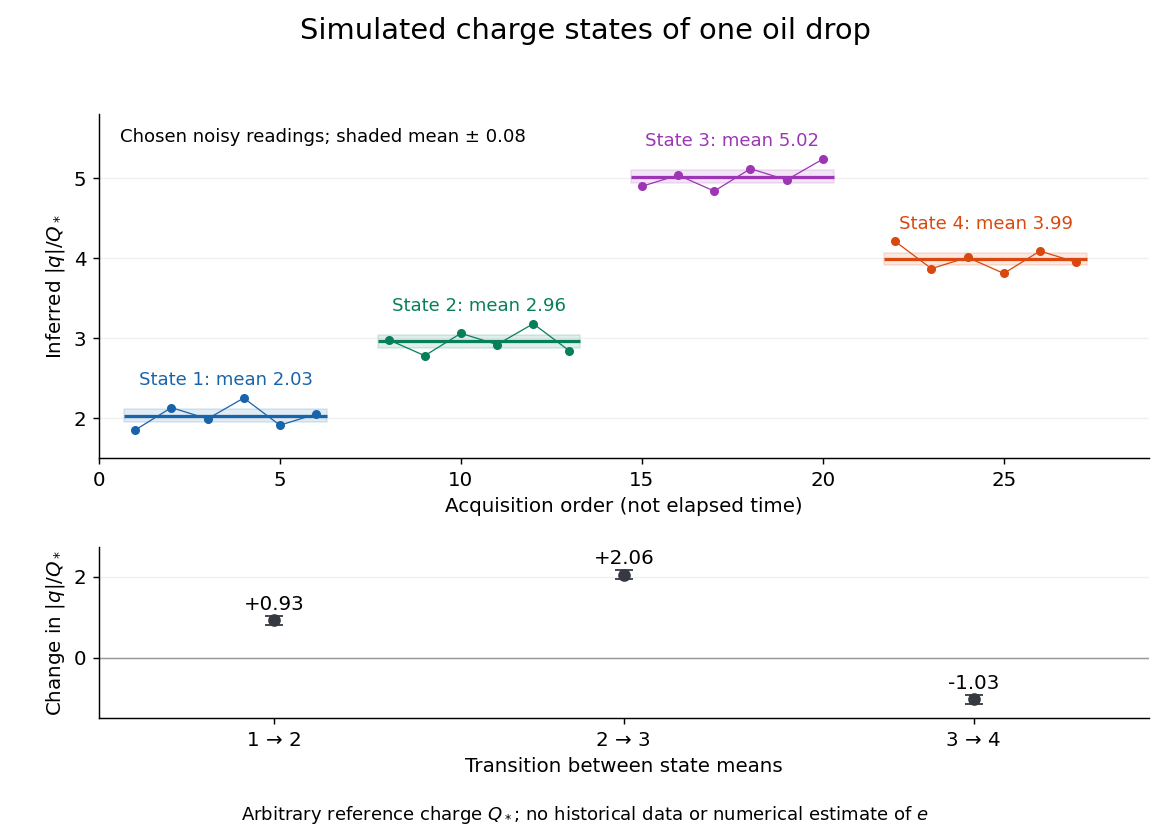
Here each σi is an independent standard uncertainty of a state mean, before shared calibration effects. The generator constructs repeated noisy observations with these means; the numbers are deliberately chosen, not historical data. There is no conversion of Q∗ to coulombs and no measured value of the elementary charge in this example.
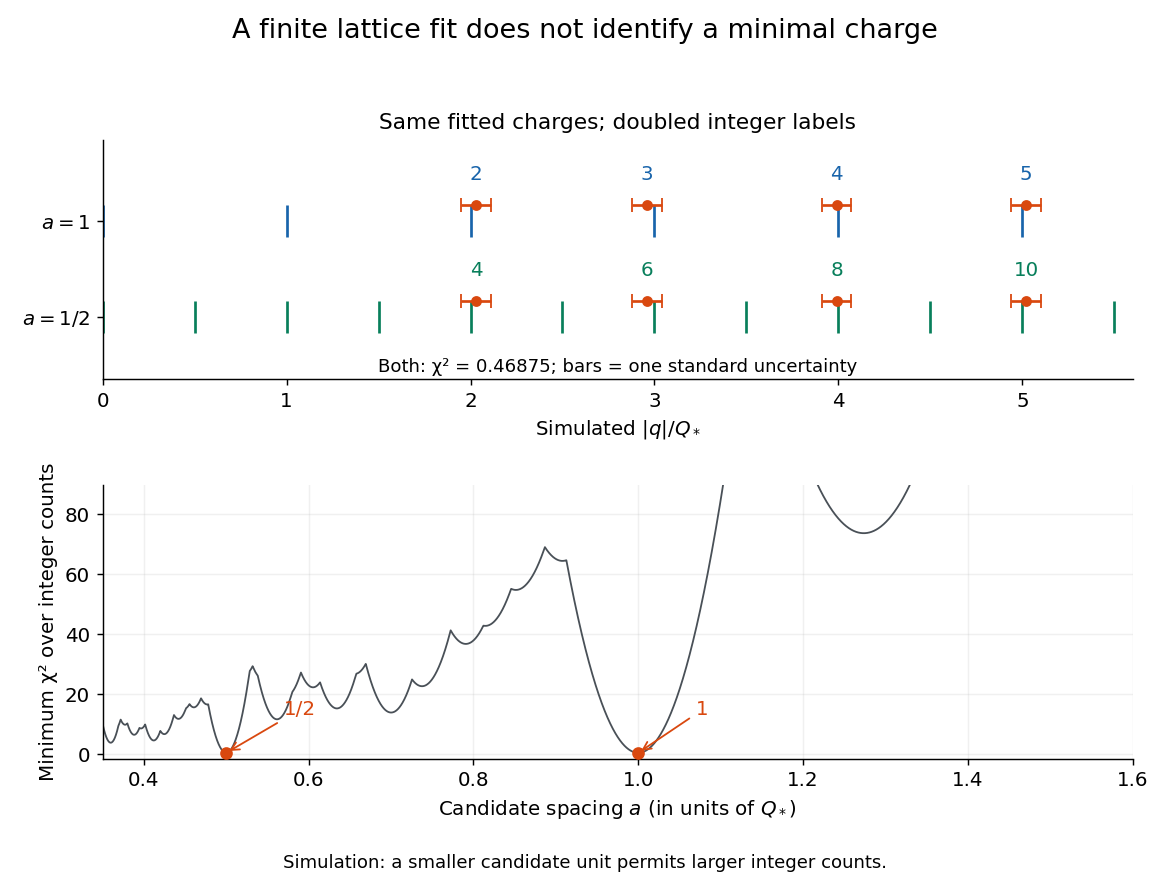
The last two expressions follow by differentiating the quadratic in a and propagating the independent errors. They are conditional on fixed, correct integer assignments and the stated error model. They do not include uncertainty from choosing those assignments. For n=(2,3,5,4), they give a=1, u(a)≃0.01089, and χ2=0.46875. Such a small residual is compatible with this chosen error scale; it is not evidence that the errors vanish. A chi-squared distribution interpretation additionally needs the appropriate normal distribution error model and allowance for the fitted parameter; searching many assignments changes that interpretation.
Finite noisy electric charges fit a candidate unit and its subdivisions
. Original calculation for the simulated state means above. Horizontal bars show one standard uncertainty. Both spacings a=1 and a=1/2 have exactly the same fitted locations and residuals when the integer labels double. The lower curve minimizes over integers separately at every candidate spacing; a low residual alone cannot identify the elementary charge. Details.
The obstruction is identifiability: replacing (a,ni) by (a/m,mni) for any positive integermleaves every predicted reading unchanged. In particular, an e-spaced pattern also fits an e/2lattice using even indices. Even the coarsest well-fitting spacing need not be the physical unit: a dataset containing only even charge states can have twice that unit. Worse, if arbitrarily fine spacings and unrestricted integers are allowed, rounding each yi/a gives
Consequently a finite fit cannot prove a minimal transferable electric charge. Reproducible smallest observed jumps supply additional evidence; interpreting them as single-carrier transfers requires independent physical support. One visibly abrupt transition could contain several unresolved transfers. In the simulation the successive differences are 0.93, 2.06, and −1.03, each with standard uncertainty2(0.08)≃0.1131. These support changes near a,2a,−a conditional on that unit; they equally support 2,4,−2 units of a/2. Neighboring differences share a state reading and are therefore correlated, even though the state means were stipulated independent.
The oil drop experiment is a famous scientific experiment conducted by physicist Robert A. Millikan in the early 20th century. Its primary purpose was to measure the elementary electric charge (the charge of a single electron) and to confirm the quantization of electric charge. Here'sa brief overview of how the experiment worked: 1. **Setup**: Millikan created a fine mist of oil droplets, which he then passed through an atomizer. These droplets were small enough to exist as individual entities.