Minkowski addition is an operation defined on two sets (usually in vector spaces) that forms a new set.
Articles by others on the same topic

The Minkowski sum of subsets of a vector space collects the result of vector addition for every possible pair:Think of fixing a point of , making a translation of the whole of by , and then taking the union of these copies over every . The points of specify displacement vectors; they need not be the centre of a shape. Minkowski addition applies to nonconvex sets too. It is different from set union: for on the real line, but .
For axis-aligned rectangles in the Euclidean plane, the coordinate intervals add separately:Every coordinate between and can be split into one coordinate in and another in , and likewise for the vertical coordinate. Thus a rectangle plus a rectangle gives a square of area , although the two input areas total only . The Minkowski sum adds possible displacements, so its area need not be the sum of input areas.
For closed Euclidean disks centred at the origin, the triangle inequality gives . Conversely, if , split any as . Therefore , including the case . Disks of radii and give a disk of radius , with areas . For disks with centres , the resulting centre is . These two examples lead to the root-of-area comparison in the Brunn-Minkowski theorem.
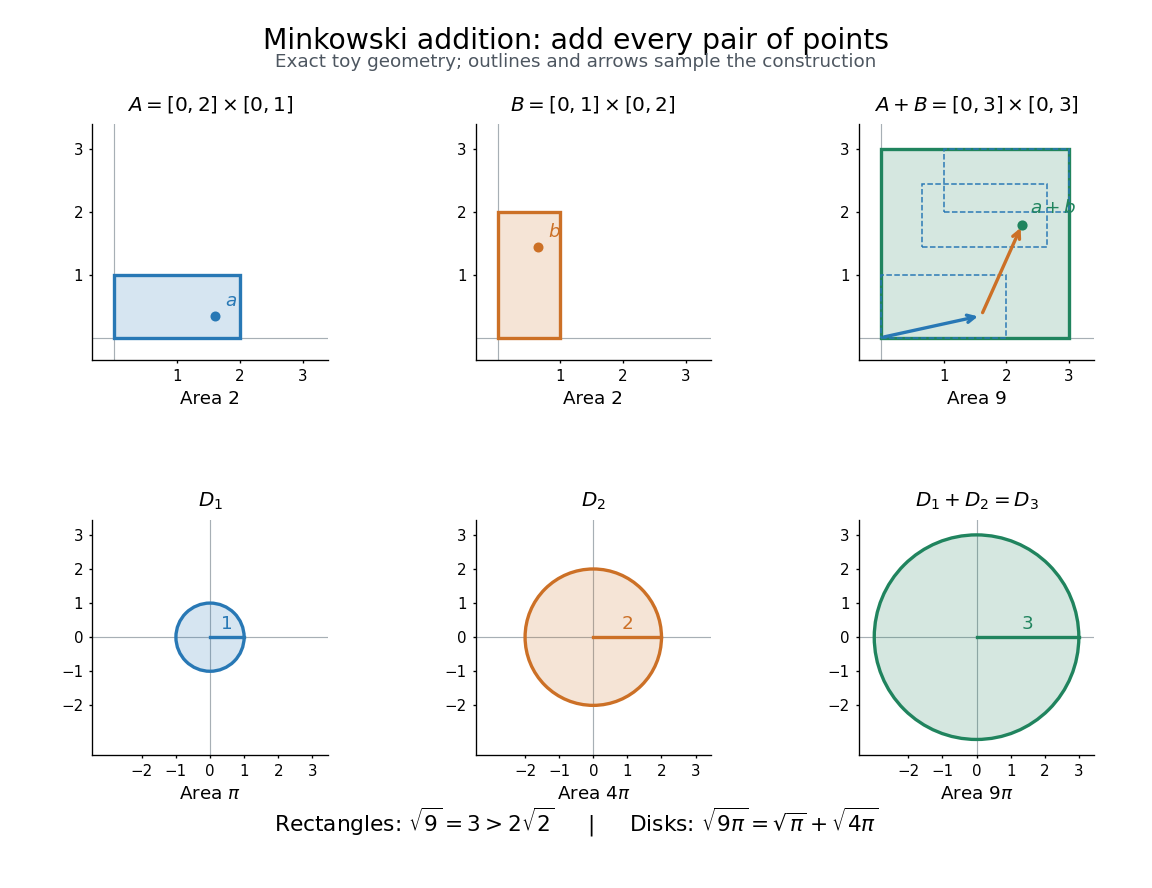
Minkowski addition of two rectangles and of two closed disks: exact toy shapes, sample displacement arrows, and the square-root-of-area comparison
. Details. 
Minkowski addition is commutative and associative because vector addition is. Its identity is the singleton , and . For displacement vectors and , translations and uniform dilations satisfywhere uses scalar multiplication. A Minkowski sum of convex sets is convex: a line segment between and is obtained by adding the corresponding points of the line segments in and . Closure requires care; see sum of two closed sets need not be closed and sum of a compact set and a closed set.