Mode locking is a technique used in lasers to generate short pulses of light (typically in the picosecond to femtosecond range) by forcing different longitudinal modes of the laser cavity to oscillate in phase. In a typical laser, multiple longitudinal modes (which are different frequencies of light that can oscillate in the cavity) can be present, but they may not be in sync with each other. This lack of synchronization results in a continuous wave output.
Articles by others on the same topic

Mode locking fixes relative phases between longitudinal normal modes of a laser, allowing short optical pulses. The same optical spectrum with wandering relative phases would not supply that stable pulse train.[ref]
Passion for Precision by Theodor W. Hänsch. Passion for Precision, p.157: coupled modes
Here is an original finite-mode model, with the convention that a positive frequency has time dependence :These field coefficients follow a Gaussian function and have aligned phases at . Choose and write . Since for every integer ,The pulse light intensity repeats every although the field needs four periods to repeat. At the pulse centers, , , and . A detector of light intensity alone therefore cannot distinguish this offset from zero. This model has far fewer teeth than a practical optical comb; its normalized time and frequency scales are chosen to make the carrier oscillations visible.
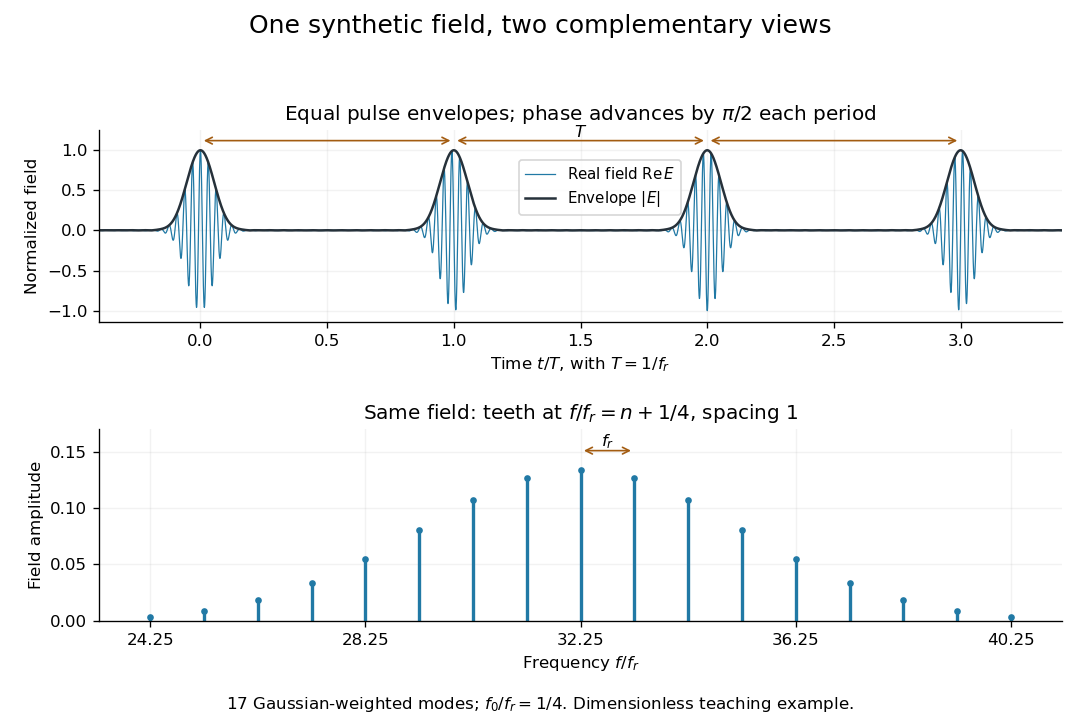

A short proof of the converse uses the Fourier series. If , then is periodic with period . Its Fourier series has frequencies ; restoring the removed factor shifts every tooth by . A finite observation time broadens the spectral peaks; it does not change this ideal infinite-train relation.