Articles by others on the same topic

A polynomial is a finite sum of monomials with coefficients in a ring. In one variable over a commutative ring , writeThe symbol is an indeterminate: it records powers formally before we choose an input value. Finite expressions are easy to add, multiply, evaluate, and differentiate, making polynomials a common language for exact algebra and approximate numerical analysis.
Consider the real polynomialThe expanded form displays the coefficients and the degree of a polynomial; the factored form displays its roots of a polynomial. At , either description gives . At and , the factored form makes the zero values immediate. Keeping several descriptions of one object is useful because each makes a different question easy.
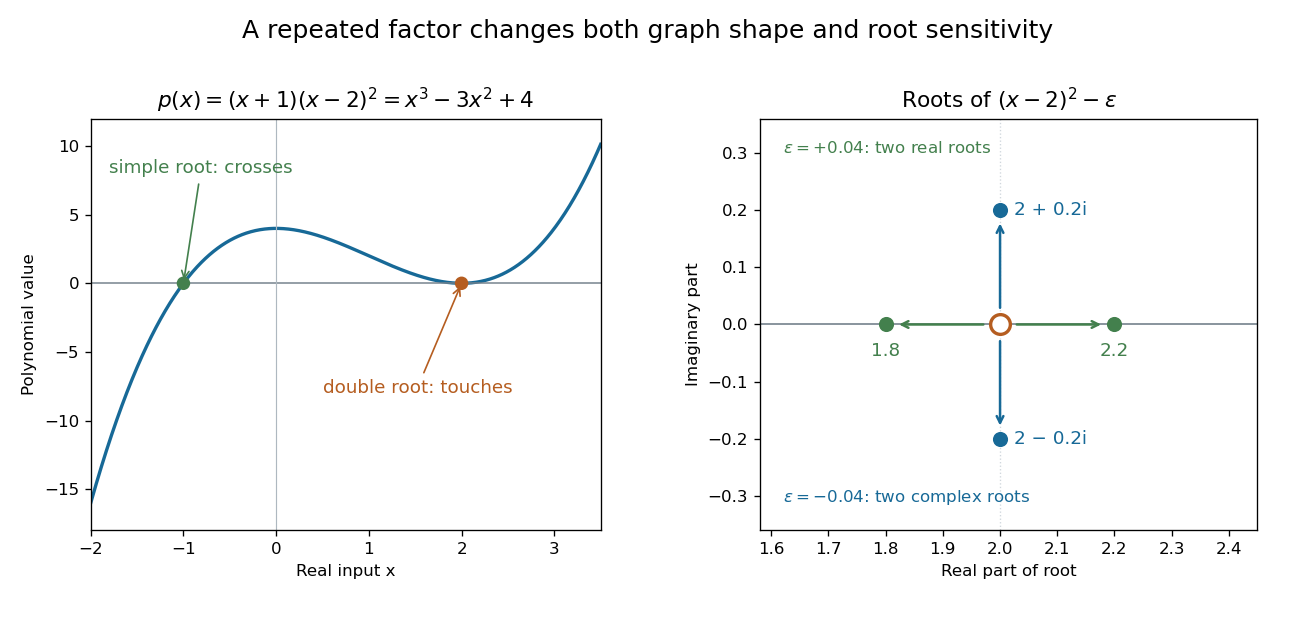
A simple polynomial root crosses the axis, while a double root touches it; perturbing the double factor can produce real or complex roots
. Details. The graph shows another connection. The factor changes sign across , while stays nonnegative across . Thus the graph crosses the axis at the simple root of a polynomial and touches it at the double root. Multiplicity of a root turns an algebraic repetition into visible local behavior.
For calculations, Horner's method evaluates a polynomial through nested multiplication. For modeling, a Taylor polynomial describes local behavior near a point, while polynomial interpolation constructs a polynomial matching prescribed data. Their usefulness comes with assumptions: a local approximation and an exact identity are different claims, and changing the coefficient ring can change which polynomial roots exist.

